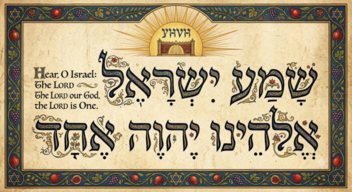
 The Shema is one of the best-known declarations of faith in Judaism. It declares that Yahweh (YHWH) is Israel’s God and that He alone is God:
“Hear, O Israel!
The LORD is our God,
the LORD is one!” (Deut 6:4)
In 1 Corinthians 8:4–6, Paul makes a similar statement. He affirms that there is only one true God and identifies that one God as the Father:
4 There is no God but one.
5 … indeed there are many gods and many lords,
6 yet for us there is but one God, the Father,
from whom are all things and we exist for Him;
and one Lord, Jesus Christ,
by whom are all things, and we exist through Him.
To put this in other words:
(a) There is only one God.
(b) For the pagans, there are many gods and many lords, but for us, there is only one God, the Father, and only one Lord, Jesus Christ.
(c) All things are from God, the Father, and we exist for Him.
(d) All things are by the Lord, Jesus Christ, and we exist through Him.
Trinitarians have claimed this as support of their position:
First, they argue that this verse identifies both the Father and the Son as Creator. Therefore, Jesus must be God. However:
Paul’s wording makes an important distinction. He says that all things are “from” the Father and “through” the Son. This means that the Father is the ultimate Source and Cause of all things. Since all things are “through” the Son, the Son is the agent or means through whom the Father acts.
Second, they argue that the titles “God” and “Lord” are functionally interchangeable. Therefore, when Paul refers to Jesus as Lord, he is also referring to him as God. However:
(a) The Greek word translated “Lord” (kurios) does not by itself mean “God.” It can refer to God, but it commonly means master, owner, or one who has authority (e.g., Acts 15:26; Mark 13:35; Matt 20:8). Therefore, calling Jesus “Lord” does not automatically identify Him as God.
(b) God made the Son Lord. For example, at Pentecost, Peter declared, “God has made Him both Lord and Christ” (Acts 2:36, cf. Phil 2:9–11; Eph 1:17–22).
Third, they argue that 1 Corinthians 8:6 intentionally distributes the words of the Shema between the Father and the Son, thereby including Jesus within the identity of Yahweh. The “LORD” of the Shema becomes “one Lord, Jesus Christ.” However:
(a) Verse 4 repeats the Shema’s monotheistic claim: “There is no God but one.” Then verse 6 identifies that one God as “the Father.” Paul’s wording is therefore direct: “For us there is but one God, the Father.”
(b) 1 Corinthians 8:6 is one of several Pauline “one God” statements. These passages may be understood as applying the Shema in a Christian context, yet they all identify the one God as the Father. For example:
“There is one God, and one mediator also between God and men, the man Christ Jesus” (1 Tim 2:5).
(c) If Paul believed Jesus was God, in the same sense as the Father, he would have said so clearly and repeatedly. But he always identifies the Father alone as God. For example, he opens every one of his letters with formulas that distinguish God from Jesus and identify God as the Father:
“Grace to you and peace from God our Father and the Lord Jesus Christ” (1 Cor 1:3).
(d) 1 Corinthians 8:6 itself distinguishes between God and Jesus. It says that all things are “from” God but “through” Christ. And while the Father is called “God,” the Son is given the lower title “Lord.”
(e) The central confession of the Shema is that Yahweh is one, but the Trinitarian interpretation of 1 Corinthians 8:6 causes the Shema to teach that Yahweh is two.
(f) The verse does not mention the Holy Spirit. If Paul intended this verse to formulate a Trinitarian doctrine, why does it not mention the Holy Spirit?
(g) The Hebrew text of Deuteronomy 6:4 does not contain the word “Lord.” In the English translations, the word “LORD” is a translation convention for the divine name YHWH.
This article challenges one of the most important claims in contemporary Trinitarian scholarship: that Paul “reworked” the Shema (Deut 6:4) to include Jesus within the identity of Yahweh. It concludes that 1 Cor 8:6 contradicts the Trinity doctrine rather than supports it. Modern Trinitarianism rests on a misreading of Paul, not Paul’s own intent.
This is only a summary. See here for the full article.
Other Articles
Other Core Articles
🔗 Christology – All articles
🔗 All articles on this Site
🔗 Daniel’s Little Horn
🔗 Daniel 9 – Verse-by-Verse
🔗 Daniel 9 – Four Alternative Interpretations
🔗 The Mark of the Beast
🔗 The Trinity doctrine
🔗 The True Origin of the Trinity Doctrine
🔗 The Sabbath was part of the Arian Controversy
🔗 Christ’s Return
Other Article Series
🔗 The Antichrist in Daniel 2, 7, 8, and 11
🔗 The 490 years of Daniel 9
🔗 The Book of Revelation
🔗 The Origin of Evil
🔗 Death, Eternal Life, and Eternal Torment