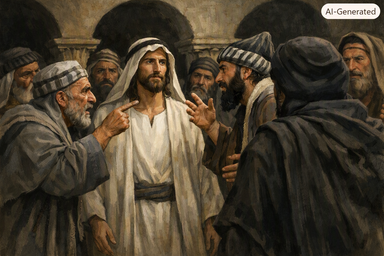
 In John 10:33, according to standard English translations, the Jews accused Jesus of claiming to be God.
This interaction began when the Jews surrounded Jesus in the temple and asked Him whether He is the Christ. Jesus answered that He already said so, but they do not believe. He continued and made some astounding claims. He said:
- “My sheep hear My voice … and they follow Me.”
- “I give eternal life to them, and they will never perish.”
- “No one will snatch them out of My hand.”
- “My Father, who has given them to Me, is greater than all; and no one is able to snatch them out of the Father’s hand.”
- “The Father and I are one” (John 10:27-30).
The Jews picked up stones to stone Him, and said He is blaspheming: “You, being a man, make Yourself out to be God.”
Did Jesus claim to be God?
However, for the following reasons, this translation does not reflect what the Jews really said:
First, the Greek word behind “God” is theos. This term can refer to the God of the Bible. Then English translators normally write “God.” But, in Greek usage, the same word theos can also refer to a supernatural being, a divine figure, or a so-called god. Then translators write “god,” with a lower-case g.
Second, Jesus already acknowledged that He is subordinate to the Father. Immediately before the accusation, He spoke of the Father as the One who gave Him His sheep and as the One who is “greater than all” (John 10:29), which means that the Father is also greater than the Son. He said that the works that He does, He does in His Father’s name (John 10:25). He did not speak as though He was the Almighty Himself.
Third, in His defense against this accusation, He explicitly stated that He claimed to be the Son of God (John 10:36), not God Himself
Fourth, later, when the Jews restated their charge before Pilate, they did not say, “He claimed to be God.” They said, “He made Himself out to be the Son of God” (John 19:7).
For these reasons, John 10:33 can reasonably be interpreted, not that the Jews understood Jesus to be claiming to be God Almighty, but as an accusation that He, though a man, was making Himself out to be “a god” or a divinely exalted being. John 10:33, therefore, perhaps should be translated as: “You, being a man, make Yourself out to be divine.”
Jesus ‘ Extraordinary Claims
Nevertheless, Jesus made some extraordinary claims:
He said, “I am the Son of God,” the One “whom the Father sanctified and sent into the world” (John 10:36). He appealed to His works as “the works of My Father” (John 10:37). In other words, He claimed that His authority came from the Father.
He said, “I give eternal life to them” (John 10:28). This is a remarkable claim. However, John’s Gospel explains that the Son has this life-giving authority because the Father gave it to Him. Jesus said, “Just as the Father has life in Himself, even so He gave to the Son also to have life in Himself” (John 5:26).
Jesus also said that no one will snatch His sheep out of His hand (John 10:28). He immediately added that no one is able to snatch them out of the Father’s hand, because the Father “is greater than all” (John 10:29). The security of the sheep, therefore, rests ultimately in the Father, who protects them through the Son.
Finally, Jesus said, “I and the Father are one” (John 10:30). Many interpret this as a claim that the Father and the Son literally are one Being. However, Jesus prayed that His followers “may be one, even as We are” (John 17:11), and again, “that they may be one, just as We are one” (John 17:22). The disciples do not become one person or one being. They become united in purpose, love, and mission. In the same way, John 10:30 can be understood as a claim that the Father and Son are perfectly united in their work of protecting the sheep.
These claims present an extremely high view of Christ, but none of them mean that the Son is the Almighty God Himself.
He claimed to be the King of Israel.
Jesus, by claiming to be “the Son of God,” claimed to be the Christ, the King of Israel:
God’s people are often called sons of God. But Jesus did not claim to be a son of God; He claimed to be the Son of God. He said: “I am the Son of God” (John 10:36).
This title is closely connected with the title “Christ.” For example, John states the purpose of his Gospel in these words: “These have been written so that you may believe that Jesus is the Christ, the Son of God” (John 20:31).
The title, “the Son of God,” is also synonymous with “the King of Israel.” For example, Nathanael confessed, “Rabbi, You are the Son of God; You are the King of Israel” (John 1:49).
In other words, Jesus’ claim, to be the Son of God, was not merely a general claim to be one of God’s children. It was a messianic and royal claim. He claimed to be the Christ, the promised King of Israel. This explains the strong reaction of the Jews.
Conclusion
He did not claim to be the Almighty God but rather the sanctified and sent Son of God. This affirms that Jesus’ authority and power derive from the Father, not independent divinity. Jesus acts with divine authority but remains subordinate to the Father.
Other Articles
Other Core Articles
🔗 Christology – All articles
🔗 All articles on this Site
🔗 Daniel’s Little Horn
🔗 Daniel 9 – Verse-by-Verse
🔗 Daniel 9 – Four Alternative Interpretations
🔗 The Mark of the Beast
🔗 The Trinity doctrine
🔗 The True Origin of the Trinity Doctrine
🔗 The Sabbath was part of the Arian Controversy
🔗 Christ’s Return
Other Article Series
🔗 The Antichrist in Daniel 2, 7, 8, and 11
🔗 The 490 years of Daniel 9
🔗 The Book of Revelation
🔗 The Origin of Evil
🔗 Death, Eternal Life, and Eternal Torment