The Woman and the Dragon
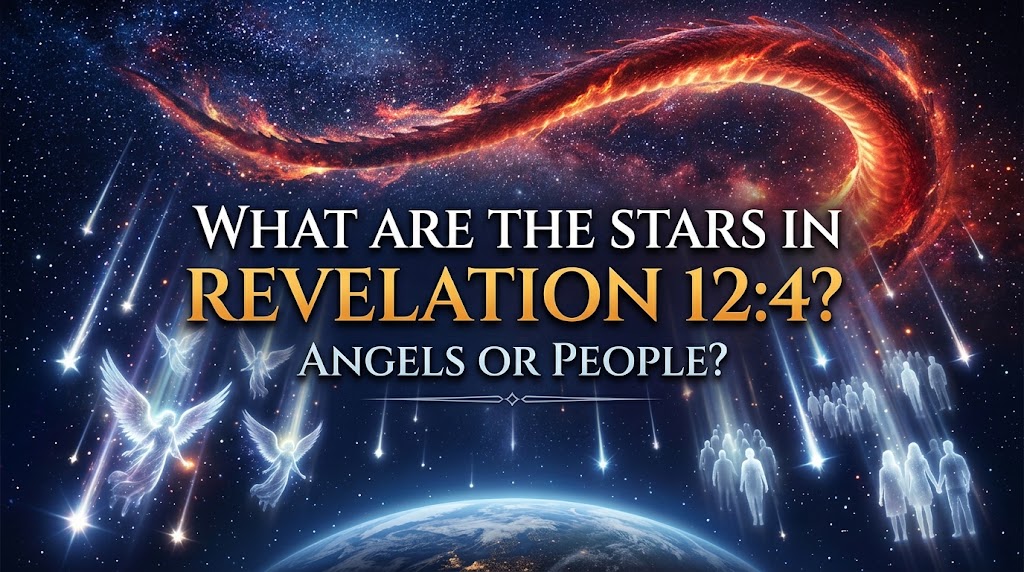
Revelation 12 begins with “a woman clothed with the sun” who is expecting a child (Rev 12:1-2). The next verses describe “a great red dragon.” Its “tail swept away a third of the stars of heaven and threw them to the earth” (Rev 12:3-4).
The Dragon’s Tail
The Dragon’s tail can be interpreted in terms of Isaiah 9:14-15, which says:
“The head is the elder and honorable man,
And the prophet who teaches falsehood is the tail.”
Applied to the Dragon, the dragon’s tail is deception. Since Satan deceives both in heaven and on earth through his representatives, the question is: Do the stars symbolize deceived people or angels?
Stars could be angels.
Revelation 12 also describes a war in heaven between the dragon’s angels and Michael’s angels, at the end of which the dragon and his angels were thrown down (Rev 12:9). In this context, the great red dragon is identified as Satan (Rev 12:9). Therefore, the “stars” in 12:4 could be Satan’s angels. Has a third of God’s beautiful angels been deceived by Satan?
The Book of Job also describes angels as stars (Job 38:1-7). Job wrote that the morning stars sang together when the LORD laid the foundation of the earth (Job 38:1-7). Since this refers to the creation of our world, these “morning stars” are supernatural beings.
Stars could be people.
However, in some other instances, stars symbolize people. For example:
(a) Daniel wrote that the evil horn would cause “some of the stars to fall to the earth, and it trampled them down” (Dan 8:10). Since the horn is an earthly organization, these stars must be people, specifically God’s people.
(b) In Revelation 1, Jesus has seven stars in His right hand, which are explained as the angels of the seven churches (Rev 1:20, 13, 16). But I assume that these “angels” really are the leaders of those churches and, therefore, they are people.
(c) The woman in Revelation 12 has a crown of 12 “stars” (Rev 12:1). She represents God’s people of all ages. Since the number 12 is derived from the 12 tribes of Israel and Jesus’ 12 disciples, the stars in her crown symbolize some aspect of God’s people:
In the Garden of Eden, God said to the serpent that He would put enmity between the serpent and the woman, and between his seed and the woman’s seed. “He shall bruise you on the head, And you shall bruise him on the heel” (Gen 3:15).
Revelation 12 converts this into a symbol. The serpent becomes the Dragon (cf. Rev 12:9), and Eve becomes the woman, symbolizing all people, including people before Israel existed, who looked forward to the coming of the One who will bruise the serpent’s head, namely the Messiah.
However, after Christ has ascended “to God and to His throne” (Rev 12:5), the woman remains on earth (Rev 12:6, 14) and also has other children who “hold to the testimony of Jesus” (Rev 12:17). In other words, she now represents God’s New Testament people; later described as “the bride, the wife of the Lamb” (Rev 21:9). (Read Article)
The woman’s eternal home is the New Jerusalem: After the angel had said to John that he would show him “the bride, the wife of the Lamb,” John saw “the holy city, Jerusalem, coming down out of heaven from God” (Rev 21:9-10).
Since the New Jerusalem has written on it the names of both the 12 tribes of Israel (Rev 21:12) and the 12 apostles of the Lamb (Rev 21:14), this confirms that the 12 stars on the woman’s head symbolize God’s people of all ages.
The Immediate Context
I propose that the stars in 12:4 must be interpreted within its immediate context, which describes the war between the woman and the dragon:
Since the woman symbolizes God’s people, specifically, in this context, God’s Old Testament people, the stars that the dragon throws down to earth could be God’s people who have been deceived.
Although the dragon is identified as Satan in the context of the war in heaven (Rev 12:9), in verse 4, it has “seven heads and ten horns” (Rev 12:3), symbolizing the organizations on earth through which Satan persecutes God’s people (Rev 17:9, 12). This may also imply that the stars in 12:4 are people.
“Of heaven”
The stars are described as “of heaven” (Rev 12:4). However, that does not mean that the “stars” are literally in heaven because Revelation consistently describes God’s people on earth as if they are in heaven. For example:
“Those who had been victorious over the beast” (Rev 15:2) are depicted as “standing on the sea of glass” (Rev 15:2), which is before the throne of God (Rev 4:6). But they are still on earth because, later, they are advised to keep their clothes (Rev 16:15). (Revelation uses white robes as a symbol of being right with God (e.g., Rev 7:14).
That is also what we see in the innumerable multitude before God’s throne (Rev 7:9), and the 144000 before the throne (Rev 14:1-3).
Since “those who dwell on the earth” (11:10; 13:8; 13:12, 14; etc.) always describe God’s enemies, throwing the stars down from heaven to earth may symbolize that these people have now become God’s enemies.
Conclusion
In the immediate context, the stars symbolize God’s people. That the dragon swept away a third of the stars of heaven and threw them to the earth then means that Satan has deceived a large number of God’s Old Testament people.
Other Articles
Revelation 12
🔗 Who are the woman and her child?
🔗 What are the stars of heaven (12:4) – angels or people?
🔗 When was Satan thrown out of heaven?
🔗 How Christ’s death won the victory in the war in heaven
🔗 How did they overcome Satan?
🔗 Why did God not end evil after the Cross?
Other Core Articles
🔗 All articles on this Site
🔗 Daniel’s Little Horn
🔗 Daniel 9 – Verse-by-Verse
🔗 Daniel 9 – Four Alternative Interpretations
🔗 Revelation 13 Dragon, Roman Empire
🔗 Revelation 13 Beast, Roman Christian Authority
🔗 What is the Mark of the Beast?
🔗 The Trinity doctrine
🔗 The True Origin of the Trinity Doctrine
🔗 The Sabbath was part of the Arian Controversy.
🔗 Christ’s Return
Other Article Series
🔗 The Antichrist in Daniel 2, 7, 8, and 11
🔗 The 490 years of Daniel 9
🔗 Book of Revelation
🔗 Christology
🔗 Origin of Evil
🔗 Death, Eternal Life, and Eternal Torment
For general theology, I recommend Graham Maxwell.