Overview
The Book of Revelation describes different kinds of beasts. Three of them have seven heads and ten horns each: the Dragon, the Sea Beast, and the Scarlet Beast.
Daniel 7 describes history from ancient Babylon to Christ’s return, using four animals to symbolize four successive empires. For reasons such as the following, this article concludes that Revelation’s seven-headed beasts are part of, and elaborate on, the series of animals in Daniel 7:
-
- Both Daniel’s animals and Revelation’s seven-headed beasts exist from before Christ to His return. In other words, they exist concurrently.
- The three beasts in Revelation each have seven heads and ten horns. In total, the animals in Daniel 7 have the same number of heads and horns.
- The Sea Beast of Revelation 13 receives characteristics from a lion, a bear, a leopard, and a dragon-like beast (13:1-2). These are the same animals as in Daniel 7.
Therefore, Revelation’s seven-headed Beasts explain Daniel 7 in more detail. This article identifies Revelation’s Dragon as follows:
Revelation 12 uses the title “dragon” as a general name for Satan’s forces in a series of wars involving different entities, from before Christ to the End Time.
Rev 13 repeats some of these wars but distinguishes the anti-God powers between the Dragon, the Sea Beast, the False Prophet, and the Image of the Beast. The following implies that Revelation’s Dragon corresponds to the fourth animal in Daniel 7.
-
-
- Daniel 7 does not name the fourth animal but describes it as like a dragon. It was dreadful, terrifying, extremely strong, and had large iron teeth (7:7).
- Rev 13:2 lists the Dragon as one of four animals from which the Beast receives things, and the other three animals are explicitly the first three animals in Daniel 7: the lion, bear, and leopard.
-
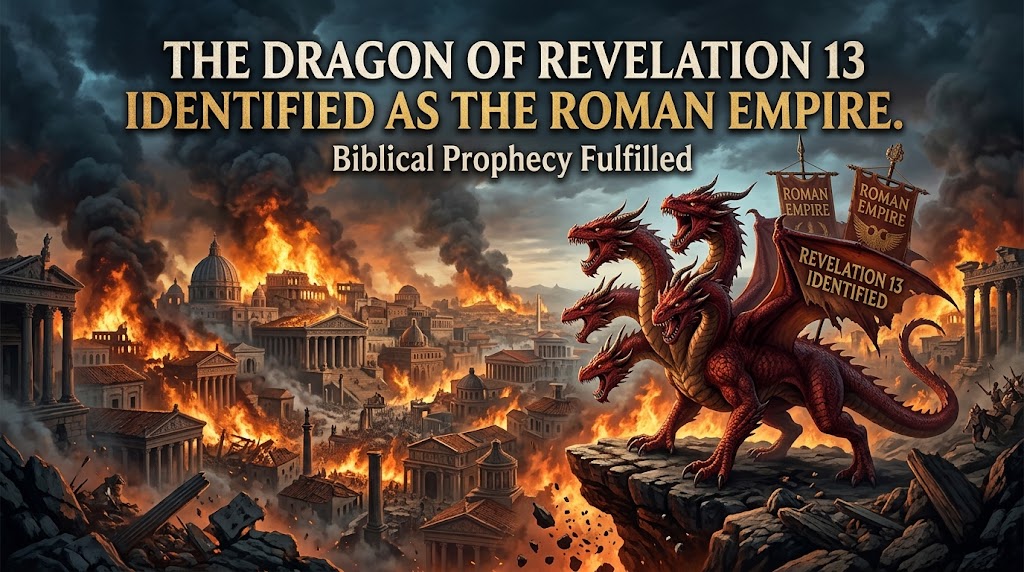
In conclusion, when Revelation mentions the Dragon with the Beast, the Dragon is specifically equivalent to Daniel’s terrible fourth animal. Since a previous article identified Daniel’s fourth animal as the Roman Empire, Revelation’s Dragon, when mentioned with the Beast, is also the Roman Empire.
Seven-Headed Beasts
Revelation has three seven-headed beasts.
They are the Dragon, the Sea Beast, and the Scarlet Beast. Given their strange appearances, they are not literal beasts. Since they all have seven heads and ten horns, they must be related. But since they are different beasts, they represent different things:
The Great Red Dragon (Rev 12:3) gives power and authority to the Sea Beast (Rev 13:2).
In the End Time, the Sea Beast‘s mark will be put on the foreheads of people (Rev 13:1, 16-17).
The harlot sits on the Scarlet Beast (Rev 17:3).
Since the Image of the Beast (Rev 13:15) is an image of the Sea Beast, presumably, it also has seven heads and ten horns.
They are part of the animals in Daniel 7.
For the following reasons, Revelation’s three seven-headed beasts, including the Dragon, are part of the series of animals and horns in Daniel 7:
(1) As a general principle, later prophecies elaborate on earlier ones. Daniel 2 is the base prophecy. Daniel 7 explains it in more detail, and Daniel 8 and 11 provide still further details. Since the Book of Revelation is grounded in Daniel’s prophecies, this general principle implies that Revelation’s beasts provide more detail about the animal-empires symbolized in Daniel.
(2) Each of Revelation’s seven-headed beasts has the same number of heads and horns as the animals in Daniel 7. Daniel 7 uses four animals as symbols for successive empires:
-
-
- Lion (Dan 7:4)
- Bear (Dan 7:5)
- Leopard with four heads (Dan 7:6)
- Dragon-like beast with 10 horns (Dan 7:7)
-
Horns – While the first three animals in Daniel 7 do not have horns, the fourth animal “had ten horns” (Dan 7:7).
Heads – While the other three animals have one head each, Daniel’s third animal, the Leopard, has four (Dan 7:6). So, Daniel’s four animals have seven heads in total.
(3) Daniel’s animals and Revelation’s seven-headed beasts exist at the same time because both groups exist from before Christ’s birth until His Return:
In Daniel, the four animals in chapter 7 represent the ancient Babylonian, Medo-Persian, Grecian, and Roman Empires (see here). The 11th horn, which grows out of the Roman Empire, continues to exist until Christ returns (Dan 7:26, 27).
In Revelation, while the Dragon is first described before Christ’s birth (Rev 12:3, 5), the Sea Beast is finally destroyed when Christ returns (Rev 19:11, 19, 20).
(4) Revelation’s Sea Beast receives its appearance and power from the animals in Daniel 7:
It looks like a leopard, a bear, and a lion (Rev 13:2), which are the first three animals in Daniel 7.
It receives its power, authority, and throne from a ‘dragon’ (Rev 13:2), which is a good name for Daniel’s fourth animal, described as “dreadful and terrifying and extremely strong … It devoured and crushed and trampled down the remainder with its feet” (Dan 7:7).
These are perhaps the strongest allusions to the Old Testament anywhere in the Book of Revelation. It is not a coincidence but implies that the seven-headed Beasts are related to Daniel’s animals, are part of the series of kingdoms in Daniel 7, are the same type of thing as Daniel’s animals, namely kingdoms and nations (cf. Rev 17:9-12), and explain the animals, heads, and horns in Daniel 7 in more detail.
The Dragon
This article identifies the Dragon. Revelation mentions the Dragon, the Beast, and the False Prophet together several times. For example:
(a) The Dragon gave the Beast its great authority (Rev 13:2), and the False Prophet (the Land Beast) exercises all the authority of the Beast in his presence (Rev 13:12).
(b) Demon spirits come out of the mouths of the Dragon, the Beast, and the False Prophet (Rev 16:13, 14).
The purpose of this article is to determine what the Dragon is, particularly when mentioned with the Beast:
Revelation 12
(A) Before Christ – all God’s enemies
Before Christ, the Dragon it symbolized all the kingdoms that opposed God’s Old Testament people.
When Revelation first describes the Dragon, it stands before the woman who is about to give birth to Christ, ready to devour her Child (that is, Jesus) as soon as He is born (Rev 12:3-4). Here, the woman symbolizes God’s people before Christ’s birth. Her pregnancy symbolizes the promise of the Savior made in the Garden of Eden. These verses describe the confrontation between Satan and God’s people ever since that promise was made. The Dragon is later described as Satan (Rev 12:9), but since the Dragon here has 7 heads and 10 horns, symbolizing the kingdoms of the world (Rev 17:9, 10, 12), it represents all the kingdoms that opposed God’s Old Testament people.
(B) For Jesus – the Roman Empire
When it confronts Jesus, it could represent the Roman Empire.
Once her Child is born, the Dragon attacks the Child, but the Child is “caught up to God and to His throne” (Rev 12:3, 4, 5). Since it attacks Christ, the Dragon here probably represents the Roman Empire, including Judea.
(C) In the war in heaven – Satan
After the Child has been caught up, war breaks out in heaven between the Dragon and Michael and their angels (Rev 12:7). In that context, ‘the Dragon’ is explicitly identified as Satan (Rev 12:9).
(D) During the 3½ times – the Sea Beast
During the time, times, and a half, the Dragon is equivalent to the Sea Beast.
After the Dragon has been defeated in heaven and thrown down to earth, it again attacks the woman (Rev 12:13-14). She now represents God’s New Testament people. She hides in the wilderness for a “time and times and half a time” (Rev 12:14). Since this is the same as the 42 months during which the Sea Beast has authority (Rev 13:5 – see here), the Dragon is now an alternative symbol for the Sea Beast.
(E) In the end-time – Image of the Beast
After the Earth helped the woman (Rev 12:16), the Dragon “went off to make war with the rest of her children” (Rev 12:17). This refers to the end-time war against God’s people as described in the last half of Rev 13, where the Dragon is not directly involved. The Image of the Beast is the primary aggressor and oppressor. So, here, the Dragon seems equivalent to the Image.
Revelation 13
The Dragon is Daniel’s terrible fourth animal.
In 13:1-2, the Dragon is the same as Daniel’s terrible fourth animal.
The first time the Dragon and the Beast are mentioned together is in Rev 13:1-2, where the Beast emerges from the Sea. There are several indications that the Dragon here is equivalent to Daniel’s fourth animal:
(a) As discussed above, the Dragon is part of the series of kingdoms in Daniel 7.
(b) In the description of the Sea Beast, the Dragon is listed with the Lion, Bear, and Leopard (Rev 13:2), which are the first three of the four animals in Daniel 7 (Dan 7:3, 5, 6), implying that the Dragon is the fourth.
(c) Daniel 7 does not say what kind of animal the fourth is but describes it as like a dragon. It is “dreadful and terrifying and extremely strong, and it had large iron teeth. It devoured and crushed and trampled down the remainder with its feet” (Dan 7:7).
(d) Both the 11th horn of Daniel 7 and Revelation’s Beast are described as the Antichrist, God’s main enemy on earth, cursing God and persecuting His people (Dan 7:25; Rev 13:6-8). Furthermore, both reign for a “time, times, and a half” and both will only be destroyed when Christ returns (Dan 7:26-27; Rev 19:20). Therefore, Revelation’s Beast is the 11th horn. (See here for a detailed discussion.) Since Daniel’s 4th animal gives existence to the 11th horn and Revelation’s Dragon gives power to the Beast (13:2), Daniel’s 4th animal and the Dragon must also describe the same entity.
Daniel’s fourth animal is the Roman Empire.
As stated, Daniel 7 uses a series of four animals, symbolizing four successive empires, to describe world history from the Babylonian Empire until Christ’s return. It does not identify the animals, but Daniel 8 uses two animals as symbols for empires and explicitly identifies them as Medo-Persia and Greece. A comparison of the descriptions of the animals in Daniel 7 and 8 (see here) identifies the four empires in Daniel 7 as follows:
-
- Lion (Dan 7:4) = Babylon
- Bear (Dan 7:5) = Medo-Persia
- Leopard with four heads = Greek Empire
- Dragonlike Beast = Roman Empire
Therefore, the horns of Daniel’s 4th animal symbolize the fragments into which the Roman Empire was divided:
Ten horns grew from the fourth animal in Daniel 7. These horns are explained as that: “out of this kingdom ten kings will arise” (Dan 7:24), interpreted as that: while each of the first three empires (Babylon, Medo-Persian, Greece) would each be replaced by one single empire, the fourth (the Roman Empire) will fragment into multiple kingdoms. The number “ten” is possibly not strictly literal. (cf. Dan 1:20)
After them, an 11th horn grew by uprooting three previous horns. It was small at first but grew and eventually dominated the other horns. It is different from the others because it blasphemes God and persecutes His people. It is the main character in Daniel 7 and will only be destroyed when Christ returns.
Conclusion
When mentioned with the Beast, the Dragon is the Roman Empire. The Beast, which received its authority from the Dragon, is that organization that continued the authority of the Roman Empire after it fragmented into various nations.
Other Articles
Revelation 13
🔗 The Dragon is the Roman Empire.
🔗 The Beast continues the authority of the Roman Empire.
🔗 The Beast’s fatal wound is its sixth head. (13:3-4)
🔗 Revelation’s Beast is the Church of the Roman Empire.
🔗 The Mark of the Beast
Other Core Articles
🔗 All articles on this Site
🔗 Daniel’s Little Horn
🔗 Daniel 9 – Verse-by-Verse
🔗 Daniel 9 – Four Alternative Interpretations
🔗 Revelation 13 Dragon, Roman Empire
🔗 Revelation 13 Beast, Roman Christian Authority
🔗 What is the Mark of the Beast?
🔗 The Trinity doctrine
🔗 The True Origin of the Trinity Doctrine
🔗 The Sabbath was part of the Arian Controversy.
🔗 Christ’s Return
Other Article Series
🔗 The Antichrist in Daniel 2, 7, 8, and 11
🔗 The 490 years of Daniel 9
🔗 Book of Revelation
🔗 Christology
🔗 Origin of Evil
🔗 Death, Eternal Life, and Eternal Torment
For general theology, I recommend Graham Maxwell.
Excellent teaching. The only thing I wonder about is the woman and the “manchild.” While clearly representing Mary and Jesus in typology, it can’t be Mary and Jesus literally for a few reasons. Jesus is not going to be born again. He will not enter his mothers womb again, to borrow the musing of Nicodemus. But there’s other more subtle problems– why is the woman persecuted? Or why is the man child persecuted by another image of the Church? What are we to do with the idea that the Church might become sufficiently apostate to reject the son of God directly, or indirectly in the form of this latter day son of God figure in infancy, the man-child?
Therefore it seems clear that the man-child has to represent some remnant Church which takes headship in the last days. More work needs to be done on Rev. 12. We will find that there’s important connections there, most importantly that which binds Israel to the overcoming Church in the eschatological fulfillment of all the Old Testament prophecies concerning the Jewish people and not merely Daniel who is the most apparent prophetic witness echoed in Revelation.