Purpose
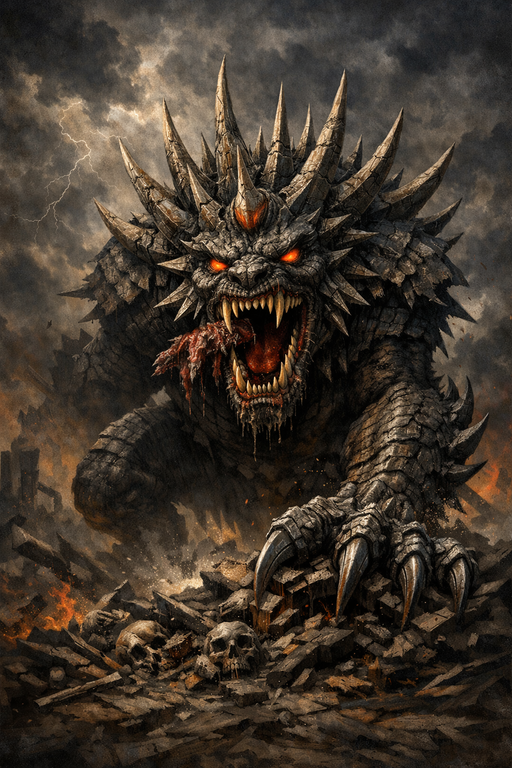
In Daniel 7, the fourth beast was “dreadful and terrifying and extremely strong; and it had large iron teeth. It devoured and crushed and trampled down the remainder with its feet” (Dan 7:7). The Antichrist then appears as an 11th horn growing from that beast. To determine whether the Antichrist is of Greek or Roman origin, this article identifies the Fourth Animal. If it represents Rome, the Antichrist is Roman; if it represents Greece, the Antichrist is Greek.
As discussed in a previous article, Daniel 2 uses the parts of a statue to represent four successive empires. That vision identifies the first as ancient Babylon, which ruled in the 7th and 6th centuries B.C. 🔗
The vision in Daniel 7 uses animals to symbolize the same four empires. The fourth empire is fragmented into 11 kingdoms, represented by 11 horns.
Daniel 7 and 8 both describe the Antichrist as a Little Horn that grows great and powerful. It becomes God’s great enemy and is destroyed only when Christ returns. 🔗
To identify the fourth animal in Daniel 7, this article identifies all four animals. Daniel 7 and 8 both use animals as symbols for empires. But, while Daniel 7 does not explicitly name any of its animals, Daniel 8 identifies its two animals, a Ram and a Goat, as Medo-Persia and Greece (Dan 8:20-21). This article, therefore, identifies the animals in Daniel 7 by comparing their descriptions to the animals in Daniel 8.
Revelation’s Beast resembles a Leopard, has the feet of a Bear, the mouth of a Lion, and receives authority from a Dragon (Revelation 13:1–2). These are the same four animals found in Daniel 7, making Revelation’s Beast a composite of Daniel’s animals. By implication, Revelation’s Beast is a continuation of the empires in Daniel 7. Consequently, by identifying the animals in Daniel 7, this article also begins to identify Revelation’s Beast.
Competing Interpretations
Before identifying the four animals, we should first consider the main alternative interpretations.
From Daniel’s time onward, Israel came under four major empires: Babylon, Medo-Persia, Greece, and Rome.
Conservatives and Liberals agree that the first animal in Daniel 7, the Lion, represents ancient Babylon. They disagree, however, about the identity of the other three animals:
In the Conservative interpretation, the Bear represents Medo-Persia, the Leopard represents Greece, and the fourth animal represents Rome. Therefore, the Antichrist arises from the Roman Empire.
In the Liberal view, by contrast, the second animal, the Bear, represents the Medes and the third, the Leopard, represents Persia. Thus, in the Liberal view, the second and third animals are combined into a single empire, Medo-Persia. Consequently, the fourth animal represents Greece, and the Antichrist is identified as a Greek king.
The two competing systems may be compared as follows:
| Daniel 7 | Conservative | Liberal |
| Lion | Babylon | Babylon |
| Bear | Medo-Persia | Medes |
| Leopard | Greece | Persians |
| Fourth | Rome | Greece |
The Liberal Rationale
Why do liberals hold this view? The reason is that they cannot accept that Daniel contains genuine prophecy. Since Daniel explicitly refers to the Greek Empire, they argue that the book must have been written after the Greek Empire already existed. Therefore, they conclude that the fourth beast, from which the 11th horn emerges, must represent Greece.
On that basis, the best explanation Liberals can find, from history, is that it was written in the 2nd century B.C., by some unknown Jew, who presented history as prophecy. In this view, Daniel focuses on the persecution of the Jews by the Greek king Antiochus IV. Consequently, liberals identify Antiochus as the Antichrist—the evil 11th horn of Daniel 7.
But this creates a problem when identifying the earlier empires. Liberals accept Babylon as the first empire. Historically, however, only one empire stood between Babylon and Greece: Medo-Persia. Yet Daniel 7 presents two animals between the first and fourth beasts. To resolve this, liberals divide Medo-Persia into two separate empires: Media and Persia. Therefore, they align the prophecies as follows:
| Daniel 2 | Gold (Babylon) | Silver | Brass | Iron |
| Daniel 7 | Lion | Bear | Leopard | Dreadful Beast |
| Daniel 8 | Ram (Medes) | Ram (Persia) | Goat (Greece) |
Comparing the Animals
We can identify the beasts in Daniel 7 by comparing them with the animals described in Daniel 8.
The Ram (Medo-Persia)
The first animal in Daniel 8 is a ram, explicitly identified as “Media and Persia” (Daniel 8:20). It has two horns, one higher than the other; the higher horn appeared last. The Ram charges in three directions: the West, the North, and the South (Daniel 8:3-4). Which animal in Daniel 7 corresponds to this ram?
The Ram is the Bear of Daniel 7:
The first similarity is that both the bear and the ram are higher on one side. The bear is raised on one side, while the ram has two horns, one longer than the other. The two sides reflect the empire’s composite nature, formed by the union of Media and Persia. The ram’s horn that appeared last but became longer, like the bear’s higher side, represents Persia. At first, the Medes dominated Persia, but Cyrus reversed that relationship, so that by the time their combined forces conquered Babylon, Persia dominated Media.
A second similarity is that both the Bear and the Ram conquer three things. The ram charges in three directions, while the bear holds three ribs in its mouth. Since animals symbolize kingdoms, the ribs may represent conquered kingdoms or territories. These three ribs can be understood as the three major conquests of the combined Medo-Persian forces: Lydia in the north in 547 B.C., Babylon in the west in 539 B.C., and Egypt in the south in 525 B.C.
Because of these two strong similarities, the bear in Daniel 7 appears to correspond to the ram in Daniel 8, which is explicitly identified as “Media and Persia.”
The Ram is not the Leopard.
Because the Liberal interpretation treats the ram of Daniel 8 as including both the bear and the leopard of Daniel 7, the ram must also be compared with the leopard. Yet the two show no similarity; in fact, they differ clearly. Daniel’s prophecies use heads and horns to indicate divisions within empires. While the Ram has two horns, meaning it has two divisions, identified as the Medes and Persians, the Leopard has four heads, meaning that it has four divisions (Daniel 7:6). Therefore, the Ram and the Leopard are not related
So, comparing the ram of Daniel 8 (Medo-Persia) with the animals of Daniel 7 shows that the ram corresponds to the bear, but not to the leopard.
The Goat (Greece)
Next, consider the second animal in Daniel 8: the goat, explicitly identified as Greece (Daniel 8:21). It comes from the west without touching the ground. At first, it had one great horn, but that horn was broken while still strong. Four horns then arise in its place, extending toward the four directions of the compass (Daniel 8:5, 8).
The Goat is the Leopard.
The goat in Daniel 8 corresponds to the leopard in Daniel 7, for the following reasons:
First, both are portrayed as swift. The leopard has four wings, while the goat moves so quickly that it appears to fly. This speed points to the rapid conquests of Alexander the Great.
Second, both are divided into four parts. The leopard has four heads, and the goat has four horns. These symbolize the four Greek kingdoms that emerged after Alexander’s death.
These parallels indicate that the leopard in Daniel 7 corresponds to the goat in Daniel 8, which is explicitly identified as Greece.
The Goat is not the Fourth Animal.
In the Liberal interpretation, the Goat in Daniel 8 corresponds to the Dreadful Fourth Beast in Daniel 7, and both represent Greece. However, nothing in their descriptions confirms that. On the contrary, while the Goat first has only one horn, and later four, the Fourth Beast first has ten horns, then an 11th comes up, and uproots three of the first 10 horns. Since horns represent divisions within kingdoms, the Goat is not the Fourth Beast.
Conclusion
In conclusion, if the second beast, the bear, represents Medo-Persia, and the third beast, the leopard, represents Greece, then the dreadful fourth beast must be the empire that followed Greece: Rome:
| Daniel 7 | Daniel 8 | Empire |
| Lion | – | Babylonian |
| Bear | Ram | Medo-Persian |
| Leopard | Goat | Greek |
| Fourth | – | Roman |
This confirms the Conservative view, and it means that the Antichrist arises from the Roman Empire.
Medo-Persia
Above, this article surveyed the visions in Daniel 2, 7, and 8, explained the Liberal Interpretation and its rationale, and confirmed—by comparing the animals—the Conservative Interpretation.
Another argument against the Liberal Interpretation is that, to make their interpretation fit the text, Liberals divide Medo-Persia into two empires, one represented by the Bear, and the other by the Leopard.
Liberals argue that Daniel’s author treated the Medes as a separate empire because Isaiah and Jeremiah had prophesied that Babylon would fall, not to a Medo-Persian Alliance, but to the Medes. In the Liberal view, the author of Daniel—whom they regard as uninspired and historically mistaken—believed that Babylon fell to the Medes under Darius before the rise of the Persian king Cyrus (Daniel 5:30-31; 6:28; 10:1). However, this view conflicts with both secular history and the Book of Daniel.
Historically, the Persians conquered the Medes around 550 B.C. Eleven years later, the combined Medo-Persian forces conquered Babylon under Cyrus the Great.
The division of Media and Persia into two empires also contradicts Daniel itself, which consistently treats them as one empire. For example:
Daniel foretold that the combined forces of the Medes and Persians would conquer Babylon (Daniel 5:28).
He referred to the unchangeable law of the Medes and Persians (Daniel 6:9, 13, 16).
He also identified the ram as “the kings of Media and Persia” (Daniel 8:20). It would be inconsistent for Daniel to portray Media and Persia as one beast in Daniel 8, but as two separate beasts in Daniel 7 and two separate metals in Daniel 2.
Final Conclusion
Therefore, the fourth beast in Daniel 7 is Rome, meaning that the 11th horn of that beast—the Antichrist—is Roman in origin.
The next article in this series will confirm this interpretation by showing that the Antichrist, in Daniel 8, is also Roman, not Greek, in origin. 🔗
Theological Implications
Prophecies are reliable.
The Academic/Liberal interpretation rejects predictive prophecy, claiming Daniel was written after the events it “predicts.” But the article affirmed that Daniel predicted events centuries before they occurred. If Daniel correctly predicts Rome, it strengthens confidence in biblical prophecy as genuinely supernatural. The God of Israel is One who reveals the future, consistent with Isaiah’s claim that prophecy is evidence of divine sovereignty.
The Antichrist is Roman.
If the Fourth Beast is Greece, then the 11th horn, the Antichrist, is a Greek figure—usually Antiochus IV—whose relevance is confined to the 2nd century BC. But if the Fourth Beast is Rome, as this article has shown, then the Antichrist is not Antiochus IV. Rather, the Antichrist would be a Roman power that arises from Rome’s fragmentation. This single interpretive decision reshapes the entire Christian prophetic timeline.
The Antichrist exists today.
The feet of iron and clay, in Daniel 2, and the horns of the fourth beast, in Daniel 7, represent the fragmented post‑Roman world. We currently live in that prophetic era. The Little Horn emerges within this fragmented world and is destroyed only when Christ returns.
The Antichrist is a political‑religious power.
Because it uproots other horns and dominates them, it is political. But it is also religious because it blasphemes God and persecutes God’s people. This supports interpretations where the Antichrist is a system, not merely an individual.
Revelation’s Beast is Roman.
The Beast of Revelation 13 is a composite of Daniel’s animals. It blends imagery of the lion, bear, leopard, and dragon of Daniel 7. In other words, Daniel and Revelation form a unified framework. It further means that, if the Fourth Beast is Rome, then Revelation’s Beast is not limited to the New Testament, but emerges from Daniel’s fourth kingdom, but is a continuation of Rome. It is rooted in Roman political, cultural, and religious structures. The Roman Empire—its legacy, institutions, and spiritual influence—persists into the Christian era and plays a decisive role in end-time events. Rome’s legacy shapes the final conflict between Christ and evil.
There will not be another world Empire.
Daniel 7 teaches that after Rome, never again will a single empire rule the world. The world remains permanently divided until Christ’s kingdom arrives. Attempts at global empire (ancient or modern) are doomed. The only future worldwide kingdom is God’s eternal kingdom, after Christ’s return.
Other Articles
• Next: Three interpretations of the evil horn of Daniel 8.
• All articles on Daniel
Other Core Articles
• All articles on this Site
• The Mark of the Beast
• The Trinity doctrine
• The True Origin of the Trinity Doctrine
• The Sabbath was part of the Arian Controversy
For general theology, I recommend Graham Maxwell.