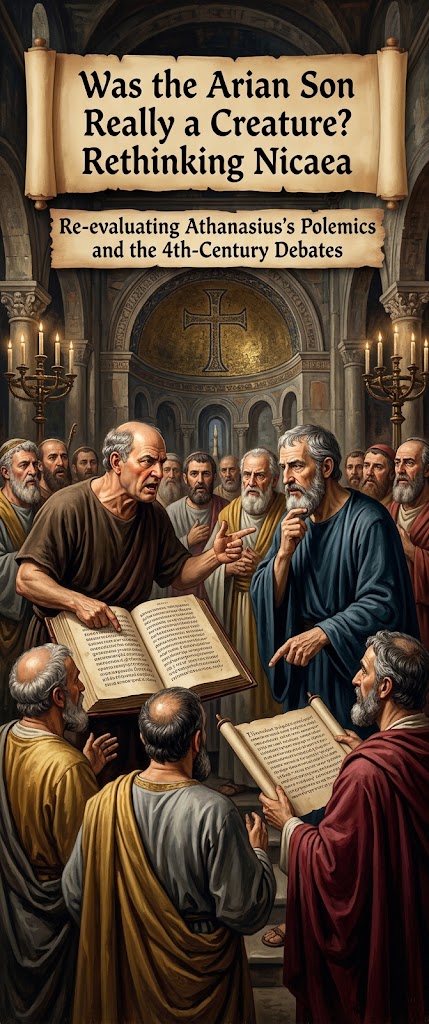
Was the Arian Son Really a Creature? Rethinking Nicaea
Popular church history often characterizes fourth-century non-Nicene (“Arian”) theology as reducing the Son to a mere “creature” created out of non-existence. However, modern patristic scholarship (including Lewis Ayres, R.P.C. Hanson, Khaled Anatolios, and Rowan Williams) demonstrates that this binary distinction between uncreated God and created non-God was not a shared starting premise, but rather an outcome of the fourth-century debates. Non-Nicenes like Eusebius of Caesarea placed the Son within a unified divine hierarchy (trias), holding that He was uniquely begotten out of the Father’s divine being before all time. This post examines how the “Son as creature” framing originated as a brilliant polemical strategy by Athanasius to simplify his opponents’ nuanced subordinationism—a narrative that has persisted for over 1,500 years due to pedagogical convenience, apologetic utility, and historiographical inertia.