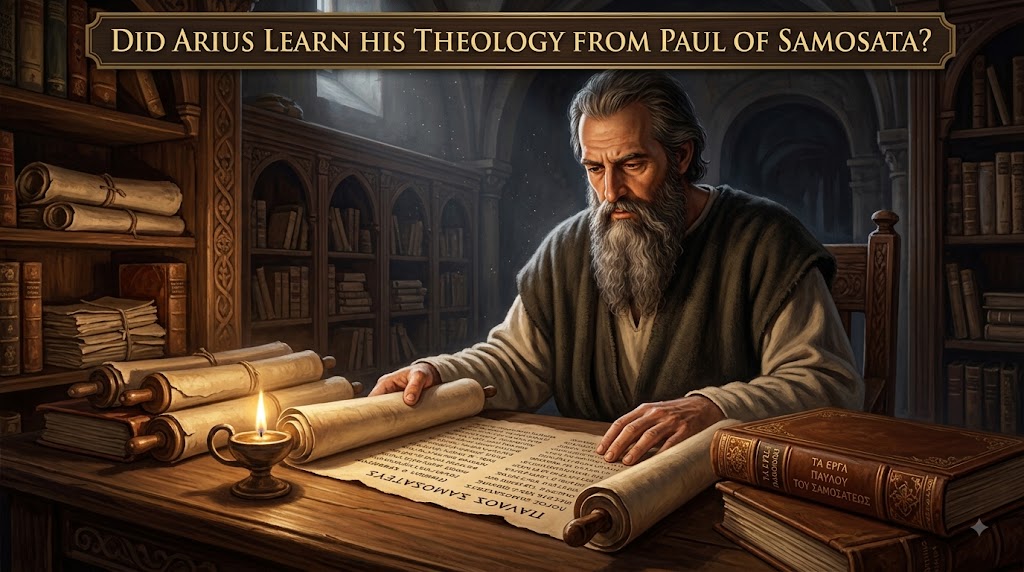
 From ancient times, many writers believed that Arius inherited his heresy from the third-century theologian Paul of Samosata. Paul taught that Jesus Christ had no personal pre-existence. In his view, Jesus was a mere man whom God adopted as His Son. This teaching is commonly called Adoptionism. Paul was condemned for these views by a council at Antioch in 268.
The claim that Arius received his theology from Paul of Samosata was first made by Arius’s direct opponent, Alexander of Alexandria. Many later writers repeated the same accusation. For example, in 1683, Cave wrote that Arius, like Paul of Samosata, taught that Christ was “a mere man.”
Harnack (1909) also believed that Arius taught a form of Adoptionism:
In the second and third centuries, Christian apologists explained Jesus Christ as the Logos of Greek philosophy. In this theology, the Logos always existed as an aspect of God. However, when God decided to create, the Logos became a second divine Being, subordinate to the supreme God. The Logos shared in the divine life, united creatures to God, revealed God, and became incarnate as Jesus Christ. (🔗) According to Harnack, however, Arius rejected this understanding of the Logos.
Harnack described Arius’s system as a mythological form of Adoptionism in which the Logos was a created being. This Logos became incarnate as Jesus Christ and was adopted by God, but was promoted to sonship only after the incarnation. In other words, Harnack believed Arius did not teach a truly pre-existent Son of God.
Elliger (1931) was another writer who claimed that Arius taught Adoptionism. Like Harnack, he argued that Arius stood close to Paul of Samosata in some respects, although Arius also tried to reconcile this position with the belief that Jesus Christ was the pre-existent Logos.
Lorentz, Prestige, Boularand, and Gregg and Groh expressed similar views of Arius.
In short, the traditional claim was that Arius, like Paul, taught that Jesus Christ had no pre-existence, but was a mere man adopted by God as His Son. However, as discussed below, this claim is rejected by the leading scholars of Arianism from the last fifty years, including Simonetti, Hanson, Williams, and Ayres.
First, we know very little about what Paul actually taught. Any claim that Paul of Samosata influenced Arius must therefore rest largely on speculation.
Second, as will now be discussed, based on what we do know, recent scholarship places Paul and Arius in opposing theological camps.
Pre-incarnation
First, compare Paul’s and Arius’s views of the pre-incarnate Christ.
Paul of Samosata
For Paul, the Logos before the incarnation was not a distinct Being. Rather, Paul is generally understood to have viewed the Logos as God’s own inner Word, existing within the Father’s own being. As a result, the Word became the Son of God only after the incarnation, when God adopted Christ as His Son. In this view, Jesus Christ did not pre-exist as a distinct Person.
Arius
By contrast, the Eusebians, including Arius, taught that the Logos existed as a distinct Being before time itself. He was timelessly begotten by the Father. Unlike the invisible and unchangeable God, the Eusebians believed that the Logos was visible and changeable. For this reason, the Logos could act as mediator. Because He was changeable, He could also become incarnate as Jesus Christ.
Incarnated Christ
Next, compare Paul’s and Arius’s views of the incarnate Christ.
Paul of Samosata
Paul taught that Jesus Christ had a human soul, that is, a human mind. This means that Jesus Christ was a human being inspired by the Word of God.
Arius
By contrast, Arius and the Eusebians maintained that Jesus Christ did not have a human soul or mind. Instead, the pre-existent Logos, as a mutable divine Being, united Himself to a human body and took the place of the human soul in Jesus. Therefore, Jesus Christ was a divine Being in a human body. The Eusebians strongly rejected the claim that Jesus Christ was merely a man.
Opposing Camps
The fourth-century Sabellians, led by Eustathius of Antioch and Marcellus of Ancyra, also believed that the pre-incarnate Word was the Father’s inner word and that Jesus Christ had only a human mind. For this reason, the Eusebians regarded Paul as a Modalist or Sabellian.
Modern scholars often reach the same conclusion. If Paul’s teaching can be reconstructed at all, he is better understood as an ancestor of the Sabellians, not of Arius and the other Eusebians.
Because the Sabellians allied with the Nicenes against Arius and the other Eusebians, Paul and Arius belonged to opposing sides in the controversy.
Conclusion
For centuries, many writers repeated the claim of Arius’s fourth-century opponent: that Arius received his heresy from Paul of Samosata. Yet this claim is difficult to sustain. First, very little is known with certainty about Paul’s theology. Second, from what can be reconstructed, Paul and Arius appear to have held opposite views. Leading scholars of the last fifty years therefore agree that there are serious obstacles to treating Paul as a theological ancestor of Arius.
Quotes from Leading Scholars
“Many scholars have conjectured that the views of Paul of Samosata, or at least of his school, must have influenced Arius. Lorentz in particular . . . has spent considerable ingenuity in drawing out the resemblances between the views of Paul and those of Arius. He sees no less than nine points of resemblance. . . . Several scholars have taken the same line, assuming that Paul taught a kind of Adoptionism and opposed any ontological union of the Son with Father, e.g., Prestige, who attempts too characteristically to harmonize all the sources, Boularand, and Gregg and Groh” (Hanson, p. 70-1).
“Although it is no longer possible to speak with certainty about Paul’s theology, it seems that his opponents were unhappy with his insistence that Christ possessed a human soul and body and that the union of natures in Christ was not comparable to the union of soul and body in a human being. To his opponents, insisting that Christ had a soul meant that the Logos never truly entered into the man. For his opponents this theology could only result from semi-modalism. Paul is understood to have seen the Logos as God’s own inner Word and not as a distinct separate being: he could not subsequently envisage that the Logos really became one with a human person. There is also some evidence that he did not think of the Word as ‘Son’ until the incarnation, in ways that do interestingly prefigure Marcellus of Ancyra“ (Ayres, p. 76).
“Most recently, Rowan Williams believes that the type of doctrine taught by Paul of Samosata would have appeared to be Sabellianism to Arius: ‘the divine Logos is “internal” to the Father’s substance and does not subsist in any other way; between Jesus of Nazareth and the divine principle of rationality there is no intermediary subsistent, no heavenly Son or hypostatic Word” (Hanson, p. 71).
“When we turn to the beginning of the fourth century, we find that for Arius the Logos was able to act as mediator because it was in some sense visible and changeable. In this Arius seems to be part of a tradition present in Paul’s third-century opponents and also visible in Eusebius of Caesarea. But, for this tradition, while the mutability of the Logos enabled union with a human being, any such union involved the Logos replacing the human soul” (Ayres, p. 76).
“It certainly seems that if we can reconstruct the teaching of Paul at all, his doctrine is more likely to have been the inspiration of Eustathius and Marcellus than of Arius. Arius believed firmly in a pre-existent Son allied in some sense to the Logos, but apparently for Paul the Son was Jesus Christ the historical figure without any preexistent history at all. And the stock accusation made against Paul by all ancient writers who mention him from the ivth century onward was that he declared Jesus to be no more than a mere man, whereas this is an idea which all Arian writers after Arius (and, in my view, probably Arius himself) regularly rejected. There are grave obstacles to envisaging Paul as an ancestor of Arius. But in fact we know very little with certainty about Paul of Samosata. It is a 72 delicate task to disentangle from the fragmentary accounts which we have any clear outline of his teaching. Any attribution of influence from Paul of Samosata upon Arius must rest almost wholly upon speculation” (Hanson, pp. 71-2).
Other Articles
Other Core Articles
🔗 Christology – All articles
🔗 All articles on this Site
🔗 Daniel’s Little Horn
🔗 Daniel 9 – Verse-by-Verse
🔗 Daniel 9 – Four Alternative Interpretations
🔗 The Mark of the Beast
🔗 The Trinity doctrine
🔗 The True Origin of the Trinity Doctrine
🔗 The Sabbath was part of the Arian Controversy
🔗 Christ’s Return
Other Article Series
🔗 The Antichrist in Daniel 2, 7, 8, and 11
🔗 The 490 years of Daniel 9
🔗 The Book of Revelation
🔗 The Origin of Evil
🔗 Death, Eternal Life, and Eternal Torment