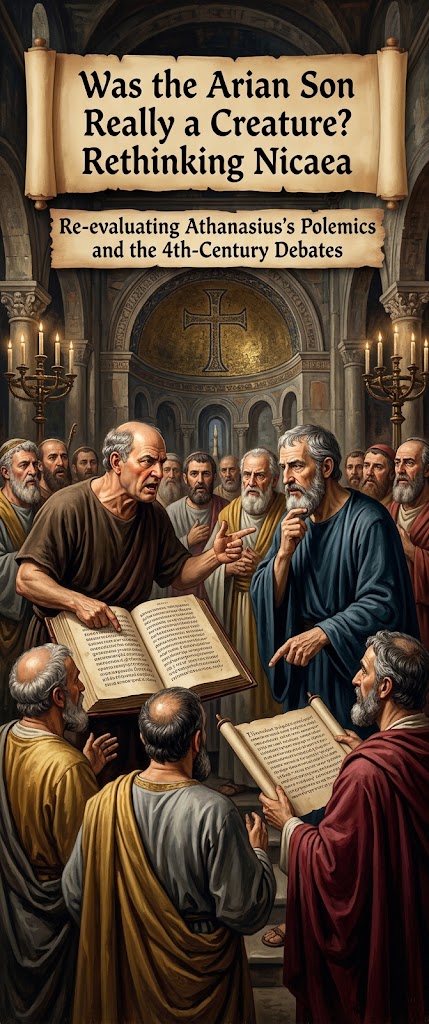
The common characterization of fourth-century non-Nicene (“Arian”) theology as reducing the Son to a simple “creature” (ktisma) made out of nothing (ex ouk onton) is largely a legacy of Athanasius’s highly successful polemical strategy rather than an accurate reflection of mainstream Eastern non-Nicene thought.
1. God/creation boundary
As modern patristic scholarship (e.g., R.P.C. Hanson, Lewis Ayres, Khaled Anatolios) has demonstrated, the fourth-century trinitarian debates were not fought over a pre-existing, universally accepted binary between “uncreated God” and “created non-God.” Rather, that ontological boundary was the result of the fourth-century debates. As Lewis Ayres observes:
“A second approach that we need to reject treats the fourth-century debates as focusing on the question of whether to place the Son on either side of a clear God/creation boundary. The ease with which this distinction can be made by modern theological readers is itself an achievement of the fourth century.” (Ayres, Nicaea and Its Legacy, p. 4)
2. The Eastern Non-Nicene Self-Understanding
From the Father’s being
Eastern theologians, like Eusebius of Caesarea and the broader “Eusebian” alliance, did not view the Son as a created entity in the sense of mundane creation. Instead, Eusebius and his contemporaries operated within an older Origenist tradition where the Son was uniquely begotten directly out of the Father’s divine reality before all time:
Incommunicable Origin: The Son was “put forth from the being of the Father, not by a partaking or a cutting or a division, but unspeakably and, for us, unexplainably” (Ayres, p. 58, quoting Eusebius).
From the Father’s Ousia: “The Son is ‘from the Father’s ingenerate nature and inexpressible ousia‘, but he [Eusebius of Caesarea] very soon qualifies this statement, warning against materializing interpretations” (Hanson, The Search for the Christian Doctrine of God, p. 188).
While Arius’s early slogans included the phrase “out of non-existence” (ex ouk onton), Hanson points out that “it does not in fact, at least as stated in this form, figure at all prominently in general Arian thought, and later Arianism deliberately dropped it” (Hanson, p. 24).
A Unified Divine Order
The non-Nicenes viewed the Father, Son, and Holy Spirit as a unified divine order—a Trinity of three divine hypostaseis forming an ineffable, coherent unity:
“The clear difference and diversity spoken of by one camp [the Arians] seems to the other [the Nicenes] to be the result of thinking about God as two (or three) distinct beings, separated like material entities” (Ayres, p. 43).
“There exists a Trinity in unequal glories” (Ayres, p. 55, quoting Arius).
“We have to resist the anachronistic characterization of him (Arius) as an antitrinitarian theologian.” “He writes simply, ‘So there are three hypostaseis,’” meaning “the set of beings that form the object (or objects) of Christian confession. … the three hypostaseis seemingly form a certain unity” (Anatolios, Retrieving Nicaea (2011), pp. 47-48).
3. Athanasius’s Polemical Strategy
Why, then, does popular literature continue to describe the non-Nicenes as teaching that the Son was a creature? This framing is directly traceable to Athanasius. He reframed his opponents’ nuanced, hierarchical Christology into a strict binary. In his Orations Against the Arians, Athanasius explicitly insisted that no intermediate ontological category exists:
Establishing the Absolute Binary: “For if the Word is not… proper to the essence of the Father… then He must be a creature, or one of the things made; and if a creature, then created out of nothing.” (Contra Arianos 1.11)
Equating the Son to Mundane Creation: Athanasius routinely charged that non-Nicenes reduced the Son to the level of ordinary creatures, arguing that under their view: “Christ is not the true power of God, but he is one of those who are called powers, among which are also the locust and the caterpillar…” (Contra Arianos 1.5; cited in Hanson, p. 13).
By framing the debate around this strict dualism—either homoousios with the Father or a created ktisma, and by insisting that any distinct entity generated from the Father must fall into the second category—Athanasius effectively collapsed the Eastern non-Nicene middle ground. He charged that Eastern subordinationism reduced Christ to the level of creation—placing Him, as he rhetorically asserted, alongside creatures like “the locust and the caterpillar” (Hanson, p. 13). As Lewis Ayres notes, this was “a masterpiece of the rhetorical art” that shaped church histories for over 1,500 years (Ayres, pp. 106–107).
“Whatever Athanasius took from Marcellus was woven into an increasingly sophisticated account of his enemies as ‘Arians’ seeking to perpetuate a theology stemming from Arius. It is thus in these years that we see the full flowering of a polemical strategy that was to shape accounts of the fourth century for over 1,500 years. . . . The result is a masterpiece of the rhetorical art: Athanasius draws together a complex genealogy of the ‘Arian’ heresy stemming from Arius himself” (Ayres, Nicaea and Its Legacy, p. 106-7).
4. Impact on Historiography
Writers and theologians frequently default to this “Athanasian shorthand” for three main reasons:
Pedagogical Simplicity: Framing the controversy as a binary conflict between “Orthodoxy (Son is God)” and “Arianism (Son is a creature)” is far easier to teach than untangling 4th-century Greek philosophical distinctions (ousia, hypostasis, arche).
Protection of Classical Trinitarian Apologetics: Athanasius’s framing established the classic defense against idolatry: if Christ is a creature, worshipping Him violates monotheism. Acknowledging that non-Nicenes placed the Son within the divine sphere complicates traditional apologetic proofs.
Historiographical Inertia and Liturgical Weight: For over 1,500 years, church histories relied on pro-Nicene sources as direct narrative fact. As Rowan Williams points out, this polemical framing still subtly shapes modern perceptions:
“What is rather more surprising is the way in which the modern study of Arius and ‘Arianism’ has often continued to accept, consciously or not, the image of this heresy as the radically ‘Other’ . . . It is certainly not the case that scholars have engaged in deliberate sleight of hand here; but the combination of Nicaea’s traditional and liturgical importance with the long history of what I have called the ‘demonizing’ of Arius is extraordinarily powerful” (Williams, p. 2).
Conclusion
In short, non-Nicenes did not view themselves as antitrinitarians or as worshipers of a creature. They articulated a hierarchical, subordinationist model of divine unity rooted in the Father as the sole unbegotten source (arche). The default presentation of the Son as a “creature” persists because Athanasius’s rhetorical reframing became the foundational framework for subsequent Western theology.
Other Articles
Other Core Articles
🔗 All articles on this Site
🔗 Daniel’s Little Horn
🔗 Daniel 9 – Verse-by-Verse
🔗 Daniel 9 – Four Alternative Interpretations
🔗 Revelation 13 Dragon, Roman Empire
🔗 Revelation 13 Beast, Roman Christian Authority
🔗 What is the Mark of the Beast?
🔗 The Trinity doctrine
🔗 The True Origin of the Trinity Doctrine
🔗 The Sabbath was part of the Arian Controversy.
🔗 Christ’s Return
Other Article Series
🔗 The Antichrist in Daniel 2, 7, 8, and 11
🔗 The 490 years of Daniel 9
🔗 Book of Revelation
🔗 Christology
🔗 Origin of Evil
🔗 Death, Eternal Life, and Eternal Torment
For general theology, I recommend Graham Maxwell.