Purpose
In Daniel 7, four animals represent four successive empires. The previous article, on Daniel 2, identified the first as ancient Babylon. Another article in this series identifies the remaining empires as Medo-Persia, Greece, and Rome. However, liberal interpreters reject this view.
Indeed, Liberals do not regard Daniel as containing genuine prophecy. Instead, they argue that it was written AFTER the events it claims to predict. Specifically, they believe that the Book of Daniel was composed in the 2nd century BC, during the time of the Greek King Antiochus. In this view, the fourth kingdom is Greece rather than Rome, and Daniel’s Antichrist is Antiochus himself.
But this article argues that the liberal interpretation does not fit Daniel 7. Other articles in this series make the same case for Daniel 8 and Daniel 11.
This article assumes that readers have already read the previous article on Daniel 2. 🔗
Overview of Daniel 7
Before examining the Liberal Interpretation further, consider this overview of Daniel 7.
Four Kingdoms
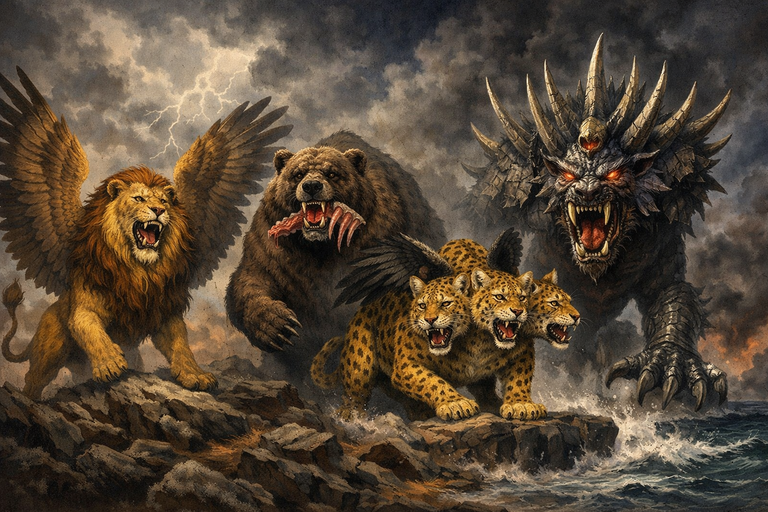
In this vision, four animals emerge from the sea in sequence: first a lion, then a bear, a leopard, and finally a dragon-like beast.
What do these animals represent? The prophecy calls them kings, yet it also describes the fourth beast as a kingdom (Dan 7:17, 23). Thus, each king represents a kingdom, and the four animals symbolize four kingdoms, each ruled by a succession of kings.
Consecutive Kingdoms
Do these kingdoms exist in sequence or at the same time? The four beast-kingdoms in Daniel 7, like the four metal kingdoms in Daniel 2, reign consecutively for the following reasons:
First, Daniel 7:7 says the first three beasts existed “before” the fourth, indicating chronological order.
Second, verse 23 says the fourth beast will devour the whole earth. That leaves no room for the others to rule alongside it. These empires are worldwide in scope and therefore reign one after another.
Third, in describing the sequence of these animal kingdoms, Daniel 7:6-7 repeatedly uses the phrase “after this,” which also points to chronological sequence.
The Sea symbolizes the people.
 According to verse 3, the animals rise from the sea. What, then, does the sea represent? Verse 17 says they rise from the earth, meaning the sea represents the world—not the physical planet, but its peoples. Similarly, Revelation 17:15 uses waters to symbolize peoples, multitudes, nations, and languages.
The Ten Horns are fragments of the Fourth.
What are the horns of the fourth beast? At first, the beast has ten horns, which are explained as ten kings arising from it. Since kings represent kingdoms, the ten horns symbolize ten kingdoms, each ruled by a succession of kings. In other words, the horns growing from the fourth animal show that the fourth empire would fragment into many kingdoms. They are the fragments of the Fourth Empire. That empire would never be replaced by another world empire. Another article identifies the fourth kingdom as Rome. Therefore, according to this vision, after Rome, no single kingdom will ever again rule the whole world. The world will always remain divided among many kingdoms and nations.
The 11th horn is the Antichrist.
After the first ten horns, an eleventh horn rises from the fourth beast. It appears “among” the ten and uproots three of them as it rises (Daniel 7:8).
This eleventh horn was small at first, which is why it is often called the Little Horn. Yet it became greater than the others, meaning it would eventually dominate the other kingdoms. It is the central figure of Daniel 7 and the main focus of the prophecy. Daniel devotes more space to it than to any other figure. The preceding four animals and ten horns are described ONLY so the reader can identify this eleventh horn.
This horn persecutes God’s people, blasphemes God, attempts to change times and law, and is destroyed only when Christ returns (Daniel 7:8, 20, 25). Therefore, the eleventh horn is the Antichrist.
Daniel 7 explains Daniel 2.
The previous article examined Daniel 2. This section argues that Daniel 7 parallels Daniel 2 and expands on it. Therefore, the two visions should be read together.
Similarities
The parallels between the two visions are shown by several similarities:
First, both Daniel 2 and Daniel 7 symbolize four successive empires. In Daniel 2, they appear as the four metal sections of a human statue; in Daniel 7, they are represented by four animals.
Second, in both chapters, the fourth empire is called the “fourth kingdom” (Dan. 2:40; 7:23) and is linked with iron (Dan. 2:40; 7:7). In Daniel 2, the fourth empire is the statue’s IRON legs; in Daniel 7, it is the beast with IRON teeth.
Third, in both chapters, the fifth phase continues the fourth. Daniel 2 shows this through the iron that remains in the fifth kingdom, while Daniel 7 shows it through the 11 horns that grow from the fourth animal. In Daniel, horns represent divisions of empires; therefore, the 11 horns are divisions of the fourth animal, the final empire.
Fourth, in both Daniel 2 and Daniel 7, the fifth kingdom is fragmented, with many kingdoms existing at the same time. Daniel 2 describes it as a “divided kingdom” (verse 33), while Daniel 7 depicts this fragmentation through the 11 horns of the fourth animal. During this period, different kings rule different parts of the world.
Fifth, in both chapters, the divided kingdom is followed by God’s eternal kingdom (Dan. 2:44; cf. 7:26–27).
Because of these similarities, commentators generally agree that Daniel 2 and Daniel 7 describe the same four successive kingdoms, the same fifth divided kingdom, and the same eternal kingdom.
Comparison Table
The two chapters can therefore be compared as follows:
| Daniel 2 | Daniel 7 |
| Head of Gold | Lion |
| Breast and Arms of Silver | Bear |
| Belly and Thighs of Bronze | Leopard |
| Legs of Iron | Fourth animal, dreadful, terrifying, and extremely strong |
| Feet of Iron and Clay | Eleven horns of the fourth animal |
| Eternal kingdom | Everlasting Kingdom |
The two visions form a unit.
For these reasons, Daniel 7 parallels Daniel 2. The visions should be read together because they explain one another. For example:
(1) Since Daniel 2 identifies the gold kingdom as the Babylonian Empire, the lion kingdom in Daniel 7 also represents Babylon.
(2) Daniel 2 does not mention the Antichrist, but Daniel 7 represents him as the 11th horn of the fourth animal. This means he arises only after the first four empires and after the first 10 horn-kingdoms, as a fragment of the fourth kingdom.
The Liberal Interpretation of Daniel 7
As noted above, this article aims to show that the Liberal Interpretation does not fit Daniel 7. This section, therefore, briefly outlines that interpretation.
The academic world, including major university theology faculties, generally does not allow for miracles—such as accurate predictions of the future—in its explanations of the Bible. Everything must be explained naturally. Therefore, because Daniel names the Greek Empire, the academic view, referred to here as the Liberal view, holds that Daniel was written after Greece had already appeared. In this view, Daniel is history presented as prophecy.
Because Greece is the last empire named explicitly, the Liberal Interpretation reaches the following conclusions:
(a) The fourth animal in Daniel 7 represents the Greek Empire.
(b) The Antichrist, the 11th horn of the fourth animal, must therefore be Greek.
(c) More specifically, the Antichrist is identified as the Greek king Antiochus IV, who ruled in the mid-second century BC, persecuted the Jews, and defiled the temple.
(d) The 11 horns symbolize 11 successive Greek kings.
(e) The Book of Daniel was written during Antiochus’s reign.
For a sense of the academic perspective, read the Wikipedia article on the Book of Daniel, or consult another encyclopedia.
Objections to the Liberal View
This site rejects that interpretation. The following are three specific objections:
1. Comparison of the Animals
First, Daniel 7 and 8 both use animals to symbolize successive empires and describe them with features such as multiple heads, multiple horns, and some have wings. Daniel 8 contains only two animals, but identifies them explicitly as the Medo-Persian and Greek Empires. Therefore, a first objection to the Liberal Interpretation is that the next article in this series compares the animals in Daniel 7 and 8, and shows that the fourth empire in Daniel 7 is Rome, not Greece. 🔗
2. The horns exist AFTER the fourth empire.
Second, in the Liberal Interpretation, the 11 horns exist DURING the fourth empire. They are seen as 11 successive kings OF that empire. However, Daniel 2 indicates that the 11 horns exist AFTER the fourth empire has fragmented. To explain: In Daniel 2, the five parts of the statue are five consecutive periods of history. This means that the fifth age, the divided kingdom, exists after the fourth. Since the 11 horns in Daniel 7 parallel the divided kingdom in Daniel 2, they must also belong after the fourth empire, not during it.
3. The horns exist concurrently.
Third, the Liberal Interpretation treats the 11 horns as consecutive rulers, but Daniel indicates that they exist at the same time:
(a) As argued above, the horns parallel the divided kingdom in Daniel 2, and the term “divided kingdom” implies concurrent fragments.
(b) Verse 43 says these kings try to unite through intermarriage, which also implies that they coexist.
(c) Daniel saw the 11th horn among the other ten horns (Daniel 7:8), and “among” describes entities that exist together.
(d) Verse 8 says the 11th horn uproots three other horns, implying that at least those three kings existed at the same time.
(e) In Daniel 8, both animals have horns, and in both cases the horns represent concurrent kingdoms: the ram’s two horns represent the Medes and Persians, and the goat’s four horns represent the four simultaneous divisions of the Greek Empire.
Conclusion
In conclusion, this article has summarized the vision in Daniel 7, explained the Liberal Interpretation, in which the fourth empire is Greece, and presented three objections to that view. These objections support the Conservative Interpretation, which identifies the fourth empire as Rome. The next article in this series will confirm that identification. 🔗
Theological Implication
Because the article rejects the liberal view, it implicitly affirms that Daniel is historically reliable. It was not written by an unknown writer, centuries after Daniel, and it is not history written in the form of prophecy. The book’s accuracy is evidence of divine inspiration.
Other Articles
• Next: Daniel’s fourth beast is the Roman Empire.
• All articles on Daniel
Other Core Articles
• All articles on this Site
• The Mark of the Beast
• The Trinity doctrine
• The True Origin of the Trinity Doctrine
• The Sabbath was part of the Arian Controversy
For general theology, I recommend Graham Maxwell.