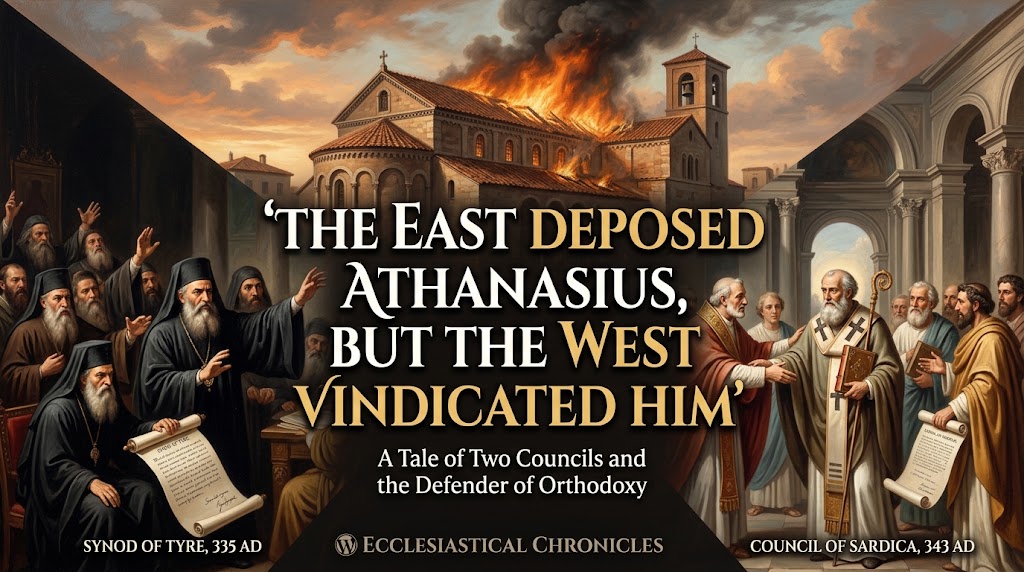
This article examines the critical historical shift between the Council of Tyre in 335, where the Eastern Church deposed and excommunicated Athanasius, and the Council of Rome in 341, where Bishop Julius of Rome formally vindicated him. Drawing on modern patristic scholarship—including works by R.P.C. Hanson, Lewis Ayres, and Rowan Williams—the study analyzes Athanasius’s polemical strategy of labeling his opponents as “Arians,” the reaction of the Eastern bishops at Antioch, and how Rome’s intervention drew the Western Church into the heart of the Arian Controversy, ultimately deepening the schism between East and West.
Arian Controversy
In the Roman Empire, all Romans were Church members, and the Emperor was the Head. After the Empire fragmented, the Roman State Church became the Roman Church.
What is the Mark of the Beast? Revelation 13 Explained
INTRODUCTION Purpose This site identifies the Mark of the Beast through many articles, including articles on Daniel and Revelation. This article
The Sabbath’s Connection to the Arian Controversy
This article argues that the historical dispute over Saturday Sabbath versus Sunday worship was directly linked to the multi-century Arian Controversy regarding the nature of Christ. Utilizing modern revisionist historical scholarship, the author asserts that the earliest Jewish and Eastern Christian churches were non-Trinitarian (viewing the Father and Son as distinct Beings) and observed the Saturday Sabbath. In contrast, both single-Being Nicene theology and Sunday worship originated in 2nd-century Rome. The piece outlines how early Arians, Eastern Christians, and conquering Germanic tribes maintained Sabbath observance until forced Nicene orthodoxy and Roman tradition phased it out over subsequent centuries.

