Daniel 2 lays the foundation for identifying the Beast of Revelation.

The man of Daniel 2The vision in Daniel 2 is an amazingly accurate outline of history, an overview of world kingdoms, from the time of the ancient Babylonian Empire, 600 years before Christ, until the End, when Christ will return.

It even describes what the world would be like after Christ’s return. In God’s everlasting kingdom, nothing of the current world order will remain.

Begins to identify the Beast.

Before we analyze the vision itself, we can comment on its importance.

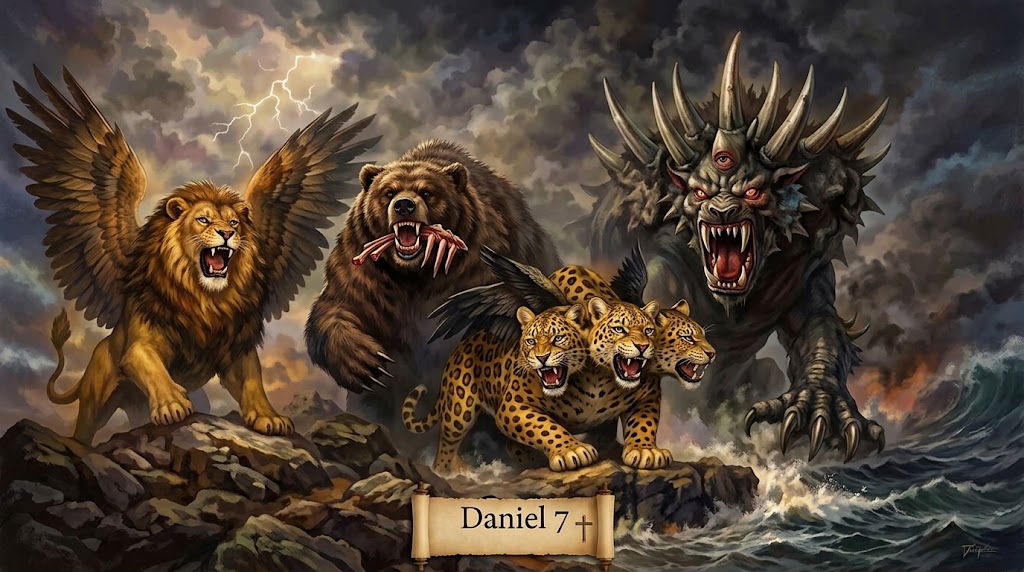
This article series will show that Daniel 7 describes the same four empires as in Daniel 2. While Daniel 2 uses the four metal parts of a statue of a man for that purpose, Daniel 7 uses four animals: a Lion, a Bear, a Leopard, and a Dragon-like animal.

It is then important to note that Revelation 13 uses the same four animals, the lion, bear, leopard, and dragon, to describe the Beast of Revelation. The Beast looks like a leopard, has the feet of a bear, the mouth of a lion, and receives its authority from a dragon (Rev 13:1-2). This means that the Beast of Revelation is somehow related to the empires described in Daniel 2 and 7.

Furthermore, this article series will also show that the prophecies of Daniel chapters 2, 7, 8, and 11 describe the same events, but use different symbols and emphasize different aspects. For example, Daniel 2 and 7 both describe the kingdom that “will never be destroyed” (Dan 2:44; 7:14).

Daniel 2, therefore, serves as the framework for interpreting Daniel’s later prophecies and, eventually, for identifying Revelation’s Beast. The Beast cannot be identified from the Book of Revelation alone.

Divides history into six ages.

In a dream, God gave King Nebuchadnezzar a vision of the statue of a man consisting of different metal parts (Dan 2:32-33), symbolizing six consecutive ages of history.

Head of Gold

The first age is represented by the statue’s Head of Gold. Daniel identifies it as Nebuchadnezzar. However, Daniel added that the Head of Gold will be followed by “another kingdom” (Dan 2:37-39). In other words, the Head of Gold symbolizes the entire Babylonian Empire. Nabopolassar founded the Neo-Babylonian empire in 626 BC. Nebuchadnezzar the Great inherited this empire in 605. It ended when the Persians captured Babylon in 539.

Silver and Bronze

The next two empires are symbolized by the silver and bronze parts of the statue. They are called kingdoms and are described as ruling one after the other over all the earth, but Daniel 2 does not identify them (Dan 2:32, 39).

Note that, according to the prophecy, these kingdoms were worldwide, but we know they were not. These prophecies were given to Israel. From their perspective, these kingdoms were worldwide.

Legs of Iron

The fourth empire, symbolized by the statue’s Legs of Iron, would be as strong as iron. It would crush and break its predecessors into pieces (Dan 2:40).

Divided Empire

The fifth age is symbolized by the statue’s feet. While the legs are of iron, the feet consist of iron and clay parts, implying that this fifth age is, in some way, a continuation of the fourth.

Daniel calls the fifth age “a divided kingdom” (Dan 2:33, 41). During each of the first four empires, a single supreme king would rule, but the fifth divided kingdom would be a period when multiple kingdoms would exist concurrently, ruling different parts of the known world. For example, Daniel said that these kings would attempt to combine their kingdoms through intermarriage, but they would fail (Dan 2:43). The divided kingdom is a continuation of the fourth, but in a fragmented form.

Some propose that the clay parts of the divided kingdom represent spiritual authority, while the iron represents civil kingdoms. However, the prophecy says that iron symbolizes strength, that some parts will be strong, but other parts will be brittle (Dan 2:40-42). Therefore, the iron and clay parts probably symbolize strong and weak kingdoms, respectively.

End of the World

A stone was cut out without hands (Dan 2:34), meaning supernaturally.

It struck the statue on its feet (Dan 2:34), meaning the very last part of the kingdoms of this world.

It simultaneously crushed the iron, clay, bronze, silver, and gold (Dan 2:34-35). In other words, although the four empires dominate one after the other, remnants of each of them remain until Christ returns. They are only fully and finally destroyed when the eternal kingdom is set up.

The iron, clay, bronze, silver, and gold became like chaff from the summer threshing floors. The wind carried them away so that no trace of them was found. Nothing will remain of the current world order. As God promised: “Behold, I am making all things new” (Rev 21:5).

The Eternal Kingdom

The stone would become a great mountain that will never be destroyed (Dan 2:44). In other words, it represents God’s eternal kingdom. The parallel vision in Daniel 7 refers to it as the “everlasting kingdom” (Dan 7:18, 27).

It will fill the whole earth (Daniel 2:35). God’s eternal kingdom will be on this earth.

In the parallel vision in Daniel 7, “the Ancient of Days” will give the eternal kingdoms to “One like a Son of Man.” Then, all the peoples, nations, and men of every language will serve Him (Dan 7:13-14). In other words, Jesus Christ will rule God’s eternal kingdom.

Some argue that this eternal kingdom does not refer to a physical kingdom but to “the kingdom of God” that Jesus often mentioned (e.g., Matt 12:18; cf. Luke 17:20-21), and which refers to a spiritual reality that always exists, even today. However, once the stone has crushed the statue, all traces of the previous age have been obliterated. All people will serve Christ. The Antichrist will no longer exist. Since none of these are true today, that stone-kingdom lies in our future.

Identity of the Empires

This article does not identify the 2nd, 3rd, and 4th kingdoms. Daniel 7, which describes the same six ages as Daniel 2, also does not identify any empire by name. However, Daniel 8 uses two animals, a ram and a goat, to symbolize two of the four empires. The important point is that Daniel 8 explicitly names these two empires as Media-Persia and Greece (Dan 8:20-21). Consequently, one of the future articles in this series identifies the four kingdoms by comparing the animals in Daniel 7 to those in Daniel 8.

The Antichrist

The Antichrist is prominent in the later visions in Daniel. The main purpose of these visions is to identify the Antichrist, but Daniel 2 does not mention it. On the other hand, the broad outline of history in Daniel 2 serves as a framework for interpreting Daniel’s later prophecies and, therefore, eventually, for identifying the Antichrist.

Other Articles

Next Article: Daniel 7 

The current article, in more detail 

All articles on this site

Daniel’s fourth beast is the Roman Empire.

This article assumes that the previous article, which provides an overview of the vision in Daniel 7, has been read.

Purpose of the Article

Using a series of four animals, symbolizing four consecutive empires, Daniel 7 describes world history, from the time of the Babylonian Empire until Christ returns. The fourth empire fragments into 11 kingdoms, existing concurrently.

Daniel 2 describes the same four empires. As stated in the article on Daniel 2, that vision identifies the first as the ancient Babylonian Empire, which reigned in the 6th and 7th centuries B.C.

Daniel 7 does not identify any of the four animals.

Both Daniel 7 and 8 use animals as symbols for empires. Daniel 8 uses two animals, a Ram and a Goat, and explicitly identifies them as “Media and Persia” and “Greece” (Daniel 8:20, 21). The purpose of the current article is to identify the four animals in Daniel 7 by comparing them to the animals in Daniel 8.

The Antichrist

In both Daniel 7 and 8, the main character is an evil horn. Commentators generally agree that the horns in these two chapters symbolize the same entity. This article refers to it as the Antichrist because Daniel describes it as God’s great enemy, and it will only be destroyed when Christ returns. In Daniel 7, the Antichrist is the 11th horn growing out of the 4th animal.

Competing Interpretations

From the time of the prophet Daniel, the nation of Israel was subject to four empires: the Babylonian, Medo-Persian, Greek, and the Roman Empires.

Both Conservatives and Liberals interpret the first animal in Daniel 7, the Lion, as the ancient Babylonian Empire.

However, they differ with respect to the other three animals. While Conservatives hold that Medo-Persia is symbolized by the second animal, the Bear, Liberals believe that Medo-Persia is symbolized by BOTH the second and third animals, the Bear and the Leopard. Liberals identify the second animal as the Medes, and the third as Persia. Consequently, the two competing systems may be compared as follows:

Daniel 7 Conservative Liberal
Lion Babylon Babylon
Bear Medo-Persia Medes
Leopard Greece Persians
Fourth Rome Greece

Since the Antichrist-horn in Daniel 7 grows out of the 4th animal, in the Conservative scheme, the Antichrist is of Roman origin, but, in the Liberal view, the Antichrist is Greek.

The Bear represents Medo-Persia.

This section begins to identify the animals in Daniel 7 by comparing them to the animals in Daniel 8.

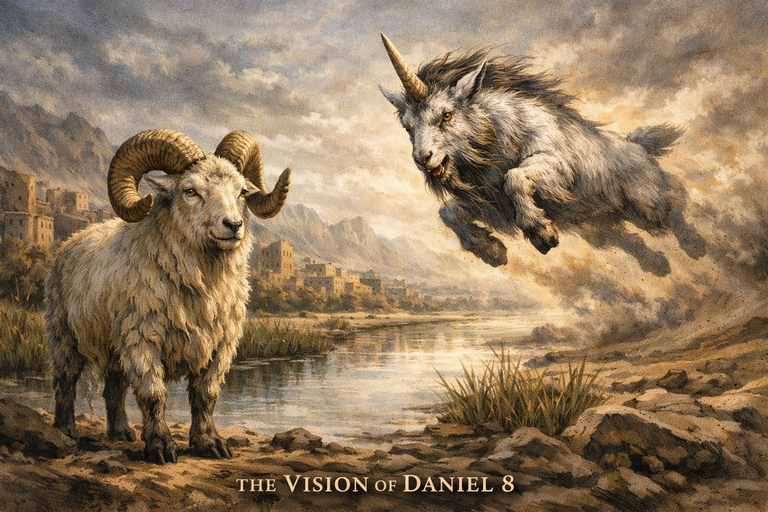
The first animal in Daniel 8 is a Ram, explicitly identified as “Media and Persia” (Daniel 8:20). It has two horns, one higher than the other. The higher horn came out last. It charges in three directions: the West, the North, and the South (Daniel 8:3-4).

The Bear of Daniel 7 is similar to the Ram:

Firstly, both are higher on one side. While the Bear is “raised up on one side,” the Ram has two horns, one longer than the other. The two sides are Media and Persia. The Ram’s horn that came out last but became longer, and the higher side of the Bear, symbolize the Persians. Initially, the Medes dominated Persia, but Cyrus reversed the relationship so that Persia dominated the Medes when their combined forces conquered Babylon.

Secondly, both conquer three things. While the Ram charges in three directions, the Bear has three ribs between its teeth (Daniel 7:5). Since animals symbolize kingdoms, the ribs between the teeth of the Bear may represent kingdoms or territories conquered. The three ribs may reasonably be taken as the three major conquests of the combined forces of the Medes and Persians in the sixth century BC:

        • Lydia in the north in 547,
        • Babylon in the west in 539, and
        • Egypt in the south in 525.

The Leopard is not Medo-Persia.

In the Liberal interpretation, the Ram of Daniel 8 includes both the Bear and Leopard of Daniel 7. However, there is no similarity between the Ram and the Leopard. On the contrary, they clearly differ. Daniel’s prophecies use heads and horns to indicate divisions of empires. While the Ram has two horns, meaning it has two divisions, the Medes and Persians, the Leopard has four heads (Daniel 7:6), meaning that it has four divisions.

The Leopard is Greece.

The second animal in Daniel 8 is a Goat, explicitly identified as Greece (Daniel 8:21). It comes from the west without touching the ground. It has one great horn, but the great horn was broken while it was still strong. In its place came up four horns to the four directions of the compass (Daniel 8:5, 8).

The Goat is similar to the Leopard of Daniel 7:6:

Firstly, both are fast. While the Leopard has four wings, the Goat flies. The speed of its conquests refers to the speed at which Alexander the Great conquered the known world.

Secondly, both have four parts. The Leopard has four heads, while the Goat has four horns. The four heads and four horns symbolize the four Greek Empires formed after Alexander’s death at age 33.

Given these similarities, the Leopard is equivalent to the Goat and represents the Greek Empire.

The fourth animal is not Greece.

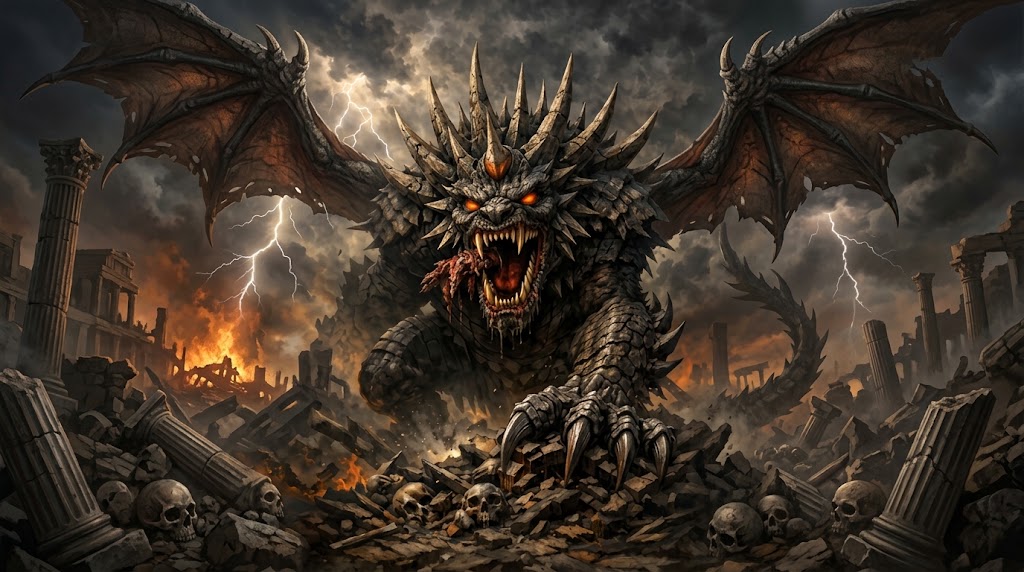
In the Liberal interpretation, the Goat of Daniel 8 is equivalent to the dreadful fourth animal of Daniel 7, and both symbolize Greece. However, nothing in their descriptions suggests that. On the contrary, while the Goat first has only one horn and then later four, the fourth animal first has ten horns, then an 11th comes up, uproots three of the first 10 horns, leaving 8 horns standing. Since horns symbolize the divisions of kingdoms, the Goat and the Dreadful Fourth Animal are not related.

Conclusion

Since the Bear is Medo-Persia and the Leopard Greece, the Dreadful Fourth Animal of Daniel 7 must be the next empire in the series, namely, the Roman Empire:

Daniel 7 Daniel 8
Lion Babylonian Empire
Bear Ram Medo-Persia
Leopard Goat Greek Empire
Fourth Animal Roman Empire

This confirms the Conservative view. It means that the Antichrist arises out of the Roman Empire.

Medo-Persia

As stated, to make their interpretation fit the text, Liberal scholars propose that the author of Daniel divided Medo-Persia into two empires. Therefore, another argument against the Liberal interpretation is that this is inconsistent with both secular history and the Book of Daniel:

Historically, the Persians conquered the Medes around 550 BC, and, 11 years later, the joint forces of the Medes and Persians conquered Babylon, with Cyrus the Great as their supreme king.

It would also be inconsistent with the Book of Daniel itself. Daniel always refers to the Medes and Persians as a single empire. For example:

He prophesied that the joint forces of the Medes and the Persians would conquer Babylon (Daniel 5:28).

He referred to the unchangeable law of the Medes and the Persians (Daniel 6:9, 13, and 16).

He identified the Ram as “the kings of Media and Persia” (Daniel 8:20).

Other Articles

Next Article: Three interpretations of the evil horn of Daniel 8.

The current article, in more detail 

All articles on this site

The Liberal interpretation of Daniel 7 does not fit the text.

This article assumes that the article on Daniel 2 has been read.

The Four Kingdoms

Kingdoms – In Daniel 7, four animals, a lion, a bear, a leopard, and a dragon-like beast, come up out of the sea. They are explained as “kings” (Daniel 7:17). However, Daniel 7:23 refers to the fourth beast as “a fourth kingdom.” In other words, the four animals are four kingdoms, consisting of a series of kings.

Sea – These animals arise out of the sea (Daniel 7:3), but Daniel 7:17 says that these kings will “arise from the earth.” Therefore, the sea is the earth, not the physical earth, but the people of the world.

Consecutive – As the four metal-kingdoms of Daniel 2, the four beast-kingdoms in Daniel 7 will reign consecutively. For example:

Firstly, according to Daniel 7:7, the first three beasts will exist before the fourth.

Secondly, the fourth beast will devour the “whole earth” (Daniel 7:23), which does not leave space for other beasts. These are ‘worldwide’ empires.

Thirdly, Daniel 7:6-7 uses the phrase “after this” several times to describe the chronological sequence of these animal-kingdoms.

The Ten Horns

Initially, the fourth beast had ten horns, explained as ten kings that will arise out of the fourth beast (Daniel 7:7-8, 24). However, since ‘kings’ are equivalent to ‘kingdoms,’ each of the ten horns symbolizes a kingdom, consisting of a series of kings.

To distinguish between the four animal-kingdoms and the later horn-kingdoms, this article refers to the animal-kingdoms as empires.

The horns growing out of the 4th animal symbolize that the fourth empire would fragment into many kingdoms.

The 11th Horn

After the first ten horns, an 11th horn grows out of the fourth empire. It comes up “among” the first ten horns, uprooting three of them (Daniel 7:8). Initially, it is small, but it grows and eventually dominates the other kingdoms.

The main character and purpose of Daniel 7 is not one of these four empires, nor one of the first ten horns, but the 11th horn. Daniel 7 allocates much more space to it than to any of the other characters. The only reason that Daniel describes the preceding kingdoms is to enable the reader to identify the 11th horn.

The 11th horn persecutes God’s people, blasphemes God, intends to change times and law, and will only be destroyed when Christ returns (Daniel 7:8, 20, 25). In other words, it symbolizes the Antichrist.

Parallel to Daniel 2

The vision in Daniel 7 is parallel to the vision in Daniel 2. Firstly, commentators agree that the four animals in Daniel 7 and the four metals in Daniel 2 symbolize the same four empires. For example:

(a) As there are four metals in Daniel 2, there are four animals in Daniel 7.

(b) Both the metals in Daniel 2 and the animals in Daniel 7 symbolize consecutive kingdoms.

(c) Both the fourth metal and the fourth animal are associated with iron (Daniel 2:40; 7:7) and are called the “fourth kingdom” (Daniel 2:40; 7:23).

Secondly, for the following reasons, the 11 horns in Daniel 7 is equivalent to the divided kingdom in Daniel 2:

(a) Both are a fifth age, following the first four empires.

(b) Both continue the fourth empire:

In Daniel 7, the 11 horns grow out of the 4th animal, indicating continuance.

In Daniel 2, the iron of the fourth empire continues in the fifth phase (Daniel 2:33).

(c) Both symbolize many kings ruling concurrently.

(d) Both will end only when God sets up His Eternal Kingdom.

For these reasons, Daniel 2 and 7 symbolize the same four empires, followed by the same fifth period of divided rule, when many kingdoms exist concurrently, followed by God’s eternal kingdom.

However, Daniel 7 adds the Antichrist, who is not mentioned in Daniel 2. That Antichrist, depicted as the 11th horn, will arise only after the first four empires and after the first 10 horn-kingdoms.

Comparison Table

Since Daniel 2 identifies the Gold Kingdom as the Babylonian Empire, that is also the identity of the Lion Kingdom in Daniel 7. The two visions may be compared as follows:

Daniel 2 Daniel 7
 Head of Gold Lion
 Breast and Arms of Silver Bear
 Belly and Thighs of Bronze Leopard
 Legs of Iron Fourth animal, dreadful, terrifying, and extremely strong
 Feet of Iron and Clay Eleven Horns
 Eternal kingdom Everlasting Kingdom

The Liberal Interpretation

The academic world, where Liberalism dominates, does not believe in miracles, such as accurate predictions of the future. Since the Book of Daniel predicts the Greek Empire by name, Liberals believe that Daniel was written AFTER that empire was already established. They believe that the Book of Daniel is history written in the form of prophecy.

Specifically, in Liberal theology, Daniel was written during the reign of the Greek king Antiochus IV, who persecuted the Jews and defiled the temple. Liberals identify Antiochus IV as the Antichrist, the 11th horn of Daniel 7. For Antiochus to fit the prophecy, Liberals identify the fourth empire as the Greek empire, and propose that the 11 horns symbolize 11 consecutive kings of that empire.

Objections to the Liberal Interpretation

For the following reasons, this article rejects the Liberal interpretation:

Firstly, Daniel 8 uses two animals as symbols, explicitly identified as the Medo-Persian and Greek Empires. Both Daniel 7 and 8 describe their animals with characteristics, such as multiple heads, multiple horns, wings, etc. By comparing the animals in Daniel 7 to those in Daniel 8, the next article will show that the fourth empire is the Roman Empire, not the Greek Empire, as the Liberals propose.

Secondly, in the Liberal interpretation, the 11 horns, including the Antichrist, exist DURING the fourth empire. However, as discussed, the five parts of the statue in Daniel 2 symbolize five consecutive periods of history. Since the 11 horns of Daniel 7 are parallel to the divided kingdom in Daniel, which follows after the fourth empire, 11 horns exist AFTER that fourth empire, not during it.

Thirdly, in the Liberal interpretation, the 11 horns are 11 consecutive Greek kings. However, the following are indications that these horns are concurrent:

(a) They are parallel to the “divided kingdom” in Daniel 2. The term “divided kingdom” implies concurrent fragments.

(b) They will attempt to unite through intermarriage (Daniel 2:43).

(c) Daniel saw the 11th horn AMONG the other ten horns (Daniel 7:8).

(d) The 11th horn uproots three other horns (Daniel 7:8).

(e) Both animals in Daniel 8 have horns, and, in both, the horns represent concurrent kingdoms (Daniel 8:20-22):

The Ram has two horns, representing the Medians and Persians of the Median-Persian Empire.

The Goat grows four horns, representing the four concurrent divisions of the Greek Empire.

Other Articles

Next Article: Daniel’s fourth beast is the Roman Empire.

The current article, in more detail 

All articles on this site