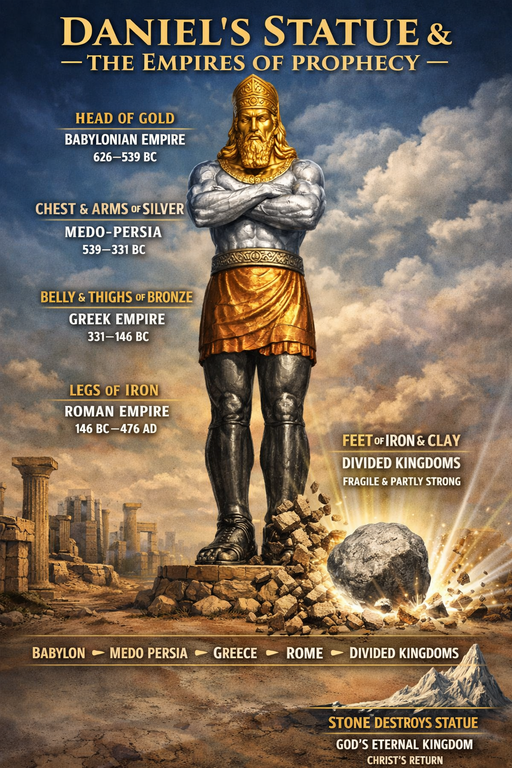
The Book of Daniel contains several apocalyptic visions. It is the Old Testament counterpart to the New Testament Book of Revelation.
Daniel, the author of the book, received these visions about 2,600 years ago—roughly 600 years before Christ—while Israel was captive in Babylon. Jesus referred to him as “Daniel, the prophet.”
This article examines Daniel’s first vision, recorded in Daniel 2. This remarkable prophecy briefly outlines the kingdoms of this world, beginning with ancient Babylon, about 600 years before Christ, and continuing to the end of time, when Christ returns and establishes God’s everlasting kingdom. In that kingdom, nothing of the present world order will remain.
The Beast of Revelation
This article series examines the visions in Daniel 2, 7, 8, and 11. It shows that these prophecies are parallel: they describe the same events through different symbols. For example, Daniel 2 and Daniel 7 both present four successive empires, followed by a divided kingdom ruled by several kings at once, and then by God’s eternal kingdom.
Although the visions cover the same events, each highlights different aspects. Together, they complement one another and form a unified whole.
Daniel 9 is the exception. Unlike the other visions, which concern all nations and all time, Daniel 9 focuses only on Israel and the 70 Weeks God assigned to that nation. Daniel 9 is addressed in a separate article series, where the 70 Weeks are understood as 490 literal years.
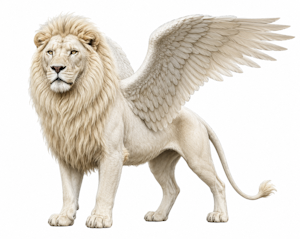 The visions in Daniel and Revelation are symbolic, using images to represent real events and realities. For instance, Daniel 2 portrays four empires through the metal parts of a statue, while Daniel 7 depicts the same empires as four animals: a lion, a bear, a leopard, and a dragon-like beast.
Revelation’s visions cannot be properly understood without first understanding Daniel’s. For example, Revelation 13:1-2 draws on Daniel 7’s four animals to describe the Beast: it resembles a leopard, has the feet of a bear, the mouth of a lion, and receives authority from a dragon. These are the same four animals as in Daniel 7. The Beast in Revelation is therefore a composite and a continuation of the animal empires in Daniel 7. Specifically, a later article in this series will argue that the 11th Horn of Daniel 7’s fourth animal is the Beast of Revelation.
Therefore, the visions in Daniel and Revelation form one unified whole. This series of articles ultimately seeks to identify the Beast in Revelation, but that cannot be done from Revelation alone. The search must begin in Daniel.
Daniel 2 provides the foundation for studying the Beast of Revelation. Daniel 7, 8, and 11 add detail, but Daniel 2 supplies the framework for interpreting Daniel’s later prophecies and, ultimately, Revelation’s prophecies.
The Six Ages
In Daniel 2, God gave King Nebuchadnezzar this vision in a dream. The vision came first to the king, not to Daniel; God later gave Daniel its interpretation. If necessary, God can still give visions to rulers today.
The vision showed a statue of a man. The statue symbolizes humanity. Its different metal parts divided history into six consecutive ages (Dan 2:32-33):
1. Head of Gold
The statue’s head of gold represented the first age. Daniel identified the head of gold as King Nebuchadnezzar himself. However, Daniel added that the head would be followed by another KINGDOM. In other words, the head of gold symbolizes the entire Babylonian Empire. Nebopolassar founded that empire in 626 BC. His son Nebuchadnezzar inherited it in 605 BC. After several later kings, the empire ended when the Persians captured Babylon in 539 BC.
While Babylon is represented by gold, the later empires are symbolized by less valuable metals: silver, bronze, and iron. Likewise, Daniel 2:39 says the second empire would be inferior to the first. Perhaps the gold points to qualities such as rulership or human rights.
2. Breast of Silver
The statue’s breast and arms of silver represent the second empire, described as an inferior kingdom that would follow Babylon (Daniel 2:39). A later article will identify it as Medo-Persia. Daniel 8 depicts Medo-Persia as a ram with two large horns. The two horns represent the Medes and Persians, respectively. Perhaps the two arms of the statue likewise point to the Medes and the Persians.
3. Belly of Bronze
The Belly and Thighs of Bronze symbolized the third empire. It is described as a third kingdom that would rule over all the earth (Dan 2:32, 39).
Note that the metals get harder as we go down. Gold is relatively soft. Silver is slightly harder, but still relatively soft and malleable. Silver scratches and dents fairly easily, compared to the tough, rigid durability of bronze alloys. Perhaps this also reflects the nature and increasing strength of the kingdoms.
4. Legs of Iron
The statue’s Legs of Iron symbolize the fourth empire. It would be as strong as iron. It would crush and break its opponents into pieces (Daniel 2:40). One of the later articles argues that the Legs of Iron is the same as the fourth beast in Daniel 7. That beast, similarly, is dreadful and terrifying and extremely strong. It devoured and crushed and trampled its opponents (Daniel 7:7).
These empires are called kingdoms, and rule consecutively. They rule over “all” the earth (Dan 2:32, 39). However, except for the first, Daniel 2 does not identify them. They are identified by the subsequent visions.
According to the prophecy, these kingdoms were worldwide, but we know they were not. The prophecies in Daniel were given to Israel. The kingdoms in this prophecy dominated the world in which Israel existed. The prophecies of the Book of Revelation also seem to involve the whole world. However, perhaps we must interpret Revelation as describing only the Christian world. For example, when Revelation says that the whole world will worship the Beast, perhaps that refers only to the Christian world, as discussed by later articles.
5. Divided Empire
The statue’s feet, partly of iron and partly of clay, symbolized the fifth kingdom (Daniel 2:41):
Since the fourth kingdom is an iron kingdom, the iron parts of the fifth kingdom indicate that the fifth kingdom continues the fourth kingdom, in some way. It is not a new metal. It continues the fourth empire, but the iron parts are now separated by clay parts.
Daniel described the fifth empire as “a divided kingdom” (Dan 2:33, 41). During each of the first four empires, a single supreme king would rule. However, during the fifth, multiple kingdoms would exist concurrently. Different kings will rule different parts of the world. For example, these kings would attempt to combine their kingdoms through intermarriage (Daniel 2:43).
In other words, the divided kingdom is a continuation of the fourth, but in a fragmented form.
What do the clay parts represent? Some interpret the clay as the spiritual authority and the iron as civil kingdoms. Yet in the prophecy, iron represents strength. Furthermore, Daniel says that some parts of the kingdom would be strong while others would be brittle (Daniel 2:40-42). Therefore, the iron most likely symbolizes strong kingdoms, while the clay represents weaker ones.
6. Christ’s Return
At the close of the divided kingdom, a stone was cut from the mountain “without hands” (Daniel 2:34).
“Without hands” means supernaturally. Daniel 8 uses similar language when it says the evil horn will be broken “without human hands” (Dan 8:25).
The mountain, from which the stone was cut, must represent God’s kingdom. The arrival of that stone will be the fulfillment of our prayer, “Let Your kingdom come, on earth as in heaven” (Matt 6:10),
The stone struck the statue at its feet (Dan 2:34). The feet represent the divided kingdom. This means no new one-world government will arise before Jesus returns. The divided kingdom will continue until Christ returns.
The stone crushed the iron, clay, bronze, silver, and gold at the same time. Although the four empires ruled in succession, remnants of each would remain until Christ returns. Only when the eternal kingdom is established will they be fully and finally destroyed. Daniel’s final verse calls this “the end of the days” (Dan 12:13).
The iron, clay, bronze, silver, and gold became like chaff from summer threshing floors, carried away by the wind until no trace remained. Nothing of the present world order will survive. As God promised, “Behold, I am making all things new” (Rev 21:5).
The stone may symbolize Jesus Christ. Yet Revelation indicates that God delays the end-time crisis until His people are ready and sealed (Rev 7:3). God is preparing the world for the final conflict between good and evil, and Jesus will return only when that battle has been won. The stone that struck the image may therefore also include the great outpouring of the Holy Spirit that precedes Christ’s physical return.
The Eternal Kingdom
The stone would grow into a great mountain that would never be destroyed (Dan 2:44). This represents God’s eternal kingdom, which Daniel 7 likewise calls the “everlasting kingdom” (Dan 7:18, 27).
This great mountain would fill the whole earth (Daniel 2:35). In other words, God’s eternal kingdom for humanity will be established on this planet. As noted above, the mountain began as a stone cut from a greater mountain. God’s kingdom has come to this world and will never end; never again will sin rear its ugly head.
In the parallel vision in Daniel 7, “the Ancient of Days” gives the eternal kingdom to “One like a Son of Man.” Then all peoples, nations, and languages will serve Him (Dan 7:13-14). Though people use His name as a curse word today, Jesus Christ will reign over God’s glorious, eternal kingdom. How would it feel to stand before the One you cursed? As stated in Revelation 14:10, “he will be tormented … in the presence of the holy angels and in the presence of the Lamb.”
Some argue that this eternal kingdom is not a physical kingdom, but the spiritual kingdom Jesus often described—for example, when He said, “Seek ye first the kingdom of God” (e.g., Matt 12:18; cf. Luke 17:20-21). That spiritual reality exists even now. However, in Daniel 2, after the stone crushes the statue, every trace of the former age is gone. All people serve Christ; the Antichrist no longer exists; and sin, sickness, and death have passed away. Since those things are not yet true, the stone-kingdom remains future.
Identity of the Empires
Daniel 2 explicitly identifies the first kingdom as Babylon, but it does not name the others. Daniel 7, which covers the same six ages, also leaves the empires unnamed. By contrast, Daniel 8 represents two empires with a ram and a goat and specifically identifies them as Medo-Persia and Greece. A later article in this series identifies the four kingdoms in Daniel 7 by comparing the animals in Daniel 7 with those in Daniel 8.
The Antichrist
The Antichrist becomes prominent in Daniel’s later visions. The main purpose of these visions is to identify the Antichrist. Daniel 2 does not mention the Antichrist directly, but its broad outline of history provides the framework for interpreting Daniel’s later prophecies. For that reason, Daniel 2 is essential to identifying the Antichrist.
God knows the future.
The Wikipedia page on Daniel 2 describes this prophecy as fiction. That reflects the academic consensus. Critical scholars generally reject miracles, including knowledge of future events. As a result, they argue that Daniel was written after the events it claims to predict. Since Daniel explicitly mentions the Greek Empire, they conclude that it must have been composed after Greece had already risen to power. Specifically, they claim that Daniel was written in the 2nd century BC. However, the Book of Daniel accurately foretells events after the 2nd century B.C. For example:
As another article explains, Daniel 7 accurately predicted HOW the Roman Empire would fall. Earlier empires were conquered by the next great empire, but Rome fell through fragmentation. This occurred in the fifth century after Christ, about seven centuries after academics claim Daniel was written. 🔗
Similarly, Daniel 9 accurately predicted the Messiah’s coming in the first century, about two centuries after critics say Daniel was written. 🔗 These fulfilled prophecies give me strong assurance that God exists and knows the future.
Core Theological Implications
1. Daniel accurately predicted events centuries after Critics claim it was written—Rome’s fragmentation, the timing of the Messiah. This directly opposes modern critical scholarship that denies predictive prophecy.
2. God rules history. He directs the rise and fall of nations. Human history is moving toward a divinely appointed climax.
3. Prophecy is God’s disclosure of His governance of world events. It validates divine foreknowledge. Fulfilled prophecy anchors Scripture’s reliability.
4. Revelation cannot be understood without Daniel, especially the Beast imagery. The Bible presents a unified apocalyptic framework across Testaments. Scripture interprets Scripture.
5. Daniel’s feet-of-iron-and-clay phase is the current age, and continues until Christ returns. This challenges interpretations expecting a future unified global empire before the end. Human attempts at global unity will remain fragmented.
6. The stone “cut without hands” represents a divine intervention that destroys all earthly kingdoms. The kingdom of God is not merely spiritual but will be a literal, earthly, everlasting kingdom. Sin, death, sickness, and evil will be abolished. Human political systems cannot evolve into God’s kingdom; it arrives by divine action, a future, visible Second Coming.
Other Articles
• Next Article: Daniel 7
• All articles on Daniel
Other Core Articles
• All articles on this Site
• The Mark of the Beast
• The Trinity doctrine
• The True Origin of the Trinity Doctrine
• The Sabbath was part of the Arian Controversy
For general theology, I recommend Graham Maxwell.