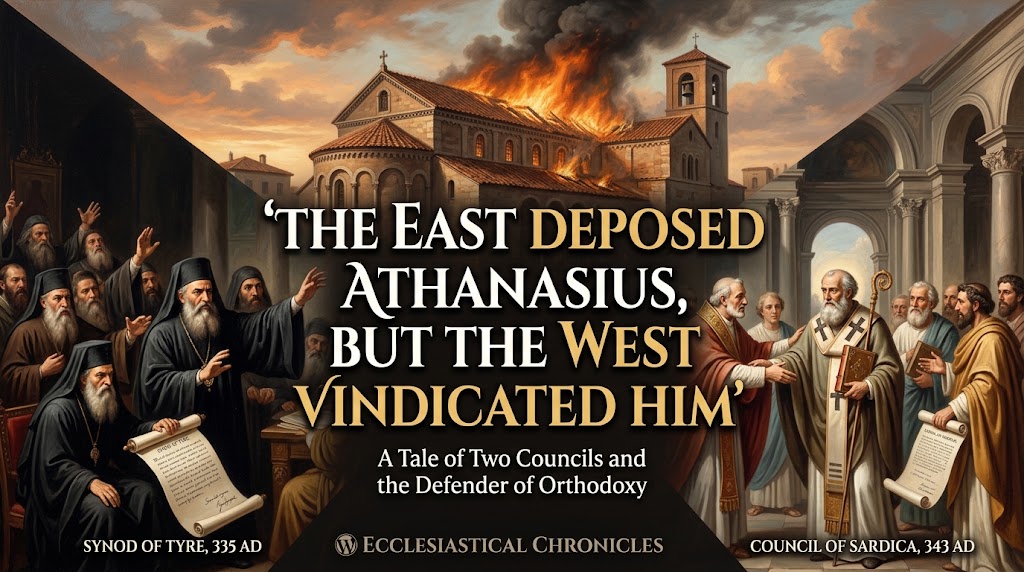
Abstract: This article examines the critical historical shift between the Council of Tyre in 335, where the Eastern Church deposed and excommunicated Athanasius, and the Council of Rome in 341, where Bishop Julius of Rome formally vindicated him. Drawing on modern patristic scholarship—including works by R.P.C. Hanson, Lewis Ayres, and Rowan Williams—the study analyzes Athanasius’s polemical strategy of labeling his opponents as “Arians,” the reaction of the Eastern bishops at Antioch, and how Rome’s intervention drew the Western Church into the heart of the Arian Controversy, ultimately deepening the schism between East and West.
Purpose of the Article
A previous article examined the conflict between Athanasius and the Melitians during the seven years after his election as bishop of Alexandria. It concludes that Athanasius was justly deposed for violence. The current article discusses the developments from the Council of Tyre in 335, where the Eastern Church excommunicated Athanasius, to the Council of Rome in 340, where the Western Church, under Julius, bishop of Rome, vindicated him.
Authors Cited
“The four decades since 1960 have produced much revisionary scholarship on the Trinitarian and Christological disputes of the fourth century” (Ayres, pp. 11-12). Since the scholarly view of the 4th-century Arian Controversy was significantly revised in the 20th century, this article series is based largely on books published by leading patristic scholars over the last 50 years:
Hanson, R.P.C.: The Search for the Christian Doctrine of God – The Arian Controversy 318-381, 1987
Williams, Rowan: Arius: Heresy and Tradition, 2002/1987
Ayres, Lewis: Nicaea and its legacy, 2004
Anatolios, Khaled: Retrieving Nicaea (2011)
Although I draw extensively on patristic scholarship, the conclusions are my own.
Athanasius Condemned at Tyre — AD 335
Athanasius acted violently against the Melitians. He acted authoritatively and used the influence of his episcopal office for personal advantage. The Council of Tyre found him guilty on several charges, deposed him as archbishop of Alexandria, excommunicated him, and prohibited him from returning to his see. The verdict was a crushing blow, and his recovery took considerable time. Nevertheless, Athanasius was exceptionally capable and influential, and, as this article will show, he eventually regained his position. [Show More]
| “Even if some of the proceedings of the Council of Tyre were high-handed, it was beyond doubt that Athanasius had behaved with violence against the Melitians and evinced in his general conduct an authoritarian character determined to exploit the influence of his see” (Hanson, p. 272).
The Council of Tyre “condemned Athanasius on a number of charges, deposed him from being archbishop of Alexandria, excommunicated him, and forbade him to return to his former see” (Hanson, p. 261).
“This verdict was a crushing blow for Athanasius, one from which it took him a long time to recover; and perhaps only he could have recovered from it” (Hanson, p. 262). |
The Death of Arius — AD 335–336
Emperor Constantine informed the bishops that Arius and associates had presented him with a profession of faith that the emperor considered orthodox. He therefore ordered the bishops to receive them formally into the Church. The Eusebian bishops complied. This episode illustrates again the authority the emperor exercised over the Church. The modern separation of Church and State did not exist. Church and State were united under a single head—the emperor.
Arius, however, died suddenly in 335 or 336. Athanasius later portrayed his death as an answer to prayer, but his account is not historically reliable. [Show More]
| Constantine sent the bishops “a message stating that Arius and his friends had made a profession of faith to him which was orthodox, and commanding them to admit this group formally into the Church” (Hanson, p. 264).
“The Eusebian bishops … hastened to comply with the Emperor’s orders” (Hanson, p. 264).
“Arius suddenly died” in “335 or 336” “in Constantinople” (Hanson, p. 265).
“The elaborate account of it (Arius’s sudden death) which Athanasius gives in the letter which he wrote to his friend Serapion . . . cannot be regarded as historically trustworthy” (Hanson, p. 265). |
Athanasius Returns from Exile — AD 337
Everything changed when Constantine died in 337. All Nicene bishops exiled in the decade after Nicaea, including Athanasius, were permitted to return to their sees.
Athanasius took six months to reach Alexandria. Along the way, he visited other bishops who had returned from exile and secured their support. [Show More]
| “Then on May 22nd, 337, Constantine died, and everything changed. All the exiled bishops were permitted to return to their sees, Athanasius among them” (Hanson, p. 265).
“The Eastern bishops at Serdica stated that wherever Athanasius went on his lengthy return he stirred up trouble, i.e. he supported anti-Eusebian bishops returning from exile” (Hanson, p. 266). |
Renewed action against Athanasius – AD 338
In 338, the Eusebians, led by Eusebius of Nicomedia, brought new charges against Athanasius. They held that a properly constituted synod had formally deposed Athanasius on charges that could hardly be refuted. It was against all church order that he should be readmitted to his see on the bare word of an Emperor.
In the winter of 337-338, the leaders of the church of Antioch (the headquarters of the Eastern Church) met and sent a letter to the three emperors. They accused Athanasius of violence, challenged the regularity of his election, and recalled the verdict of the Council of Tyre. [Show More]
| The year 338 “was to see a renewal of the opposition to Athanasius on the part of Eusebius of Nicomedia and his party. After all, Athanasius had been formally deposed by a properly constituted synod on charges which could hardly be refuted. It was against all church order and tradition that he should be readmitted to his see on the bare word of an Emperor who did not even have any jurisdiction in Egypt” (Hanson, p. 266).
“In the winter of 337-338 the standing committee … of the church of Antioch met and sent a letter to the three Augusti … accusing Athanasius of acts of violence committed by himself or by his deputy, impugning the regularity of his election and recalling the uncancelled verdict of the Council of Tyre” (Hanson, p. 266-7). |
Athanasius’ Polemical Strategy
Athanasius referred to ‘Arians’ for the first time in 338. This was an important development. Athanasius labeled those who had excommunicated him as “Arians,” followers of Arius’s already rejected theology. He maintained that he was innocent of violence and had been deposed by an Arian conspiracy because of his opposition to Arianism. Using this strategy, Athanasius successfully appealed to bishop Julius of Rome in 339–40. Up to this time, the Western Church was on the periphery of the Controversy, but Julius’ acceptance of Athanasius’ polemics made it a main player. [Show More]
| “The first reference which Athanasius in his writings makes to Arians by name is in the Festal Letters 10, written in 338” (Hanson, p. 266).
“The development of Athanasius’ own polemical strategy seems to have begun only after his return from his first short exile (November 335–mid-337)” (Ayres, p. 108).
“Athanasius appealed to Julius of Rome in 339–40 by using his strategy of narrating a theological conspiracy of ‘Arians’. His success had a profound impact on the next few years of the controversy” (Ayres, p. 108). |
Athanasius sought support from the West.
In response to these accusations, Athanasius held a council of bishops in Alexandria in 338. That council sent out a circular, suggesting that his enemies were preparing to overturn the decisions of the Council of Nicaea. That was Athanasius’ polemical strategy: Whenever he was accused of violence, he claimed he was being persecuted for supporting the Nicene Creed and opposing Arianism.
Athanasius also sent a deputation to Rome with this circular. In response, Julius, bishop of Rome, wrote to both parties (the Eastern Church, headquartered in Antioch, and the bishops of Alexandria), summoning them to a synod in Rome. [Show More]
| “In reply to this move, Athanasius held a grand council of bishops in Alexandria in 338. It sent a circular to all bishops … suggesting that his enemies were preparing to overturn the decisions of the Council of Nicaea” (Hanson, p. 267).
“He sent a deputation with this document to Rome. … Julius [bishop of Rome] therefore (still in the year 338) wrote to both parties (the Eastern Church with headquarters in Antioch and the bishops of Alexandria), summoning them to a synod in Rome” (Hanson, p. 267). |
A New Era for the Church
This was the beginning of a new era for the church. It later resulted in the fanatical attachment to Athanasius. It was also the beginning of the mistaken identification of the Nicene interpretation with the true faith. [Show More]
| “From now on, the balance of power in Egypt shifts. … The later fanatical attachment to the person of Athanasius has its beginnings here, and the oversimplified vulgar identification of the Nicene interpretation with the true faith. This vulgarisation of theology was to have far-reaching, by no means wholly good, results in the future” (Hanson, p. 268). |
As discussed in other articles:
What we today call ‘Arianism’, the view that the Son is a distinct divine Person subordinate to the Father, was the church’s traditional teaching during the first three centuries and into the fourth and fifth centuries. [Show More]
| “’Subordinationism’, it is true was pre-Nicene orthodoxy” (Henry Bettenson, The Early Christian Fathers p. 239).
“There is no theologian in the Eastern or the Western Church before the outbreak of the Arian Controversy, who does not in some sense regard the Son as subordinate to the Father” (Hanson, p. 64).
See here for a discussion. |
Homoousios was a Sabellian term. Before Nicaea, only Sabellians preferred it. [Show More]
| “The word homousios had not had … a very happy history. It was probably rejected by the Council of Antioch, and was suspected of being open to a Sabellian meaning” (Philip Schaff).
“Once he (Constantine) discovered that the Eustathians [the Sabellians] were in favour of it, and that, when he had insisted that it did not have the objectionable meaning which Arius and Eusebius of Nicomedia had attached to it, the favourers of Arius in the Council could accept it, he pressed for its inclusion” (Hanson, p. 202).
(See here for a discussion of how the term was used before Nicaea.) |
Like the Sabellians, Athanasius believed that the Son is internal to the Father’s being. Therefore, the Father and Son are a single Person (one hypostasis). For that reason, at Nicaea, Alexander was able to ally with the Sabellians. [Show More]
| One hypostasis
“The fragments of Eustathius that survive present a doctrine that is close to Marcellus, and to Alexander and Athanasius. Eustathius insists there is only one hypostasis“ (Ayres, p. 69). [Eustathius and Marcellus were the leading Sabellians at Nicaea.]
Allied
“Marcellus, Eustathius and Alexander were able to make common cause against the Eusebians” (Ayres, p. 69)
See here for a discussion of original Nicene theology. |
The vast majority of the delegates to Nicaea were Eusebians (Arians). However, Emperor Constantine sided with Alexander. This allowed the Sabellians to significantly influence the wording of the Nicene Creed. Constantine forced the council to accept a creed the majority was uncomfortable with. [Show More]
| “Constantine took part in the Council of Nicaea and ensured that it reached the kind of conclusion which he thought best” (Hanson, p. 850).
“Overawed by the emperor, the bishops, with two exceptions only, signed the creed, many of them much against their inclination” (Britannica, 1971 edition, Vol. 6, “Constantine,” p. 386).
See here for a discussion. |
The emperor also insisted that the controversial phrases (from the substance of the Father, same substance as the Father) must not be understood as implying that God has a body or that the Son was begotten bodily. He explained the terms as merely meaning that the Son is from the Father and not from anywhere else. The Eusebian (Arian) majority at Nicaea accepted the Creed with this explanation. [Show More]
| “He (Eusebius of Caesarea) gives the impression throughout this letter that Constantine took the initiative in all the matters that the letter deals with” (Hanson, p. 160).
“Eusebius, in his Letter to his Diocese written in 326, writes that Constantine himself spoke, endorsing the term homoousios, but insisting that it did not imply any material division in God” (Ayres, p. 90).
“In Eusebius’ reading of the text . . . – the creed’s technical terms are all interpreted to mean that the Son is like the Father, and is truly from the Father” (Ayres, p. 91).
“He (Eusebius) defends his acceptance of homoousion … also because … the Son of God bears no likeness to creatures … but that he is likened in all things only to the Father … and that he is of no other hypostasis and ousia but only of the Father” (Hanson, p. 165).
“Eusebius tells us that once he had been assured that this phrase (from the ousia of the Father) served only to indicate that the Son was truly from the Father he could agree even to homoousios” (Ayres, p. 96). |
However, Athanasius and the Sabellians had reason to accept that homoousios means ‘one substance.’ The Nicene Creed was a Sabellian victory. After all, the Creed explicitly states that the Father and Son are a single Person (hypostasis). [Show More]
| “Those who were broadly in the same trajectory as Alexander … would have read them (Nicaea’s terms) in a very different manner (than Eusebius)” (Ayres, p. 91).
“The production of N … must have been deeply disturbing for many who could not seriously be described as Arian in sympathy but could not believe that God had only one hypostasis, as the creed apparently professed” (Hanson, p. 274) |
Athanasius driven out of Alexandria – AD 338/9
During the winter of 338/339, the Eusebian party again deposed Athanasius from the see of Alexandria and chose Gregory as bishop. The Eastern Emperor Constantius issued an edict approving Gregory. Roman soldiers then drove Athanasius out of his episcopal residence. This caused riots in which two large churches went up in flames, and several people were killed. [Show More]
| “During the winter of 338/339 the Eusebian party … declared Athanasius deposed from the see of Alexandria again and … chose as bishop of Alexandria a learned Cappadocian called Gregory. … Constantius issued an edict to the Alexandrians telling them that he approved of Gregory. … Philagrius, reappointed prefect of Egypt, appeared on the scene with a detachment of soldiers. They drove Athanasius out of his episcopal residence. … In the resulting riots two large churches went up in flames and several people were killed. Gregory then arrived and tried to compel everybody to treat him as patriarch of Alexandria. This was a grave mistake on the part of the Eusebian party; their chief justification in opposing Athanasius had been that he had certainly used violence in administering his see, and they were now fighting him with his own tactics” (Hanson, p. 268). |
Athanasius appeals again to Rome
After Gregory’s arrival, Athanasius wrote to Julius of Rome. He also went to Rome later that year. In response to requests from Athanasius, Marcellus, and other Nicene exiles in Rome, Julius wrote to the Eusebian party, inviting them to a council in Rome in 340 to investigate the cases of Athanasius and Marcellus.
The Eusebians responded only a year later. They defended the validity of the Council of Tyre, stated that the Eastern Church respected the see of Rome, but did not feel inferior to it, repeated the charges against Athanasius and Marcellus, and threatened schism if Rome continued to communicate with these two. [Show More]
| “In March or April Athanasius published the Encyclical Letter of the Egyptian Bishops which had been provoked by the arrival of Gregory in Alexandria. The letter was in effect addressed to Julius of Rome, and to Rome Athanasius came late in 339. As a result of pressure put on him by Athanasius, Marcellus and other pro-Nicene exiles in Rome, Julius now wrote to the Eusebian party … inviting them to a council in Rome in the spring of 340, to be called for the purpose of investigating primarily the cases of Athanasius and Marcellus” (Hanson, p. 269).
“The Eusebians did not reply to this letter for a whole year. … (When they did reply, they) defended the validity of the Council of Tyre and its decisions, acknowledged that the Eastern Church respected the see of Rome, but did not feel inferior to it, repeated the charges against Athanasius and Marcellus and threatened schism if Rome continued to communicate with these two” (Hanson, p. 269). |
Rome vindicates Athanasius. – AD 341
Julius held his Council of Rome without Easterners present early in 341. The council pronounced Athanasius blameless and Marcellus orthodox. [Show More]
| “Julius finally held his Council of Rome quite early in 341. … Not only was Athanasius’ conduct examined by this Council and pronounced blameless, but Marcellus’ orthodoxy was investigated and declared to be sound” (Hanson, p. 270).
“In 340 a deputation from the East went to Rome to explain the Easterners’ case against Athanasius, Marcellus of Ancyra, and others … Marcellus, Athanasius, and Asclepas of Gaza, all of them deposed, also traveled to Rome, presumably hoping for vindication. Julius took the occasion to summon a synod that would retry the cases of Athanasius and Marcellus and wrote to the Eastern bishops inviting them to attend. The Eastern bishops refused to come, on the ground that the decisions of one council (Tyre, in 335, which had deposed Athanasius) could not be reversed by another. Julius, however, persisted in holding a synod, which upheld the orthodoxy and innocence of Athanasius, Marcellus, and others; and Julius received them into communion. He then wrote the letter already mentioned to the Easterners to explain these actions” (Lienhard). |
The West attacks the East. – AD 341
After the council, Julius wrote a letter to the Eusebian bishops whose center was at Antioch. He called them ‘the party of Eusebius’ and claimed jurisdiction over them. He accused them of receiving Arians and of challenging the validity of the Nicene Creed. He claimed that Athanasius and Marcellus had been unjustly treated, and that Marcellus is perfectly orthodox and indeed a zealous opponent of Arianism.
Julius also accused the Eusebians of being ‘Arians’ and of challenging the Nicene Creed. This shows the acceptance of Athanasius’ polemical strategy.
The bishop of Rome had no secure precedent in seeking to oversee the Council of Tyre or hear appeals from it. He must have appeared to the Eastern bishops as meddling. [Show More]
| “After the council was over, Julius wrote a letter to the Eusebian bishops whose centre was at Antioch. He again uses the invidious (unpleasant) title for those to whom he addresses the letter, ‘the party of Eusebius.’ … (He wrote that) he did not like their claim that each Council has its own jurisdiction. … But, says Julius, ‘the party of Eusebius’ have received Arians, and Athanasius and Marcellus, doughty (tough) opponents of Arianism at the Council of Nicaea, have been shamefully and unjustly treated. This was in effect to impugn (question) the validity of a council – that of Nicaea” (Hanson, p. 270).
Julius wrote further that “Marcellus is perfectly orthodox and indeed at Nicaea proved himself a zealous opponent of Arianism” (Hanson, p. 271).
“The fact that the letter openly invokes the name of Arius to describe the eastern bishops is one indication that an Athanasian account of the conflict had been influential” (Ayres, p. 125).
“Declercq describes this letter of Julius as ‘a truly magnificent document of quiet dignity and authoritative wisdom’. Simonetti, writing twenty-one years later, takes a very different view. The bishop of Rome, he thinks, had no secure precedent in seeking to oversee the Council of Tyre or hear appeals from it. He must have appeared to the Eastern bishops to be meddling” (Hanson, p. 271). |
The West was Sabellian.
At Nicaea, the delegates were “drawn almost entirely from the eastern half of the empire” (Ayres, p. 19).
The West was traditionally ‘Monarchian’. Monarchianism was the second-century form of Sabellianism in which ‘Father’ and ‘Son’ are two names for exactly the same Being, also called Modalism. In the West’s traditional Monarchianism, Marcellus was orthodox. Two years later, at the Council of Serdica of 343, the Westerners formulated a manifesto that explicitly teaches that the Father and Son are one single hypostasis (Person). [Show More]
| “The Western bishops made no serious attempt to analyse the complexity of the situation which faced them; they had hitherto remained on the periphery of the controversy; their traditional Monarchianism could square well enough with the little they knew of the Council of Nicaea; by an oversimplification they were able to see Marcellus as orthodox. This intervention gave those in the East who wished to change the Creed of Nicaea an opportunity; the West’s vindication of the manifestly heterodox Marcellus increased the disquiet which N had already created, for N appeared to favour the near-Sabellianism of Marcellus” (Hanson, p. 272).
“Westerners, especially Romans, are probably rightly said to have held on to the spirit of the monarchian theology of the late second and early third centuries and thereby virtually to have ignored Tertullian” (Lienhard). |
Schism between East and West
These events caused a divide between the Eastern and Western Churches that led to a series of heated interactions and creeds in the 340s. The East had condemned both Athanasius and Marcellus, but for different reasons. The West, previously on the fringes of the Controversy, had now not only vindicated both but also attacked the East through Julius’ letter. Later that same year (431), the East held a Council to discuss Julius’ letter and issued the Dedication Creed. Two years later, in 343, the emperors called the Council at Serdica to seek reconciliation, but that council never met as one. [Show More]
| “Once Julius had acted we begin to see divisions between the Church in the eastern and western halves of the empire emerging” (Ayres, p. 109).
“The chief causes … of the unhappy situation created after Julius had written his letter to the Eusebians of 341 … were the intrigue of Eusebius of Constantinople, the opportunism of Julius of Rome, and the misconduct of Athanasius of Alexandria, and among these three causes we must judge the last to be the most serious” (Hanson, p. 274). |
Other Articles
Other articles in this series
• Articles on the Trinity doctrine
• Arian Controversy
• Pre-Nicene Fathers
• Arius, Controversy begins
• Nicene Council (AD 325)
• Arianism – What is it?
• Nicenes and Nicene Theology
• End of the Controversy
• Development in Later Centuries
Other Core Articles
• The Mark of the Beast
• All articles on this Site
• Daniel’s Little Horn Identified
• Daniel 9 – Verse-by-Verse
• Daniel 9 – Four Alternative Interpretations
• The Dragon of Revelation 13
• The Beast of Revelation
• The Trinity Doctrine
• The Origin of the Trinity Doctrine
• The Sabbath and the Arian Controversy
• Christ’s Return
Other Article Series
• The Antichrist in Daniel
• The 490 years of Daniel 9
• Book of Revelation
• Christology – Who is Jesus?
• Why does evil exist?
• Death, Eternal Life, and Eternal Torment
For general theology, I recommend Graham Maxwell.