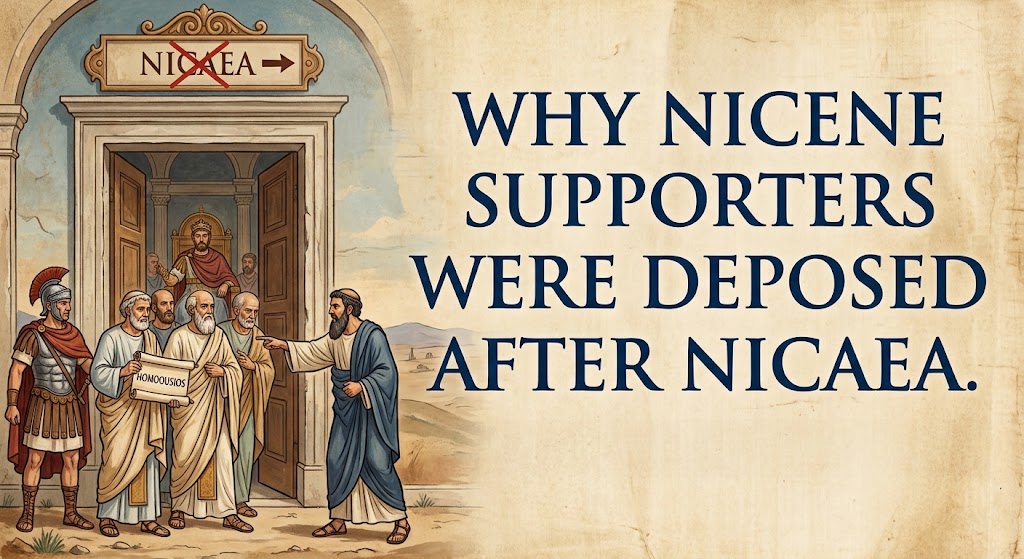
Abstract: In the decade following the Council of Nicaea (325), the political and theological landscape of the early Church underwent a dramatic reversal: exiled Arians were reinstated while leading supporters of the Nicene Creed were deposed or exiled. This post-Nicene fallout was not driven by an “Arian conspiracy,” but by an intense conflict between Eusebians and Sabellians.
At Nicaea, an anti-Arian alliance allowed Sabellian theologians to influence key Creed formulations—most notably the controversial term homoousios. When Sabellian leaders subsequently claimed that the Council had officially endorsed their single-hypostasis theology, Eusebian bishops resisted what they viewed as a dangerous heresy threatening the distinct personality of the Son. Backed by Emperor Constantine, the Eusebians successfully removed key Sabellian figures like Eustathius of Antioch and Marcellus of Ancyra, causing homoousios to virtually disappear from theological discourse for over two decades.
Introduction
Purpose of this article
After the Council of Nicaea, Arius and several other so-called “Arians” were deposed. Yet within the following decade, all the exiled Arians were permitted to return, while the leading supporters of the Nicene Creed were exiled. During the same period, the term homoousios disappeared from the controversy. This article examines how and why this reversal occurred.
Scholars Quoted
This article is based on the writings of leading patristic scholars of the last 50 years, particularly:
Hanson, R.P.C.: The Search for the Christian Doctrine of God – The Arian Controversy 318-381, 1987
Williams, Rowan: Arius: Heresy and Tradition, 2002/1987
Ayres, Lewis: Nicaea and its legacy, 2004
Pre-Nicene
Controversy Continued
For the purposes of this article, it is important to recognize that the fourth-century controversy was not entirely new. Rather, it continued and intensified theological disputes that had already emerged in the third century:
“This controversy is a complex affair in which tensions between pre-existing theological traditions intensified as a result of dispute over Arius, and over events following the Council of Nicaea” (Ayres, pp. 11-12).
For that reason, the story of the post-Nicene reversal therefore begins in the third century.
The Core Issue in the Controversy
As discussed in a previous article, the central issue was whether the preincarnate Son is a distinct divine Being. Arians maintained that the Son is a second divine Being, distinct from and subordinate to the Father, whereas the Nicenes held that the Father and Son are one Being. In fourth-century Greek terminology, Arians spoke of the Father and Son as two hypostases, while the original Nicenes spoke of one hypostasis:
“The way of using the word hypostasis characterized the two opposing parties for much of the fourth century; one preferred to speak of one hypostasis in God, the other of two (or three, if the Holy Spirit is considered)” (Lienhard).
Arius had a “strong commitment to belief in three distinct divine hypostases” (Williams, p. 97).
The “clear inference from his (Athanasius’) usage” is that “there is only one hypostasis in God” (Ayres, p. 48).
The Controversy in the Third Century
In the third century, the controversy centered largely on the contrasting views associated with Origen and Sabellius:
-
- Origen proclaimed three hypostases, meaning that the Father, Son, and Spirit are three distinct Beings (three minds).
- Sabellius taught one hypostasis. He taught that the Father, Son, and Spirit are three modes or forms of one Being.
During that century, the Church formally rejected Sabellianism. Sabellius was deposed in 220, and Paul of Samosata, whom modern scholarship associates with a similar theology, was deposed by a council at Antioch in 268. Antioch was probably one of the principal Christian centers of the period. [Show More]
Origen, by contrast, was the most influential theological writer of the third century. Eusebius of Caesarea, for example, was “the most learned and one of the best-known of the 300-odd bishops present” at the Council of Nicaea (Hanson, p. 159) and “a dedicated admirer and supporter of Origen” (Hanson, p. 46). Moreover, “the great majority of the Eastern clergy [at the Council of Nicaea in 325] were ultimately disciples of Origen” (Frend, The Rise of Christianity).
Nicene Council
The Parties at the Nicene Council
Fourth-century Sabellian and Nicene theologies were not identical. Both regarded the Father and Son as one Being, but the original Nicenes described the Son as intrinsic to the Father—namely, as the Father’s own eternal Wisdom—whereas the Sabellians identified the Son with God’s internal Word. Nevertheless, because both groups understood the Father and Son as one Being, they opposed the Arians, who maintained that the Godhead consists of three hypostases. Following Origen, the Arians taught that the preincarnate Son is a second divine Being, distinct from and subordinate to the Father. At the Council of Nicaea in 325, the Nicenes and Sabellians therefore formed an alliance against the Arians:
“Marcellus, Eustathius and Alexander were able to make common cause against the Eusebians” (Ayres, p. 69).
“Eustathius and Marcellus … certainly met at Nicaea and no doubt were there able to join forces with Alexander of Alexandria and Ossius” (Hanson, p. 234).
“Simonetti estimates the Nicene Council as a temporary alliance for the defeat of Arianism between the tradition of Alexandria led by Alexander and ‘Asiatic’ circles (i.e., Eustathius, Marcellus) whose thought was at the opposite pole to that of Arius. … Alexander … accepted virtual Sabellianism in order to ensure the defeat of Arianism” (Manlio Simonetti, La Crisi Ariana nel IV secolo (1975)) (Hanson, p. 171).
Sabellians Influential at the Council
Emperor Constantine took the part of the Nicene/Sabellian alliance:
“(Emperor) Constantine had taken Alexander’s part” (Ayres, p. 89).
“This imperial pressure coupled with the role of his advisers in broadly supporting the agenda of Alexander must have been a powerful force” (Ayres, p. 89).
As a result, the Sabellian party exercised significant influence on the Creed’s formulation. In particular, the emperor pressed for the inclusion of the term homoousios after observing that the Eustathian party favored it:
“Once he (Constantine) discovered that the Eustathians (Eustathius was the leader of the Sabellians at Nicaea) … were in favour of it (homoousios) … he pressed for its inclusion” (Hanson, p. 211).
“Marcellus of Ancyra … had been an important figure at the council and may have significantly influenced its wording” (Ayres, p. 431). See here for a further discussion.
Consequently, the Nicene Creed seems Sabellian:
“If we are to take the creed N at its face value, the theology of Eustathius and Marcellus [the two leading Sabellians at Nicaea] was the theology which triumphed at Nicaea. That creed admits the possibility of only one ousia and one hypostasis. This was the hallmark of the theology of these two men” (Hanson, p. 235).
On the other hand, scholars also say that the Nicene Creed is more like a drawn battle between Sabellianism and Arianism:
“It is going too far to say that N is a clearly Sabellian document. … It is exceeding the evidence to represent the Council as a total victory for the anti-Origenist opponents of the doctrine of three hypostases. It was more like a drawn battle” (Hanson, p. 172).
The Emperor Exiled the Arians.
At the end of the Council, Emperor Constantine exiled Arius and two Libyan bishops who supported him. A year or two later, he also exiled Eusebius of Nicomedia, one of the main Arian leaders.
Situation Reversed after Nicaea
During the decade following the Council of Nicaea in 325, however, this situation was reversed:
All exiled Arians were allowed to return and were reinstated:
“Arius and most of his supporters were, at Constantine’s request, readmitted to communion within two or three years of the council” (Ayres, p. 100).
Eusebius of Nicomedia later baptized Emperor Constantine on his deathbed in 337, indicating how fully he had been restored to imperial favor:
“Eusebius of Nicomedia quickly rose again to a position of importance, baptizing Constantine on his death-bed in 337 and becoming bishop of Constantinople” (Ayres, p. 100).
Meanwhile, the leading supporters of the Nicene Creed were removed from influence. Alexander, the principal Nicene leader at the council, died in 328. Within ten years of Nicaea, the other prominent supporters of the Creed had been deposed, disgraced, or exiled:
“Within ten years of the Council of Nicaea all the leading supporters of the creed of that Council had been deposed or disgraced or exiled – Athanasius, Eustathius and Marcellus, and with them a large number of other bishops who are presumed to have belonged to the same school of thought.” Hanson provides a list of such people (Hanson, p. 274).
Both the two leading Sabellians at Nicaea, Eustathius and Marcellus, were deposed in this decade. Both of them played a major role at Nicaea and were strong supporters of the Nicene Creed. [Show More]
Homoousios disappeared for 30 years.
After the Sabellians were removed from their positions, the term homoousios was not mentioned for more than 20 years. It was brought back into the controversy only in the mid-350s:
“For 30 or more years after 325, the Council of Nicaea is hardly mentioned and the word homoousion rarely used” (Lienhard, p. 416). [Show More]
(See here for details.)
Cause of this Reversal
So, what caused this conflict in the decade after Nicaea?
Was there an Arian Conspiracy?
According to the traditional account, the reversal resulted from political maneuvering by an Arian conspiracy:
“The usual explanation (of the resistance to the Nicene Creed after Nicaea) … describes the favourers of Arianism as setting themselves with deliberate craft and malignant intrigue to depose and replace every and any bishop who was known to be particularly favourable to N” (Hanson, p. 274).
However, Hanson argues that the evidence does not support the existence of a coordinated conspiracy. After reviewing several cases, he concludes that the sources do not reveal “a systematic campaign by the Eusebian party against known opponents of Arianism.” Rather, “a number of bishops were deposed between 328 and 336 for various reasons” (Hanson, p. 279). [Show More]
Did Arius’ theology cause the conflict?
This reversal did not represent a return to Arius’s own theology. His particular views played little part in the major debates after Nicaea, and the anti-Nicene bishops did not simply adopt his theological system.
“Arius’ own theology is of little importance in understanding the major debates of the rest of the century” (Ayres, p. 56-57).
“Arius evidently made converts to his views … but he left no school of disciples” (Williams, p. 233). See here for a further discussion.
For example, the ‘Arian’ Dedication Creed of 341 explicitly condemns aspects of Arius’ theology. The focus of the dispute after Nicaea was elsewhere. [Show More]
Was Athanasius involved in this dispute?
Athanasius was also exiled during the decade after Nicaea, in 335. Yet his exile cannot be explained simply as punishment for anti-Arianism. Contrary to later portrayals, he was not a leading figure at the Council of Nicaea, and his vigorous defense of the Nicene Creed developed only after his first exile:
“He could not possibly have been, as he was later erroneously represented to have been, a leading figure at the Council of Nicaea” (Hanson, p. 275).
“There was … no reason to regard Athanasius as a zealous supporter of the doctrine of Nicaea until at earliest his second exile (339-346)” (Hanson, p. 275).
He had no love for the Arians but “he was not until much later in his career an obvious target for those who were anxious either to limit or to undo the achievement of the Council of Nicaea” (Hanson, p. 275).
Athanasius was deposed, not for his theology, but for violence against Melitians in his see:
“He was finally deposed at Tyre for reasons which had nothing to do with Arianism, nor with any doctrinal issue, but for misbehaviour in his see, disgraceful and undeniable, and that against Melitians rather than Arians” (Hanson, p. 275). See here for a discussion.
The conflict was about Homoousios.
If the conflict of the decade after Nicaea was not primarily about Arius’s theology, was not driven by a coordinated Arian conspiracy, and did not initially center on Alexander or Athanasius, what caused it? Because the conflict led especially to the removal of prominent figures accused of Sabellianism, the evidence suggests that opposition to their theology was a central factor:
The theology of “Marcellus and Eustathius” “was able to provoke a strong and sustained reaction from the Eusebians, and one that seems to have gained wide support throughout the east” (Ayres, p. 102).
Because of the term homoousios and the implication in one of the anathemas of teaching one hypostasis, the Nicene Creed was open to a Sabellian interpretation. After Nicaea, the Sabellians claimed that the Nicene Council had formally adopted Sabellianism as the Church’s official religion:
“Marcellus and Eustathius presented their theologies as the natural context for Nicaea’s creed” (Ayres, p. 105).
“In the controversies which erupted over Eustathius of Antioch and Marcellus after Nicaea, both thought their theologies faithful to Nicaea—and they had good grounds for so assuming. Both were influential at the council, and Nicaea’s lapidary formulations were never intended to rule out their theological idiosyncrasies” (Ayres, p. 99).
The core of the dispute after Nicaea was the term homoousios:
“The fifth-century ecclesiastical historian Sozomen reports a dispute immediately after the council, focused not on Arius, but … concerning the precise meaning of the term homoousios ” (Ayres, p. 101).
Before Nicaea, homoousios was strongly associated with Sabellianism. Eustathius’ claim that the Council had formally adopted Sabellianism was largely based on this term. Eusebius, leading the opposing side, responded that the Council had accepted the term, not literally meaning ‘one substance,’ as in the Sabellian view, but figuratively meaning that the Son is like the Father:
“Some thought this term … implied the non-existence of the Son of God; and that it involved the error of Montanus and Sabellius. … Eustathius accused Eusebius [of Caesarea] of altering the doctrines ratified by the council of Nicaea, while the latter declared that he approved of all the Nicaean doctrines, and reproached Eustathius for cleaving to the heresy of Sabellius” (Ayres, p. 101, continuing the quote from Sozomen).
“This event was only one part of the conflict that now began” (Ayres, p. 101). It occurred “probably in 326 or 327” (Ayres, p. 101).
See here for a discussion of Eusebius’ understanding of the term and here for the different ways in which the term was understood at Nicaea.
The Eusebians therefore opposed the claim that the Creed confirmed Sabellianism. Marcellus and Eustathius—both strong supporters of homoousios at Nicaea—were deposed on charges associated with Sabellian theology. The Eusebians feared that, if the Nicene Creed were pressed to what they regarded as its logical conclusion, it would undermine the real distinction between the Father and the Son. They therefore considered it necessary to challenge the orthodoxy and limit the influence of Eustathius and Marcellus. [Show More]
Since the church had already formally rejected Sabellianism during the previous century, the Eusebians, in targeting these Sabellians, were resisting a known error:
“They would have said that they were not conducting a persecution in the interests of Arianism but trying to restore proper balance to the Church’s understanding of its doctrine of God” (Hanson, p. 276).
Conclusions
The Emperor switched Sides
In the traditional account, the Eusebian victory resulted from political maneuvering by an “Arian conspiracy.” In the Christian Roman Empire, however, the emperor exercised decisive authority in doctrinal disputes.
“If we ask the question, what was considered to constitute the ultimate authority in doctrine during the period reviewed in these pages, there can be only one answer. The will of the Emperor was the final authority” (Hanson, p. 849).
“The truth is that in the Christian church of the fourth century there was no alternative authority comparable to that of the Emperor. The century did indeed see an increase in the power of the bishop of Rome, but he still could not be regarded as a figure even remotely as powerful as that of the Emperor” (Hanson, p. 854).
Therefore, the Eusebian victory would not have been possible without the support of the emperor. Constantine’s decision to receive baptism from Eusebius of Nicomedia at the end of his life demonstrates Eusebius’s restored standing and suggests a significant shift in the emperor’s sympathies. This article therefore proposes that the Eusebian party prevailed in the decade after Nicaea because Constantine permitted it to remove the Creed’s principal supporters from positions of influence.
The main enemy was Sabellianism.
A further conclusion is that the principal conflict in the decade after Nicaea was between the Eusebians and theologians accused of Sabellianism, rather than simply between “Arians” and Nicenes. From the Eusebian perspective, Sabellianism remained the chief danger, and Nicene theology could appear to be a variation of it. The fundamental issue was whether the Father and Son should be understood as one divine Being—or one divine mind—or as distinct hypostases. For example:
“The leadership of this alliance (the Homoians, the largest Arian faction) was always diverse. … It included bishops of different stripes united by the desire to find a solution to the ongoing controversy that would rule out any theologies seemingly tainted with Marcellan emphases” (Ayres, p. 138).
Referring to the Eastern (Arian) Dedication Council of 431, “their main theological opponent was Marcellus, whose doctrine they countered by insisting that Father, Son, and Spirit are three hypostaseis” (Anatolios, p. 24).
Other Articles
Other articles in this series
• Articles on the Trinity doctrine
• Arian Controversy
• Pre-Nicene Fathers
• Arius, Controversy begins
• Nicene Council (AD 325)
• Arianism – What is it?
• Nicenes and Nicene Theology
• End of the Controversy
• Development in Later Centuries
Other Core Articles
• The Mark of the Beast
• All articles on this Site
• Daniel’s Little Horn Identified
• Daniel 9 – Verse-by-Verse
• Daniel 9 – Four Alternative Interpretations
• The Dragon of Revelation 13
• The Beast of Revelation
• The Trinity Doctrine
• The Origin of the Trinity Doctrine
• The Sabbath and the Arian Controversy
• Christ’s Return
Other Article Series
• The Antichrist in Daniel
• The 490 years of Daniel 9
• Book of Revelation
• Christology – Who is Jesus?
• Why does evil exist?
• Death, Eternal Life, and Eternal Torment
For general theology, I recommend Graham Maxwell.