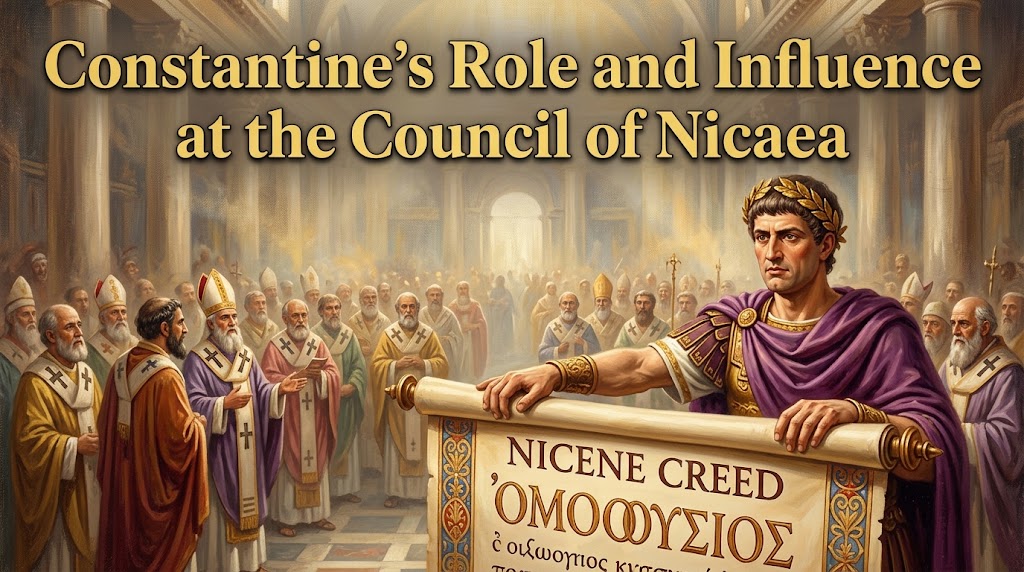
Abstract: This article examines Emperor Constantine’s decisive role in shaping the theological outcomes of the Council of Nicaea (325 AD). Drawing on modern Patristic scholarship—including the work of R.P.C. Hanson, Lewis Ayres, and Rowan Williams—it challenges traditional narratives that present Nicaea as a purely ecclesiastical assembly. Instead, the analysis demonstrates how Constantine convened the council on his own authority, appointed his advisor Ossius of Cordoba to preside, actively guided the proceedings, personally championed and enforced the inclusion of the controversial term homoousios, and exiled non-signers. His purpose was not to determine true doctrine, but to preserve imperial unity against division. Consequently, he effectively served as the head of the church.
Introduction
Modern Scholars Interpret the Controversy Differently
 Following the fourth-century Arian Controversy, the Church adopted the doctrine of the Trinity. Over the past century, however, scholars have increasingly recognized that the traditional account of the Controversy is largely history written by the victors. Drawing on ancient documents that have since become available and on extensive subsequent research, modern scholars now offer a substantially different understanding of the Controversy:
“The four decades since 1960 have produced much revisionary scholarship on the Trinitarian and Christological disputes of the fourth century” (Ayres, p. 11).
“The diatribes of Gwatkin and of Harnack (published around the year 1900) can today be completely ignored” (Hanson, p. 95).
The Traditional Account as a Distortion
R.P.C. Hanson, widely regarded as one of the foremost modern scholars of the fourth-century Arian Controversy, described the traditional account as a complete travesty. For example:
- According to the traditional account, the doctrine of the Trinity was already the established orthodoxy when the Controversy began. In fact, the traditional view at the outset was that the Son was a second divine Being subordinate to the Father (see here).
- According to the traditional account, Arius caused the Controversy by introducing a novel heresy. In fact, the dispute continued earlier third-century controversies, and Arius himself was a conservative (see here).
- According to the traditional account, after decades of controversy, the Church finally adopted Nicene theology at the Council of Constantinople in 381. Yet in the preceding year, 380, the Empire had already made Nicene theology the only legal religion, and the emperor, who convened the council, invited only Nicenes (see here).
- According to the traditional account, the Arians followed Arius. In fact, most were not even aware of him. The claim that they were followers of Arius was a Nicene polemical strategy rather than an accurate historical description (see here).
- According to the traditional account, the Arians taught that the Son was a created being. Arius may have held this view, but he was an outlier. Eusebius of Caesarea, the principal leader of those labeled “Arians,” maintained that the Son was begotten from the Father’s own being (see here).
- According to the traditional account, Arianism is defined by the belief that the Son is subordinate to the Father. Yet theologians throughout the first three centuries—and even Nicene theologians until about the 360s—described the Son as subordinate (see here).
- According to the traditional account, the councils of 325 and 381 were ecumenical. In fact, the Council of Nicaea in 325 was almost entirely Eastern, while the Council of Constantinople in 381 was wholly Eastern. Moreover, only Romans were invited; the Goths and other Germanic peoples who would rule the Western Empire in the following century were excluded (see here).
- According to the traditional account, at the councils of 325 and 381 the Church formally embraced the orthodox position. In fact, Church and State were united under the emperor. The emperors convened these councils to determine the Empire’s religious policy and retained the final authority.
See here for a further discussion of the errors in the traditional account.
Patristic Scholarship Cited
This article series therefore relies primarily on the work of patristic scholars published during the past 50 years and reflects this revised interpretation. Although most quotations are hidden in ‘show more’ blocks, they remain essential because of the highly controversial nature of the subject. The series draws especially on the following books:
R.P.C. Hanson
The Search for the Christian Doctrine of God: The Arian Controversy, 318–381, 1987
Lewis Ayres
Nicaea and Its Legacy: An Approach to Fourth-Century Trinitarian Theology, 2004
Rowan Williams
Arius: Heresy and Tradition, 2002 (originally published 1987)
Khaled Anatolios
Retrieving Nicaea, 2011
Purpose of This Article
The articles in this series examine various errors in the traditional narrative. This article focuses on Emperor Constantine’s influence over the Council of Nicaea and the Nicene Creed. It argues that the so-called first ecumenical council, held at Nicaea in 325, was in practice an imperial assembly: Constantine convened and directed it in pursuit of his own objectives.
Summary
 Christianity Legalized – Religious freedom did not exist in the Roman Empire; emperors determined which religions were permitted. After three centuries of persecution by Roman authorities, Emperor Constantine legalized Christianity in 313.
Constantine’s Letter to Alexander and Arius – Before Constantine fully understood the dispute, he wrote to Alexander and Arius and ordered them to end their quarrel. His intervention was therefore motivated not primarily by concern for doctrinal truth, but by the threat that church division posed to imperial unity.
The Council of Antioch – A few months before the Council of Nicaea, an anti-Arian council met at Antioch. Most of its participants sympathized with Alexander. The council provisionally excommunicated Eusebius of Caesarea, one of Arius’s principal supporters and the most respected theologian of the period. Constantine approved the gathering, and his religious adviser, Ossius, presided over it. Thus, even before Nicaea, Constantine had aligned himself with Alexander.
Constantine Convenes the Council – Constantine convened the Council of Nicaea on his own initiative; the Church did not ask him to do so. It was therefore an imperial assembly called for Empire’s purposes. Having conquered the Eastern Empire the previous year, Constantine also sought to bring order to the Eastern Church.
The emperor’s meeting – These councils were not purely ecclesiastical. The emperor was the principal imperial authority behind them. These were meetings of the Empire, to serve the Empire’s goals, and the emperor was expected to dominate and control them
Appointed his agent to preside – To keep the Council of Nicaea under imperial control, Constantine appointed his religious adviser, Ossius, to preside. Ossius thus acted as the emperor’s agent.
Imperial Support for Alexander – Arius is often, and correctly, said to have enjoyed substantial support. Why, then, did only two of approximately 250–300 bishops reject the deliberately anti-Arian Nicene Creed? Alexander prevailed at Nicaea because the emperor supported his position.
The Imposition of Homoousios – At the time, many regarded the term homoousios as particularly objectionable. It was neither a biblical term nor part of standard Christian vocabulary; it had been borrowed from pagan philosophy and was associated with Sabellianism. Constantine’s dominance at Nicaea is therefore especially evident in his ability to secure its inclusion: he personally proposed, explained, and insisted on the term.
 Exile Those Who Refused to Sign – The bishops knew that refusal to accept the Creed could result in exile to another part of the Empire. This raises an important question: how many bishops might have opposed the Nicene Creed had exile not been a threat?
Enforcement of the Council’s Decisions – After Nicaea, Constantine issued several letters enforcing the Council’s decisions.
Protecting the Unity of the Empire – Constantine did not convene the Council of Nicaea primarily out of concern for doctrinal correctness, but because division within the Church threatened the unity of the Empire. His ultimate objective was political stability. He therefore introduced and convened the general council as a means of governing the Church in the interests of the Empire.
Conclusion: Imperial Authority over the Church – In practice, the emperor functioned as the head of the Church. R.P.C. Hanson perhaps best summarises Constantine’s role at Nicaea:
“Constantine took part in the Council of Nicaea and ensured that it reached the kind of conclusion which he thought best” (Hanson, p. 850).
– END OF SUMMARY –
Constantine’s Role
Legalized Christianity
Religious freedom did not exist in the Roman Empire; emperors determined which religions were permitted. Christians endured periods of persecution for nearly three centuries, culminating in the Diocletianic Persecution of 303–313, the most severe campaign against Christians up to that time. Churches and sacred sites were demolished, religious writings and objects were burned, and believers were imprisoned.
In 313, however, the Western Roman emperor Constantine (306–337) legalized Christianity through the Edict of Milan, granting Christians “the right of open and free observance of their worship.” [Ehler & Morrall (1967). Church and State Through the Centuries, pp. 6–7.]
Intervened before he understood the Issues
A few years later, a dispute arose in Alexandria, Egypt, between Arius (c. 250–336), a presbyter or priest, and his bishop, Alexander, concerning the nature of Christ. This conflict arose centuries before the rise of Islam, when Alexandria was one of Christianity’s leading intellectual centers.
Alexander removed Arius from office, and a synod at Alexandria condemned Arius in 321. The controversy nevertheless continued, prompting Constantine to intervene. Before the Council of Nicaea—and before he fully understood the theological issues—Constantine wrote to Alexander and Arius, dismissing the dispute as trivial and ordering them to reconcile:
“In 324 the Emperor Constantine … (who recently) assumed control of the whole empire, took an interest in the dispute. Constantine wrote to Alexander and Arius telling them to stop quarrelling about what seemed to him to be such a small matter” (Ayres, p. 17-18).
Constantine wrote: “For as long as you continue to contend about these small and very insignificant questions, I believe it indeed to be not merely unbecoming, but positively evil, that so large a portion of God’s people which belong to your jurisdiction should be thus divided.”
(Davis, Leo Donald. The First Seven Ecumenical Councils (325-787): Their History and Theology. Vol. 21. Collegeville, Minn: Liturgical Press, 1990. 55)
Constantine’s intervention before he understood the dispute suggests that his immediate concern was not doctrinal precision but the threat that church division posed to imperial unity.
“Since Constantine desired that the church should contribute to the social and moral strength of the empire, religious dissension was a menace to the public welfare, and if necessary, secular authority might be exercised for its suppression” (Boyd, The Ecclesiastical Edicts of the Theodosian Code, p. 34).
Approved the Council of Antioch
A few months before the Council of Nicaea, an anti-Arian council met at Antioch. Most participants sympathized with Alexander (Hanson, pp. 130–131, 147, 149). The council drafted a statement of faith that supported Alexander’s position:
“That this Statement is anti-Arian is overwhelmingly clear. But it is equally clear that it represents the theology of Alexander of Alexandria” (Hanson, p. 150).
Eusebius of Caesarea was one of Arius’s principal supporters and one of the most respected theologians of the period. He had previously “acquitted the accused Arians [including Arius] of heresy” and “wrote to Alexander protesting at the way in which Arius had been treated” (Hanson, pp. 130, 135). At Antioch, however, Alexander’s supporters responded by provisionally excommunicating the leader of the Eusebian party (Hanson, p. 146).
Eusebius was not a disciple of Arius. Rather, he supported Arius because he “thought the theology of Alexander a greater menace than that of Arius” (Williams, p. 173).
Because Constantine’s religious adviser, Ossius, presided over the meeting as the emperor’s representative, it is reasonable to conclude that Constantine approved its proceedings. Even before Nicaea, therefore, Constantine appears to have aligned himself with Alexander in the dispute with Arius. [Show More]
Significantly, the statement of faith did not use the term homoousios or refer to the ousia of God (Hanson, p. 146). This suggests that Alexander did not yet regard such terminology as essential.
Convened the Council of Nicaea
Constantine’s letter failed to reconcile the opposing factions. He therefore convened the Council of Nicaea on his own initiative. No church official had asked him to do so; the council was summoned under his imperial authority and served his aims:
“Constantine himself summoned the bishops” (Ayres, p. 18).
“It was then certainly Constantine who convoked the Council of Nicaea” (Hanson, p. 153-4).
“Religious partisanship has in the past led some scholars to suggest that Silvester, bishop of Rome, convoked the Council of Nicaea, but modern Roman Catholic scholars honourably dismiss this idea” (Hanson, p. 154).
It was the emperor’s meeting.
Constantine also established the precedent for an empire-wide or general church council, modeled on methods of Roman governance:
“The general council was the very invention and creation of the Emperor. General councils, or councils aspiring to be general, were the children of imperial policy and the Emperor was expected to dominate and control them” (Hanson, p. 855).
“The procedures of a council modelled on methods of Roman governance would have been familiar to Constantine, and we can assume that he saw it as the natural means to achieve consensus within the Church” (Ayres, p. 87).
Before Nicaea, the church had never held a “general” or “ecumenical” council, representing the whole Christian world.
“By the time Nicaea met Church leaders … had no precedent for the idea of a council that would legislate for the Church as a whole” (Ayres, p. 87).
Nicaea “was the first time that any attempt had been made to summon a general council of the whole church at which, at least in theory, the church in every part of the Roman Empire should be represented” (Hanson, p. 152).
The church also lacked the practical authority and administrative reach to convene such a gathering. Only the emperor could summon representatives from across the empire.
“Even Damasus [a later bishop of Rome] would have admitted that he could not call a general council on his own authority” (Hanson, p. 855).
“Everybody recognised the right of an Emperor to call a council, or even to veto or quash its being called” (Hanson, p. 849-50).
These councils were therefore not purely ecclesiastical. The emperor was the principal imperial authority behind them. These were meetings of the Empire, to serve the Empire’s goals, and the emperor was expected to dominate and control them:
“Before Constantine, the Church was simply not in a position to make universally binding and enforceable decisions. From Nicaea onwards the Church decided, and communicated its decisions, through the official network of the empire” (Williams, 90).
“The Emperor was expected to dominate and control them” (Hanson, p. 855).
Appointed his agent as Presiding Officer
Ossius of Cordova probably presided over the council:
“The evidence weighs strongly in favour of the view that Ossius … presided at Nicaea” (Hanson, p. 154).
“Ossius of Cordoba probably chaired the meeting” (Ayres, p. 89).
As bishop of the relatively “obscure” see of Cordova (Hanson, p. 155), his ecclesiastical rank alone would not normally have entitled him to do so. He was, however, Constantine’s religious adviser and representative. His position at the council therefore helped ensure that the proceedings remained aligned with imperial policy.
“Ossius the bishop of Cordoba in Spain … apparently acted in some sort of advisory capacity to Constantine, and perhaps also served as his representative in these events” (Ayres, p. 18).
A similar pattern appeared at the Council of Constantinople in 381, when Emperor Theodosius appointed Nectarius—an unbaptized civil servant—as bishop of Constantinople and presiding figure at the council. Imperial involvement in selecting presiding officers was one means by which emperors influenced conciliar proceedings and outcomes. [Show More]
Supported the Nicene side
Arius is often said—correctly—to have enjoyed substantial support. Why, then, was the Nicene Creed, deliberately framed as an anti-Arian statement, accepted by all but two of the approximately 250–300 bishops present? [Show More]
According to the traditional account, Arius was readily rejected because his teaching opposed the church’s established orthodoxy:
“In older narratives of the fourth century it was reasonably easy to understand why the Nicene creed was agreed with little dissent: only the few ‘heretics’ would refuse such a clear acknowledgement of the Church’s constant faith. Without this older narrative, matters are more complex” (Ayres, p. 88).
The historical situation, however, was that the dispute between Alexander and Arius continued theological tensions that had already divided Christians in the third century:
“We will find pre-existing deep theological tensions at the beginning of the fourth century. Controversy over Arius was the spark that ignited a fire waiting to happen, and the origins of the dispute do not lie simply in the beliefs of one thinker, but in existing tensions that formed his background” (Ayres, p. 20).
A central issue in both centuries was whether the Son should be understood as a distinct person or existence. The term hypostasis was commonly used to express such distinct existence:
“The way of using the word hypostasis characterized the two opposing parties for much of the fourth century; one preferred to speak of one hypostasis in God, the other of two (or three, if the Holy Spirit is considered)” (Lienhard).
Arius presented himself as a theological conservative. He represented the widespread view that the Son is a distinct hypostasis. In his view, the Father, Son, and Spirit are three hypostases (three distinct Existences or Persons). This was also the view of Origen, the great Alexandrian theologian of the previous century, and of the Church majority. At the same time, Arius also advanced more extreme claims that attracted only a limited number of committed followers.
“Arius was a committed theological conservative; more specifically, a conservative Alexandrian” (Williams, 175).
Arius had a “strong commitment to belief in three distinct divine hypostases” (Williams, p. 97).
Alexander, on the other hand, like the Sabellians, believed that the Son is not a distinct Person, but that the Father and Son are a single person or hypostasis. This position was already rejected in the third century.
“The fragments of Eustathius that survive present a doctrine that is close to Marcellus, and to Alexander and Athanasius. Eustathius insists there is only one hypostasis” (Ayres, p. 69). [Eustathius and Marcellus were the leading Sabellians at Nicaea.]
This helps explain why many bishops initially supported Arius. Their support did not necessarily imply agreement with his more extreme claims; it often reflected opposition to Alexander’s theology.
On this interpretation, Arius was rejected so decisively because Constantine supported the Nicene side and exerted pressure on the council to accept a clearly anti-Arius creed. Without the backing of the emperor, the council might have judged Alexander’s theology more severely than Arius’s:
“Tension among Eusebian bishops was caused by knowledge that Constantine had taken Alexander’s part and by events at the council of Antioch only a few months before” (Ayres, p. 89).
“This imperial pressure coupled with the role of his advisers in broadly supporting the agenda of Alexander must have been a powerful force” (Ayres, p. 89).
Enforced the term Homoousios
In the traditional account of the Controversy, homoousios was a traditional term, and its adoption at Nicaea was a great victory for the traditional view. However, such older accounts are deeply mistaken:
In the “centuries-old account of the Council of Nicaea: … The whole power of the mysterious dogma is at once established by the one word homoousios … with one pronouncement the Church identified a term (homoousios) that secured its … beliefs against heresy.” But “such older accounts are deeply mistaken” (Ayres, 11).
Many delegates had serious reservations about the term homoousios (same substance). It is not a Biblical term, was not part of the standard Christian language, but was borrowed from pagan philosophy and was associated with Sabellianism (see here).
“To say that the Son was ‘of the substance’ of the Father, and that he was ‘consubstantial’ with him were certainly startling innovations. Nothing comparable to this had been said in any creed or profession of faith before” (Hanson, p. 166-7).
“Neither before nor during Constantine’s time is there any evidence of a normal, well-established Christian use of the term homoousios in its strictly Trinitarian meaning,” i.e., to describe the relation of the Son to the Father (Beatrice).
Therefore, Constantine’s domination of the Nicene Council is particularly illustrated by his success in persuading the council to accept such a disputed term. He personally proposed, explained, and enforced the term.
“’Homoousios’ and ‘from the essence of the Father’ were added to the creed by Constantine himself, bearing witness to the extent of his influence at the council” (Jörg Ulrich. Nicaea and the West. Vigiliae Christianae 51, no. 1 (1997): 10-24. 15.)
Explained — Constantine’s influence is also evident in the council’s willingness to let him explain the meaning of the term and to accept his interpretation. One major concern was that homoousios might imply that God has a body or that the Son was begotten through a material process. Constantine insisted that the term carried no such material connotations.
“Eusebius directly ascribes to Constantine only an emphasis on understanding homoousios without reference to material division or the sorts of change associated with corporeal existence” (Ayres, p. 96).
Enforced — Constantine not only proposed the term but also used his influence to secure its inclusion. He “pressed for its inclusion” (Hanson, p. 211).
“Eusebius, in his Letter to his Diocese written in 326, writes that Constantine himself spoke, endorsing the term homoousios” (Ayres, p. 90).
Exiled those who Refused to Sign
Emperor Constantine exiled Arius and two Libyan bishops. A year or two later, he also exiled Eusebius of Nicomedia:
“Two bishops who refused to sign the Creed … were deposed by the Council and exiled by the Emperor. Arius himself was exiled” (Hanson, p. 162-3).
“Constantine exiled Arius along with two Libyan bishops … The Emperor also exiled Eusebius of Nicomedia” (Ayres, p. 19).
The fact that only two bishops refused to accept the Nicene Creed is often presented as a decisive victory for Nicene Christology. Less often noted is that the bishops knew that refusal to accept the Creed could cost them their offices and result in exile. This raises an important question: how many bishops might have voted against the creed if exile had not been a possibility and if Constantine had not used his authority and personal influence to secure unanimity?
In the fourth-century Roman Empire, exile was a standard penalty for bishops judged to hold unacceptable teachings, but only the emperor had the authority to impose it. Therefore, only the emperor could authorize his restoration to office.
The two bishops whom Constantine exiled after Nicaea “were both restored to their sees by Constantine” (Hanson, p. 172)
The bishops therefore appealed to Constantine—not merely to church authorities—for reinstatement. For example:
“The third letter of Arius is … sent to the Emperor Constantine by Arius and Euzoius who are in exile and are in this letter pleading for a return from exile and a re-admission to the Church (which they presumably imagine that Constantine can effect)” (Hanson, p. 8).
In a letter, “Eusebius of Nicomedia and Theognis of Nicaea” asked “some unnamed bishops … to petition Constantine for their recall” (Hanson, p. 175).
In this respect, the emperor’s authority to exile and restore bishops allowed him to function in practice as the effective head of the imperial church. Church and State were united under a single person.
“Constantine in other respects behaved despotically towards the church when he thought it necessary. He writes to the churches after Nicaea like a mediaeval Pope” (Hanson, p. 850).
Enforced the Council’s Decisions
After Nicaea, “Constantine … issued a number of letters attempting to enforce its decisions” (Ayres, p. 88).
Constantine’s Purpose
To Reconcile the Opposing Parties
Although Constantine supported the Nicenes and insisted on the term homoousios, his broader aim was to reconcile the opposing parties.
“The Emperor, rightly or wrongly, thought himself called to foster and protect the Church, and therefore to prevent as far as he could the damage that was caused by controversy and schism” (Hanson, p. 153).
Several features of the council reveal Constantine’s desire for reconciliation. For example:
- As mentioned above, Eusebius of Caesarea “was the most learned and one of the best-known of the 300-odd bishops present” (Hanson, p. 159), but he had recently been provisionally excommunicated by the “anti-Arian Council” at Antioch (Hanson, p. 131). Hanson explains: “The excommunication of a man so universally respected for his scholarship as Eusebius of Caesarea must have given him (the emperor) a shock. He wanted to be in a position to see that the anti-Arian party at the Council did not do anything that would further exasperate the division already existing in the Church … but rather heal it” (Hanson, p. 153). Accordingly, after Eusebius read his creed, the “emperor himself was the first to witness that it was entirely orthodox” (Hanson, p. 160).
- Eustathius, the leading Sabellian at the council, reported that, after an Arian document was read, his strongly anti-Arian party was reduced to silence “using the cause of reconciliation as a pretext” (Hanson, p. 160). In other words, although Constantine sided with Alexander, he did not give Alexander’s party unrestricted control of the council.
- As mentioned, Constantine explained homoousios in a way intended to make the term acceptable even to the Eusebians (the so-called Arians).
- Eusebius of Caesarea portrayed Constantine as sincerely seeking reconciliation:
“He surrounded the Fathers (of the Council) . . . and again acted patiently as a mediator” (Hanson, p. 175).
To Protect the Empire
The Roman Empire encompassed many peoples and cultures. One of an emperor’s central responsibilities was to preserve unity. Religion could either support or undermine that goal. Religious diversity could deepen social divisions, whereas state-supported religious uniformity could strengthen imperial cohesion. Roman emperors therefore used religion as a means of maintaining unity across the empire. By maintaining influence over the church, the emperors also strengthened their influence over the empire’s population.
“Constantine’s attitude reflects deeply embedded Roman attitudes about the social function of religion” (Ayres, p. 88).
“Constantine . . . seems to have promoted Christianity as a unifying religion for the empire” (Ayres, p. 87).
“The same desire to preserve unity within the church . . . led Constantine to intercede for the settlement of the Arian controversy. . . . Believing ‘disunity in the church’ a danger to the state ‘more grievous than any kind of war’“ (Boyd, The Ecclesiastical Edicts of the Theodosian Code, p. 37).
This political use of religion helps explain both why Christians were persecuted before Christianity was legalized and why persecution resumed against dissenting Christians after Emperor Theodosius, in 380, established Nicene theology as the state religion.
Reconciliation within the church was therefore a means to a broader political end: protecting imperial unity. Constantine convened the council because he feared that conflict within the church could threaten the unity of the empire. The general council became an instrument through which the emperor could govern the church in the interests of the empire.
Conclusions
“Constantine took part in the Council of Nicaea and ensured that it reached the kind of conclusion which he thought best” (Hanson, p. 850).
In practice, the emperor functioned as the head of the church within the Roman Empire. He supported the Nicene faction, convened the council on his own initiative, located it at Nicaea, where he could participate, paid the delegates’ expenses, appointed his religious adviser to preside, welcomed and honored the bishops, opened the proceedings with an address, guided the discussions; proposed and promoted the disputed term homoousios, sought reconciliation between the factions, warned that those who rejected the creed would be exiled, exiled those who refused to sign; and enforced the council’s decisions.
“The bishops were allowed to travel by the imperial postal service … and were entertained in Nicaea at the emperor’s expense” (Williams, p. 67).
“The Emperor Constantine … had summoned the Council, had paid all its expenses” (Hanson, p. 157).
Consequently, the Nicene Creed—especially its most controversial features—may not simply reflect the majority view of the church at that time, but also reflects the outcome that Constantine considered best.
This established a pattern for the remainder of the fourth century. The church formulated and implemented its “ecumenical” decisions through the civil structures of the Roman Empire, represented above all by the emperors:
“Before Constantine, the Church was simply not in a position to make universally binding and enforceable decisions. From Nicaea onwards, the Church decided, and communicated its decisions, through the official network of the empire” (Williams, p. 90)
In this respect, church and state operated as a unified system. As Hanson notes, “Simonetti remarks that the Emperor was in fact the head of the church” (Hanson, p. 849).
Other Articles
-
-
- Other articles in this series
• Articles on the Trinity doctrine
• Arian Controversy
• Pre-Nicene Fathers
• Arius, Controversy begins
• Nicene Council (AD 325)
• Arianism – What is it?
• Nicenes and Nicene Theology
• End of the Controversy
• Development in Later CenturiesOther Core Articles
• The Mark of the Beast
• All articles on this Site
• Daniel’s Little Horn Identified
• Daniel 9 – Verse-by-Verse
• Daniel 9 – Four Alternative Interpretations
• The Dragon of Revelation 13
• The Beast of Revelation
• The Trinity Doctrine
• The Origin of the Trinity Doctrine
• The Sabbath and the Arian Controversy
• Christ’s ReturnOther Article Series
• The Antichrist in Daniel
• The 490 years of Daniel 9
• Book of Revelation
• Christology – Who is Jesus?
• Why does evil exist?
• Death, Eternal Life, and Eternal Torment
For general theology, I recommend Graham Maxwell.
- Other articles in this series
-