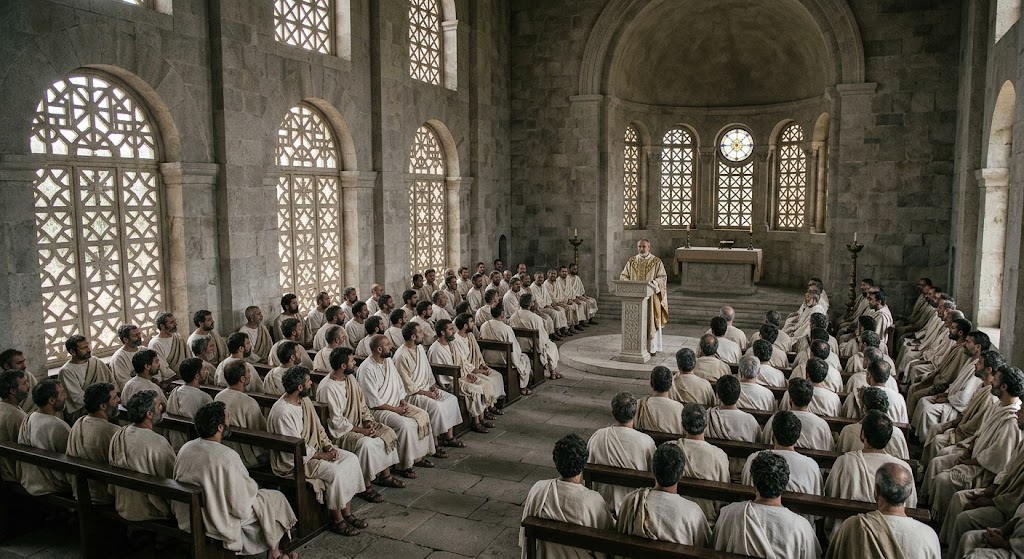
The Nicene Creed (325) describes the Son as homoousios with the Father. Why did the Dedication Council (341 ) shift to “exact image of the Father’s substance”?
Purpose of this Article
Nicene and Dedication Creeds Contrasted
In the year 325, the Nicene Council, “drawn almost entirely from the eastern half of the empire” (Ayres, p. 19), described the Son as homoousios with the Father. Homoousios literally means ‘same substance’ (homos =same, ousia = substance).
Sixteen years later, in 341, another council, known as the Dedication Council, met in Antioch in the Eastern Empire, consisting only of delegates from the Eastern Empire. In other words, the delegations to the Nicene and Dedication councils were, in many instances, the same people and shared many of the same views. [Quotes]
The Dedication Council also formulated a creed to explain how the Son relates to the Father but, instead of saying that the Son’s substance is the same as the Father’s, as in the Nicene Creed, it claimed that the Son is an “exact image of the Father’s substance.” [Quotes]
Explanation of the Difference
So, why did the Dedication Council use a different description, and how was the difference between “same substance” and “exact image of the Father’s substance” understood at the time?
The purpose of this article is to argue as follows:
(a) Different delegates to the Nicene Council interpreted the term homoousios (same substance) differently. [Quotes]
Many, particularly the Sabellians, understood ‘same substance’ as saying that the Father and Son are one single substance and Being. This is called numerical Identity and was expressed by stating that the Father and Son are ‘one hypostasis.’
But others (the Eusebians / Arians) accepted homoousios with a non-literal meaning, namely, merely as saying that the Son is ‘from the Father.’ In the Eusebian view, the Father and Son are two distinct substances (two Beings, meaning two distinct minds).
(b) “Exact image” in the Dedication Creed is the Eastern / Eusebian interpretation of homoousios:
Since an image, by definition, is distinct from its prototype, by saying that the Son is the image of the Father’s substance, the Dedication Creed interprets homoousios as saying that the Father and Son are two distinct Beings with the same type of substance. The Creed confirms this by explicitly claiming three hypostases in God.
The ‘Arians’ were ‘Eusebians.’
The anti-Nicenes of the 4th-century are traditionally called ‘Arians,’ suggesting that Arius’ theology dominated the fourth-century church. But, as discussed in another article (🔗), that seriously distorts the nature of the Controversy. Arius was not a leader, did not develop a new theology, had only a few real followers, and did not leave behind a school of followers. Rather, he was a conservative, belonging to an existing group. Ayres calls the anti-Nicenes ‘Eusebians,’ and includes Arius in the Eusebians. Therefore, this article often refers to the anti-Nicenes as ‘Eusebians.’ [Quotes]
The Nicene Council
The events leading up to 341 explain why the Easterners, at the Dedication Council, found it necessary to formulate a creed without using the term homoousios, and to describe the Son as the exact image of the Father’s substance:
Alexander was suspicious of homoousios.
Homoousios was not a term preferred by Alexander, the leader of the Nicenes at Nicaea. In his extant writings, he never used it. The Council of Antioch, a few months before the Nicene Council, formulated a pro-Alexander creed, and it did not use the term either. [Quotes]
Therefore, “Simonetti rightly notices that Alexander is chary of using the word ousia” (Hanson, p. 144). This point is important because, if Alexander did not champion the term, who did? Why was the term included in the Nicene Creed?
Eusebians opposed homoousios.
Immediately after the Nicene Council, Eusebius of Caesarea, the leader of the Eusebians, wrote to his home church to explain why and on what basis he agreed to sign the Creed. From his letter, it is clear that he accepted the term homoousios reluctantly. [Quotes]
Homoousios was suspected of being Sabellian.
The primary reason the Eastern bishops distrusted homoousios was that many associated homoousios with Sabellianism. [Quotes]
This suspicion arose from the way homoousios had been used in the third century, especially by theologians associated with Sabellian or monarchian readings of the Father-Son relationship:
Eusebius of Caesarea was a devout follower of Origen and, despite some claims to the contrary, Origen never used the term. [Quotes]
Sabellius used the term to say that the Father and Son are a single hypostasis. [Quotes]
The council that deposed Paul of Samosata in 268 also condemned the term, implying that Paul used it. Marcellus was deposed “for holding the heresy of Paul of Samosata,” implying that Paul was a Sabellian, following Sabellius. [Quotes]
Around the year 260, some Libyan Sabellians used the term. Opposing them, the bishop of Alexandria at the time denied the term. The bishop of Alexandria believed that the term implies Sabellianism, the teaching that the Father and Son are a single hypostasis.[Quotes]
It is interesting to note that, already around 260, there was a dispute about homoousios. It was between Rome and Alexandria. Rome had a Monarchian tradition and championed homoousios. [Quotes]
In conclusion, homoousios was suspected of being open to a Sabellian meaning because, in the 3rd century, the term was used only by Sabellians. [Quotes]
Constantine insisted on homoousios.
So, if Alexander was suspicious of homoousios, and if the majority Eusebians / Easterners opposed it as open to Sabellianism, why was the term accepted at the Nicene Council? It was the influence of the Emperor. “He (Constantine) pressed for its (homoousios) inclusion” (Hanson, p. 211). [Quotes]
Sabellians were prominent at Nicaea.
But why did Constantine “press” for the term?
One reason is that the Sabellians were prominent at the Nicene Council:
It is interesting to note that the Nicene Council was first arranged to meet at Ancyra, where Marcellus, the prominent Sabellian, was the bishop. The Sabellians were perhaps the strongest opponents of the ‘Arians.’ [Quotes]
Since the Eastern Eusebians were the majority at Nicaea, Alexander joined forces with the Sabellians. “Marcellus, Eustathius and Alexander were able to make common cause against the Eusebians” (Ayres, p. 69).
Alexander was not a Modalist. He maintained a distinction between the Father and Son, but not as distinct Persons or hypostases. Like the Sabellians, he believed that the Father and Son are a single hypostasis. [Quotes]
Already before the council, “Constantine had taken Alexander’s part” (Ayres, p. 89). Consequently, the Sabellians’ alliance with Alexander, whom the emperor supported, gave the Sabellians much power in the Council. “Marcellus … played a major role at Nicaea” (Ayres, p. 62). [Quotes]
Constantine followed the Sabellians.
Athanasius tells us that homoousios was selected, not because it was a traditional or important term, but because that is the only term that the ‘Arians’ could not accept. That is probably part of the reason. But another important reason was that the Sabellians wanted this term. Constantine proposed and insisted on the term when he saw that the Sabellians preferred it.
“Once he (Constantine) discovered that the Eustathians [the Sabellians] … were in favour of it (homoousios) … he pressed for its inclusion” (Hanson, p. 211).
Eusebians accepted a generic homoousios.
The Eusebian (Arian) majority objected and resisted, but in the end, they accepted the new phrases, ‘from the substance of the Father,’ and ‘homoousios,’ for the sake of peace. However, they accepted it not as meaning that the Father and Son are literally one Being, but merely meaning that the Son is from the Father. [Quotes]
Conclusion
Therefore, it is quite clear why the Easterners, in the later Dedication Creed, avoided homoousios:
- Alexander was suspicious of the term.
- The Eusebians opposed it because they regarded it as Sabellian.
- The term was part of the Sabellian heritage.
- It was selected at Nicaea only because the Emperor insisted on the term.
- The Eusebians resisted the term, but eventually accepted it by attaching a very figurative meaning to it.
Post-Nicaea Battle
But the Dedication Creed must also be understood in the context of the battle that raged in the years after Nicaea,
Sabellians claimed victory.
For Sabellians, homoousios meant ‘one substance,’ namely, that the Father and Son are a single substance and Being. Therefore, after the Council. the Sabellians claimed that the Nicene Creed, specifically the term homoousios, means that the church has formally adopted Sabellianism. [Quotes]
Dispute over the meaning of homoousios
According to the fifth-century church historian Sozomen, this claim caused a dispute over the precise meaning of the term homoousios. [Quotes]
Not between Nicenes and ‘Arians’
This dispute was not between the Nicenes and Eusebians (Arians) because homoousios was not yet a ‘Nicene’ term. As stated, Alexander never used it. Athanasius only began to use and defend homoousios in the mid-350s, about 30 years after Nicaea. [Quotes]
Between Sabellians and ‘Arians’
The dispute was specifically between the Sabellians, represented by Eustathius, and the Eusebians, represented by Eusebius of Caesarea. The Eusebians were concerned that the term “implied the non-existence of the Son of God.” In other words, that the Son does not exist as a distinct Person. The Eusebians claimed that the term was accepted at Nicaea with a generic meaning. As stated already in Eusebius’ letter immediately after the Council, he said that it was agreed at Nicaea that homoousios merely means that the Son is truly from the Father. But the Sabellians were adamant that the term literally means that the Father and Son are one hypostasis (one Person). [Quotes]
The Eusebians won that round.
In that period, Emperor Constantine switched sides. For example, he was baptized by Eusebius of Nicomedia, one of the Eusebian leaders. The emperor’s support enabled the Eusebians to exile all leading Sabellians. [Quotes]
Athanasius was also exiled (in 335), not over homoousios: “Athanasius was not deposed for heresy” (Ayres, p. 105). [Quotes]
Conclusion
“Exact image” explains “homoousios.”
Given these facts, it seems as if the Dedication Creed was the Eusebian explanation of the Nicene Creed. Specifically, the description of the Son as the exact image of the Father, even the exact image of the Father’s substance, is the Eusebian explanation of the term homoousios.
The Eusebians never adopted “exact image.”
One argument for this proposal is that the Eusebians / Arians never fully adopted the view that the Son is the exact image of the Father’s substance:
- Heterousians argued that the Son’s substance is different from the Father’s.
- The Homoians came to dominance under Emperor Constantius in the 350s and remained dominant until Emperor Theodosius in 380. They held that the Son is like the Father, as the Bible states, but banned talk about God’s substance.
- The Homoiousians claimed the Dedication Creed as support, but did not adopt “exact image” fully. They described the Son’s substance as similar to the Father’s
- The Cappadocians were perhaps the writers who were closest to “exact image.” They began as Homoiousians, then accepted the term homoousios, but continued to teach that the Father, Son, and Spirit are three distinct Beings with exactly the same image (🔗).
The Core Difference: Is the Son distinct?
As explained above, the core difference between the Sabellian and Eusebian explanations of homoousios is as follows:
The Sabellians interpreted homoousios as saying that the Father and Son are one single substance and Being (numerical identity). This was usually expressed as “one hypostasis.” The Nicene Creed was not a total Sabellian victory, but anathematizes all who claim that the Son is of a “different hypostasis or ousia” from the Father. This seems to use the terms ousia and hypostasis as synonyms, and to describe the Father and Son as a single hypostasis, which was the hallmark of Sabellian theology. [Quotes]
In the Eusebian interpretation, as reflected in the phrase “exact image” in the Dedication Creed, the Father and Son are two distinct Beings that are alike in all respects (qualitative identity). The Dedication Creed explicitly states that the Father, Son, and Holy Spirit are “three in hypostasis, but one in agreement.“ The term “agreement” confirms that “three in hypostasis” means three divine Beings with three distinct minds.
The Dedication Council is anti-Sabellian.
Traditionally, we see the Arian Controversy as between Arians and Nicenes. As confirmed by recent scholarship, the reality is that it was between the Eusebians (Arians) and Sabellians. [Quotes]
This can be explained as follows:
Nicene theology, as we know it today, did not exist when the 4th century began. It was the outcome of the 4th-century Controversy. [Quotes]
In the 3rd century, the dispute was mainly between the Logos-theologians and Sabellians. The main question was whether the Son is a distinct Being, as the dominant Logos-theology and Origen maintained, or whether He is an aspect of the Father, as the Sabellians maintained. In that century, Sabellianism was rejected. Both Sabellius and Paul of Samosata were deposed.
The 4th-century Controversy began as a dispute between Arius and Alexander. Arius was a conservative Alexandrian. He defended the traditional view of the Son as a distinct hypostasis. He did believe in a Trinity, but believed that the Son and Spirit are distinct divine Beings, inferior to the Father. [Quotes]
Opposing Arius, Alexander taught one hypostasis. He explained the Son as a property or quality of the Father, impersonal and belonging to his substance. This is a Sabellian statement. [Quotes]
As discussed, with the support of Alexander and the emperor, the Nicene Council was at least a partial victory for the Sabellians. It seems to teach only one hypostasis in God, which was the Sabellian theology. [Quotes]
As also discussed, in the decade after Nicaea, the conflict continued between the Eusebians and Sabellians. The Eusebians again gained the upper hand, and the leading Sabellians were deposed.
The Dedication Creed continues this trend. For the Dedication Council, the main enemy was Sabellianism, the denial of the Son as a distinct divine Person. And since the Nicene Creed is amenable to a Sabellian reading, the Dedication Council attempted to give an acceptable interpretation of the Nicene Creed. [Quotes]
Theological Implications
1. The controversy was between Eusebians and Sabellians.
This article challenges a common account of the development of Trinitarian doctrine. It argues that the post-Nicene debate was not simply a conflict between “orthodox Nicenes” and “heretical Arians.” Instead, it presents the early fourth-century controversy primarily as a struggle between Eastern Eusebians and their Sabellian opponents, with the Eastern bishops seeking to preserve a real distinction between the Father and the Son.
2. Homoousios was not yet a settled orthodox term.
The article argues that many Eastern bishops feared that homoousios (“same substance”) could be interpreted as meaning that the Father and the Son were numerically one being or one hypostasis, a view they associated with Sabellianism. As a result, Nicaea did not immediately settle the meaning of homoousios.
3. Nicene theology evolved.
Trinitarian theology developed through a process of clarification and reinterpretation. At first, homoousios was not the decisive marker of orthodoxy that it later became. Theological language in the fourth century was more fluid than is often assumed.
4. Emperors played a significant role.
The article portrays the inclusion of homoousios at Nicaea as shaped by political alliances and imperial pressure, rather than as the inevitable triumph of theological precision.
5. ‘Arianism’ contributed to later orthodoxy.
The Dedication Creed was not simply an expression of “radical Arianism.” Rather, it eventually contributed to the settlement reached at Constantinople in 381. Later orthodox doctrine may therefore owe more to these Eastern formulations than is often acknowledged.
6. The Dedication Creed sought a midway solution.
The Dedication Council’s “exact image” language attempted to clarify homoousios by affirming the Son’s full divinity without collapsing the Father and the Son into a single individual reality. It was not the conclusion the Eusebians wished for, but was an attempt at reconciliation.
Other Articles
Other Core Articles
🔗 All articles on this Site
🔗 Daniel’s Little Horn
🔗 Daniel 9 – Verse-by-Verse
🔗 Daniel 9 – Four Alternative Interpretations
🔗 Revelation 13 Dragon, Roman Empire
🔗 Revelation 13 Beast, Roman Christian Authority
🔗 What is the Mark of the Beast?
🔗 The Trinity doctrine
🔗 The True Origin of the Trinity Doctrine
🔗 The Sabbath was part of the Arian Controversy.
🔗 Christ’s Return
Other Article Series
🔗 The Antichrist in Daniel 2, 7, 8, and 11
🔗 The 490 years of Daniel 9
🔗 Book of Revelation
🔗 Christology
🔗 Origin of Evil
🔗 Death, Eternal Life, and Eternal Torment
For general theology, I recommend Graham Maxwell.