Overview
The main goal of this website is to identify the Mark of the Beast. The current article identifies the Beast.
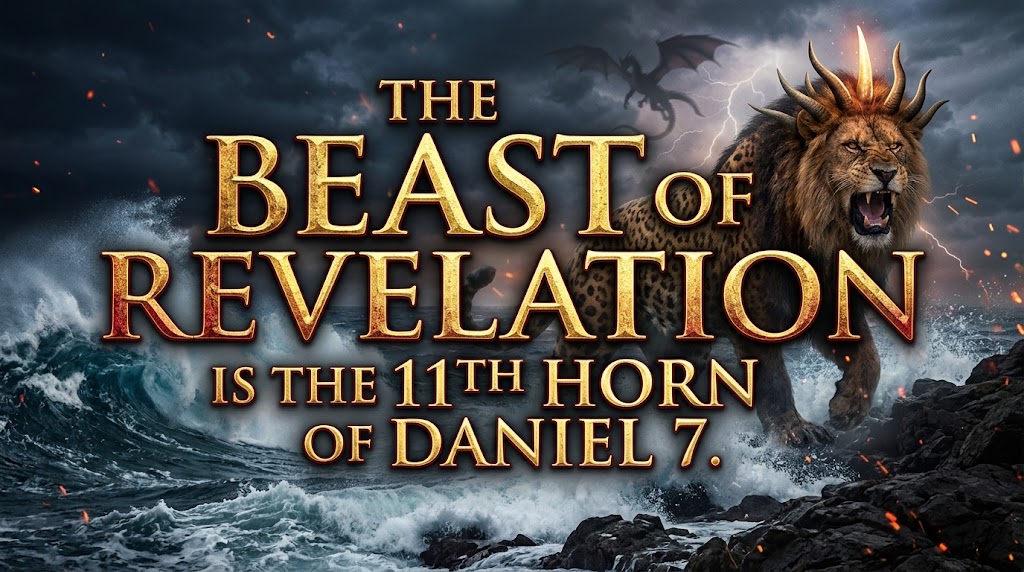
Daniel 7 uses four animals to describe four successive kingdoms. They would rule from the time of ancient Babylon until Christ’s return. According to Revelation 13:2, Revelation’s Beast receives something from each of the four animals in Daniel 7. That means that Revelation’s Beast is part of or a continuation of Daniel’s kingdoms. Specifically, this article shows that Revelation’s Beast is the 11th horn of the 4th animal of Daniel 7. For example, both Revelation’s Beast and Daniel’s 11th horn:
-
- Are the main characters in their respective prophecies,
- Are described as the Antichrist,
- Persecute God’s people for “a time, times, and half a time,” and
- Will exist until Christ returns.
A previous article identified Daniel’s 4th animal as the Roman Empire (see here). Its 11 horns symbolize the fragments into which the Roman Empire was divided. Since Revelation’s Beast is Daniel’s 11th horn, the Beast is one of those fragments. In other words, the Beast came into existence when the Roman Empire fragmented. It is that particular fragment that continued Roman authority.
The second beast in Revelation 13 is the Land Beast. It has two horns like a lamb, meaning it seems like Christ. But it is also called the “false prophet,” meaning it is a false Christian organization. Since the Land Beast exercises all the authority of the Sea Beast, the Sea Beast, which is usually just called the Beast, is also a Christian organization.
Purpose: To identify the Beast.
The ultimate goal of this website is to identify the Mark of the Beast, that is, the Mark that the followers of the Beast in the end-time will receive on their foreheads (Rev 13:16), as opposed to the Seal of God, which God’s people will have on their foreheads (Rev 14:1). The purpose of the current article is to identify the Beast to which this Mark belongs. The first question is which beast this is, for there are several beasts in Revelation:
-
-
- The Beast that comes up out of the abyss – It will kill God’s two witnesses (Rev 11:17).
- The Great Red Dragon – It will attempt to devour the woman’s Child (Rev 12:3-4).
- The Beast that comes out of the sea (Rev 13:1) – Its mark will be placed on people (Rev 13:17).
- The Beast that comes out of the Land – It has two horns like a lamb and will deceive the people by performing miracles (Rev 13:11, 13, 14).
- Scarlet Beast on which the Harlot sits (17:3) – The harlot reigns over the kings of the earth (Rev 17:18).
- The Image of the Beast – This is the real end-time persecutor of God’s people (Rev 13:14, 15). Since it is the image of the Sea Beast, it is also a beast.
-
It is the Mark of the Beast from the Sea (Rev 13:1) that will be placed on people. The Land Beast exercises all the authority of the Sea Beast (Rev 13:12) and deceives the people to make an Image of the Sea Beast (Rev 13:14). The Image then forces the people to receive the Mark of the Beast.
The Beast explains Daniel 7.
This section argues that the Sea Beast is part of the series of kingdoms in Daniel 7. It has seven heads and ten horns (Rev 13:1) and receives its appearance and power from four other animals:
“And the beast which I saw was like a leopard,
and his feet were like those of a bear,
and his mouth like the mouth of a lion.
And the dragon gave him his power and his throne and great authority.” (Rev 13:2)
Daniel 7 uses four animals to describe the kingdoms that will rule from the time of ancient Babylon until Christ’s return. The following allusions, in the description of the Sea Beast, to the animals of Daniel 7, indicate that the Sea Beast is part of the series of kingdoms in Daniel 7:
1) Both the Sea Beast and the animals in Daniel 7 come out of the sea (Dan 7:3).
2) The first three animals, from which the Sea Beast receives its appearance (the Lion, Bear, and Leopard), are explicitly the first three animals in Daniel 7 (Dan 7:5, 6, 7).
3) The fourth animal, from which the Sea Beast receives something, is a Dragon (Rev 13:2). For the following reasons, the Dragon is the fourth animal in Daniel 7:
(a) The fourth animal in Daniel 7 is not named but is described as “dreadful and terrifying and extremely strong … It devoured and crushed and trampled down the remainder with its feet” (Dan 7:7). This sounds like a dragon.
(b) Since the Dragon in Revelation is mentioned with three other animals that are explicitly the same as the first three animals in Daniel 7.
4) The Sea Beast has the same number of heads and horns as the four animals of Daniel 7 have in total, namely, seven heads and ten horns (Rev 13:1):
While the first three animals in Daniel 7 do not have any, the fourth animal “had ten horns” (Dan 7:7). The Sea Beast also has 10 horns.
While the other three animals have one head each, Daniel’s third animal, the Leopard, has four (Dan 7:6). So, Daniel’s four animals have seven heads in total, equal to the seven heads of the Sea Beast.
These are perhaps the strongest allusions to the Old Testament anywhere in the Book of Revelation. It is not a coincidence, but it implies that:
-
- The Sea Beast receives something from each of the four animals in Daniel 7.
- The Sea Beast is part of the series of kingdoms in Daniel 7, explaining it in more detail.
The Beast is Daniel’s 11th Horn.
For the following reasons, the Sea Beast is equivalent to the 11th horn that grows out of the fourth animal in Daniel 7:
(1) Both continue Daniel’s fourth kingdom.
The 11th Horn grows out of the 4th animal in Daniel 7. The Sea Beast receives its throne, authority, and great power from the Dragon (Rev 13:2), which, as argued above, is equivalent to Daniel’s 4th animal.
(2) Both are the Main Character.
Like Daniel’s 11th horn is the main character in Daniel, the Sea Beast is the main character in Revelation:
The fourth animal of Daniel 7 has 11 horns. The 11th horn is the main character in Daniel 7. It grows and becomes larger than all the other horns (Dan 7:20, 24). It will become so important that a court will sit in heaven to judge between it and God’s people (Dan 7:26, 9-11, 14). It will only be destroyed when Christ returns (Dan 7:26, 27). The only reason the first four animals and ten horns are mentioned is to enable us to identify the 11th horn.
Similarly, the Sea Beast is the main character in the Book of Revelation. For example, in the end-time crisis, the Mark of the Sea Beast, which is the Name of the Sea Beast or the Number of its Name, is put on the foreheads of God’s enemies (Rev 13:16, 17), and it will only be destroyed when Christ returns (Rev 19:20).
(3) Both are the Antichrist.
Both the 11th horn and the Sea Beast are described as the Antichrist. Both blaspheme God (Dan 7:8, 11, 20; Rev 13:5-6) and overpower God’s people (Dan 7:21, 25; Rev 13:7).
(4) Both persecute for 3½ times.
Both persecute God’s people for “a time, times, and half a time” (Dan 7:25). The Sea Beast’s period is 42 months (Rev 13:5), which is the same as the “time, times, and half a time” of the 11th horn. This is argued as follows:
Daniel and Revelation refer to:
-
-
-
-
- A time, times, and half a time (Dan 7:25; 12:7; Rev 12:14)
- 42 months (Rev 11:2, 13:5), and
- 1260 days (Rev 11:3; 12:6).
-
-
-
These refer to the same period.
(1) They are numerically equal. A time, times, and half a time = 3½ times, or years = 42 months = 42 x 30 = 1260 days.
(2) In all seven instances of this period, it is when God’s people are persecuted.
(3) Rev 12:6 and 14 describe the same wilderness period, for in both, the woman flees into the wilderness, where she has a place prepared for her and would be nourished for the same period. But, while one verse describes this period as 1260 days, the other calls it “a time, times, and half a time.” (See here for a more detailed discussion.)
(5) Both will exist until Christ returns.
See Daniel 7:26-27 and Revelation 19:11, 20. Specifically, therefore, both exist during the end-time crisis.
The Beast is Roman.
The Beast is that fragment of the Roman Empire that continues Roman authority.
Another article identifies Daniel’s fourth animal as the Roman Empire:
Using animals as symbols, Daniel 7 describes four successive ‘worldwide’ kingdoms. From the fourth grows 11 horns. Daniel 7 does not identify the four kingdoms, but Daniel 8 uses two animals as symbols for empires, explicitly identified as the Medo-Persian and Greek empires. A comparison of the animals in Daniel 7 and 8 shows that the fourth is the Roman Empire (see here).
Therefore, the 11 horns symbolize the kingdoms into which the Roman Empire fragmented. The 11th grew up last. It was the final and most important fragment of that Empire. It was small at first but grew in power and eventually dominated the other fragments (kingdoms).
It began to exist when the Roman Empire fragmented, described in Revelation as the Beast coming up out of the sea (Rev 13:1). It received its throne, authority, and great power from that Empire (Rev 13:2). Therefore, it is the main successor of the Empire, the unique continuation of the power and authority of the Roman Empire, and will only be destroyed when Christ returns! The Roman Empire is still with us!
The Beast is Christian.
The Beast is a human organization:
It comes out of the Sea (Rev 13:1). The sea is equivalent to “the earth” (Dan 7:2, 17), symbolizing the people of the world. In other words, both the animals in Daniel and the Beast in Revelation are organizations of the people of the world.
The Beast is a Christian organization:
A throne symbolizes authority to rule. Since the Beast received its throne from the Dragon (Rev 13:2), it received its authority to rule from the Roman Empire. But it was not military authority. We can see the nature of its authority in the Land Beast because the Land Beast exercises all the authority of the Sea Beast (Rev 13:12). The following indicates that the Land Beast is Christian:
-
-
- It has two horns like a lamb (Rev 13:11). All other instances of the term ‘lamb’ in Revelation refer to Jesus (e.g., Rev 5:6). In other words, the Land Beast looks like Christ, but speaks as a dragon (Rev 13:11).
- It is called the “false prophet” (Rev 16:13). In other words, the Beast is Christian in name.
-
Elsewhere in Revelation, the Power opposing God’s people also claims to be Christian. For example:
-
-
- While Revelation presents God’s people as a pure woman (Rev 12:1), it symbolizes the persecuting power as a harlot woman (Babylon – Rev 17:5). The Old Testament often describes unfaithful Israel as a harlot.
- In Revelation, the seven letters (Rev 1 to 3) always describe the enemy as inside the church.
-
In conclusion, the Beast is a Christian organization that arose when the Roman Empire fragmented. Later articles will identify it as the State Church of the Roman Empire (see here).
Other Observations
The following are further observations from Revelation 13:1-2 that are not directly connected to the identity of the Beast:
Why did John describe the horns first?
John first describes the horns and heads and then the beast’s body. Perhaps, as the beast rose from the sea, the horns became visible first, then the heads, and then the body.
Alternatively, John might have looked at these things from a vantage point in the future and saw past events in the reversed chronological sequence. Since the horns were the last to come into existence in Daniel 7, John saw them first. This might be the correct explanation because John also mentions the first three animals (leopard, bear, lion) in reverse order, compared to their sequence in Daniel 7.
What are the crowns on the Beast’s horns?
While the Dragon has diadems (an untranslated Greek word, meaning ruler crowns) on its heads (Rev 12:3), the Sea Beast has diadems on its horns (Rev 13:1). The allusions to Daniel 7, discussed above, require us to interpret these crowns in terms of Daniel 7:
Daniel 7 has four animals, symbolizing four successive empires.
Each had one head, except for the third, which had four heads, symbolizing the four concurrent divisions of the Greek Empire. The heads of the Sea Beast, therefore, exist during the time of the four empires of Daniel 7. Consequently, the crowns on the heads of the Dragon indicate that it ruled during the time of the four empires.
While none of the other animals in Daniel 7 have horns, the fourth animal has 10 and later 11 horns, symbolizing the fragments into which the Roman Empire divided. The Sea Beast’s crowns on its horns symbolize that it ruled during the time of the horns of Daniel 7. In other words, it ruled after the fourth empire had fragmented.
Who stands on the seashore?
In some older translations, such as the King James, it is John who stood on the sand of the sea in 13:1, but the earliest manuscripts of Revelation read “he,” which would refer to the Dragon mentioned in the previous verse (Rev 12:17). The context also shows it to be the Dragon:
In Rev 12, the Dragon is involved in a series of wars but suffers defeat in all of them. After the last defeat, it went away to prepare for the war against the remnant of God’s people (Rev 12:17).
In Rev 13, the Dragon, the Sea Beast, and the Land Beast work together (e.g., Rev 13:4; 13:11, 12). If it is the Dragon who stood on the sand of the seashore, then it tells us how the three came together. The Dragon goes to the seashore to secure reinforcements, where it is first joined by the Beast from the Sea (Rev 13:1) and later by the Beast from the Land (Rev 13:11).
Other Articles
Revelation 13
🔗 The Dragon is the Roman Empire.
🔗 The Beast continues the authority of the Roman Empire.
🔗 The Beast’s fatal wound is its sixth head. (13:3-4)
🔗 Revelation’s Beast is the Church of the Roman Empire.
🔗 The Mark of the Beast
Other Core Articles
🔗 All articles on this Site
🔗 Daniel’s Little Horn
🔗 Daniel 9 – Verse-by-Verse
🔗 Daniel 9 – Four Alternative Interpretations
🔗 Revelation 13 Dragon, Roman Empire
🔗 Revelation 13 Beast, Roman Christian Authority
🔗 What is the Mark of the Beast?
🔗 The Trinity doctrine
🔗 The True Origin of the Trinity Doctrine
🔗 The Sabbath was part of the Arian Controversy.
🔗 Christ’s Return
Other Article Series
🔗 The Antichrist in Daniel 2, 7, 8, and 11
🔗 The 490 years of Daniel 9
🔗 Book of Revelation
🔗 Christology
🔗 Origin of Evil
🔗 Death, Eternal Life, and Eternal Torment
For general theology, I recommend Graham Maxwell.