Summary
The Old Testament seems to present only a single divine Being, but the New Testament seems to describe Jesus as a second divine being. Therefore, at least from the second century, the dispute was whether the Son really is a second divine Being.
Nicene Theology
The fundamental principle in Nicene theology is that the Son is not a second divine being but that the Father and Son are a single hypostasis (a single Person) with a single mind, will, and consciousness. All other characteristics of the Son, such as that He is homoousios (same substance), eternal, immortal, impassible (not subject to suffering), and immutable (not subject to change), follow from this central principle.
Specifically, in original Nicene theology, as it was proclaimed while Arius was still alive and during at least the first 40 years of the Controversy, the Son is the Father’s own or only Wisdom, which means that the Father and Son are a single hypostasis (Person). This is different from the Trinity doctrine, but Nicene theology evolved during the century and beyond. What Alexander and Athanasius taught was not the same as the modern Trinity doctrine. [Show More]
Arius’ Theology
In contrast, in Arius’ theology, the fundamental principle was that the Son is a distinct divine Person. Everything else he taught was based on this principle:
Created the Son – Since two First Principles (two Beings who exist without cause and who give existence to all things) are impossible, the Father alone exists without cause and gave existence to the Son. It follows that the Son is subordinate to the Father.
Different substance – Since the substance of a created being cannot be the same as the substance of a Being who exists without a cause, the Son’s substance is different from the Father’s.
Three hypostases – Arians believed that the Holy Spirit, like the Son, is a distinct divine Person. Therefore, they believed in three divine Persons (three hypostases in the Godhead).
Distinct Minds – While Nicenes believed that the Father and Son share a single divine mind, Arians proposed that the Son has a distinct mind.
By God’s will – In the Nicene view, since the Son exists essentially as an aspect of the Father’s being, the Father never makes a decision to produce the Son. In contrast, in the Arian view, the Father willed the Son’s existence.
Eternal – In the Arian view, the Son created all things. Therefore, He came into existence before time itself existed. In other words, there never was a literal time when the Son was not. But since the Father willed the Son to exist, there was metaphysical time when the Son was not.
Begotten – Arius proposed that “begotten” must not be interpreted literally, as if the Son were begotten like a human child. He proposed that “only-begotten” means that the Son is the only being that was created by God Himself. All other beings were created by the Son.
From nothing – While the traditional Logos-theology taught that the Son always existed as part of God but later became a distinct hypostasis (Person), Arius believed that the Son was produced from nothing. This is one aspect where the Eusebians (misleadingly called ‘Arians’) disagreed with Arius. They said that the Son was begotten from the being of the Father.
Creator God – Arius believed that the Son created all things. Therefore, from the perspective of the created universe, the Son is the Creator. He has no equal. For all created beings, He is our God.
Authors Cited
Therefore / This article series quotes mainly from the patristic scholars of the last 50 years, namely writings used by most institutions of higher learning (see here), including:
• R.P.C. Hanson’s The Search for the Christian Doctrine of God (1987);
• Rowan Williams’ Arius: Heresy and Tradition (1987); and
• Lewis Ayres’ Nicaea and its Legacy (2004).
Introduction
Purpose
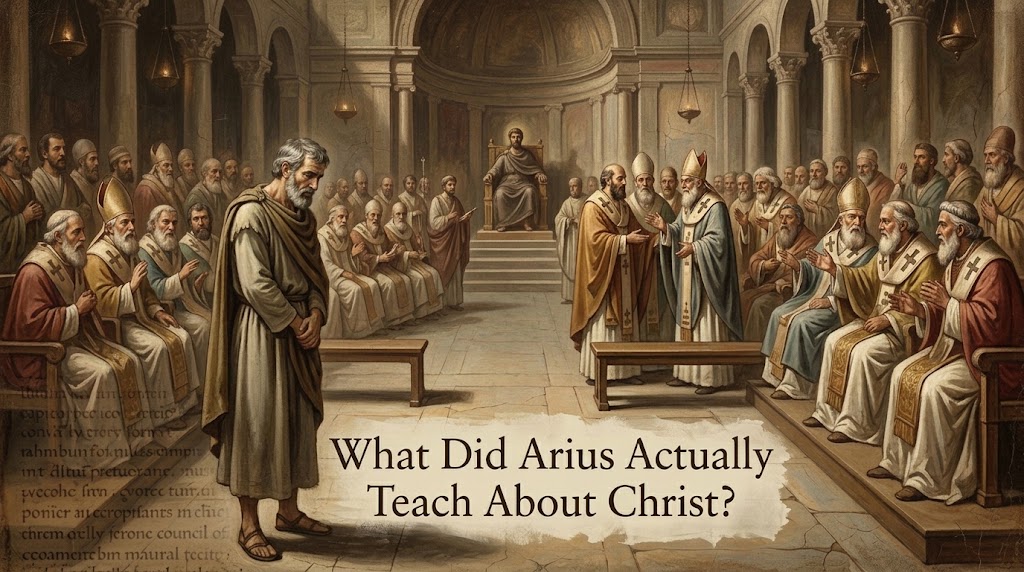
The 4th-century ‘Arian’ Controversy about the nature of Christ began in 318 when Arius, a presbyter in charge of a district in Alexandria, publicly criticized the Christological views of his bishop, Alexander (Hanson, p. 3). This article identifies the main points of Arius’ teaching. [Show More]
Why should we learn about Arius?
 Over the centuries, “Arius himself came more and more to be regarded as a kind of Antichrist among heretics, a man whose superficial austerity and spirituality cloaked a diabolical malice” (Williams, p. 1).
However, Bishop R.P.C. Hanson, a world expert on the Arian Controversy, concluded that the traditional account of the Arian Controversy is a complete travesty. Specifically, in a recent book about Arius, Archbishop Rowan Williams described Arius as:
“A thinker and exegete of resourcefulness, sharpness and originality” (Williams, p. 116). [Show More]
We do not agree with everything Arius said. Not even the so-called Arians agreed with everything he said. But understanding his theology helps to clarify the issues in the Controversy.
Authors Quoted
Due to research and a store of ancient documents that have become available since the 20th century, scholars today conclude that the traditional account of the Controversy – of how and why the church accepted the Trinity doctrine – is history written by the winner and fundamentally flawed. In some instances, it is the opposite of the true history.
Following the last full-scale book on the fourth-century Arian Controversy in English, written by Gwatkin at the beginning of the 20th century, only a handful of books on the Arian Controversy have been published. This article series is based on books published over the last 50 years, including:
| RPC Hanson, The Search for the Christian Doctrine of God – The Arian Controversy 318-381, 1987
Archbishop Rowan Williams, Arius: Heresy and Tradition, 2002/1987 Lewis Ayres, Nicaea and its legacy, 2004 (Ayres is a Professor of Catholic and Historical Theology.) |
The term ‘Arian’ is a misnomer.
We must distinguish between ‘Arianism’ and Arius’ theology. Athanasius used Arius as a stick to beat his opponents with. He called his opponents ‘Arians’, meaning followers of Arius’ already-rejected theology, and then selectively quoted Arius, pretending to attack his opponents.
But Athanasius’ opponents (the anti-Nicenes) did not follow Arius. Arius did not leave behind a school of disciples. He had few real followers. Nobody regarded his writings as worth preserving. His theology played no part in the Controversy after Nicaea. The term ‘Arian’, therefore, is a serious misnomer. [Show More]
In reality, Arius was part of a group Ayres calls the ‘Eusebians’; followers of Eusebius of Caesarea and Eusebius of Nicomedia. Consequently, this article often refers to the anti-Nicenes as the Eusebians rather than ‘Arians’. [Show More]
Arius’ Writings
Of Arius’ own writings, we only have three letters. [Show More]
Most of what we know about Arius comes from the writings of his enemies, particularly Athanasius. [Show More]
However, since Athanasius used Arius’ writings for polemical purposes, we can never be sure that his views were transmitted correctly:
“Athanasius … would not have stopped short of misrepresenting what he (Arius) said” (Hanson, p. 10).
“In places (Athanasius) may be suspected of pressing the words maliciously rather further than Arius intended” (Hanson, p. 15). [Show More]
Athanasius describes Arius’ teachings in De Synodis 15 and in Contra Arianos 1.5-6:
The first seems to be a direct quote and provides a balanced perspective. For example, here Arius described the Son as “full of truth, and grace, God, Only-begotten, unaltering” (Hanson, p. 6).
The second seems to be Athanasius’ paraphrase of Arius’ teachings and describes the Son as completely different from God and as merely a created being. [Show More]
Over the centuries, people have formed a wrong view of Arius because they relied on the writings of Arius’ enemies.
Arius’ Theology
A Trinity of Three Divine Beings
The Nicene Creed condemns Arius’ view that the Son “is of a different hypostasis or substance.” In other words, the Creed states that the Father and Son are a single hypostasis and substance (a single Person). [Show More]
This is consistent with 4th-century Nicene theology, which believed that the Son and Spirit are aspects of the Father. Therefore, only one divine hypostasis (Person) exists. Specifically, they believed that the Son is the Father’s only or own Wisdom. Therefore, only one Wisdom exists, meaning the Father and Son share a single mind. See here for a discussion of Nicene theology.
In contrast, Arius believed that the Son is a distinct hypostasis (Person) with a distinct mind. He taught “two Logoi and two Wisdoms.” The one Wisdom is the Son Himself. The other is the Father’s own Wisdom. [Show More]
Therefore, in Arius’ view, the Father, Son, and Holy Spirit are three distinct divine Persons. Arius did refer to them as a Trinity. [Show More]
Using the terms generically, the Nicenes of the 4th century were Unitarians, and the Arians were Trinitarians. However, when Arius described the Father, Son, and Spirit as a Trinity, he did not mean, as in the Trinity doctrine, that they are a single Being (see here), but that they are three distinct Persons.
The Father alone exists without a cause.
For Arius, the Father alone is “unbegotten,” meaning to exist without a cause. The Father, therefore, gave existence to all things. [Show More]
That means that the Father gave existence to the Son. The Son does not exist without a cause. [Show More]
The Son’s substance is different.
In the Nicene Creed and in Nicene theology, the Son’s substance is the same as the Father’s. Arius claimed the Son’s substance is different. He said that the Son is “unlike in substance to the Father” because the substance of a created being can never be the same as the substance of a Being who exists without a cause. [Show More]
The Son is produced by God’s Will.
Since the Nicenes believed that the Son is an essential and eternal aspect or feature of the Father, they also believed that the Son exists without cause, and the Father never ‘willed’ the Son to exist. In contrast, Arius and the Eusebians argued that, since the Son does not exist without cause, God willed the Son to exist. [Show More]
Gregg and Groh concluded that Arius’ view in this regard “is good Biblical doctrine, reproduced by Ignatius, Justin, Hippolytus, Clement of Alexandria and Origen” (Hanson, p. 90).
Williams describes this issue, whether the Son exists essentially or by God’s will, as one of the main aspects of the Controversy. [Show More]
Similar to Nicene theology, one key aspect of the present-day Trinity doctrine is Eternal Generation, which claims that God never ‘willed’ to generate the Son. It teaches that the Father has always been begetting the Son and will always be begetting the Son. In other words, it is an eternal reality and part of what God is.
The Son always existed.
The Nicene Creed condemns Arius’ view that “there was when He was not.” Both Athanasius and Alexander (Arius’ enemies) claimed that Arius taught that there was ‘time’ before the Son. They wrote, for example:
| “There was a time when God was not Father.”
“There was a time when he (the Son) did not exist” (Hanson, p. 13, 16, 17). |
But Arius did not use the word “time” in this context. In Arius’ view, since the Son made all things, He existed before all things. Since He created time, the Father begat the Son before time itself existed. Arius said that the Son was “brought into existence … before all times and ages” (Williams, p. 97), in the unknowable and timeless infinity beyond time. From our perspective (beings who exist ‘in’ or are subject to time), the Son has ‘always’ existed. [Show More]
On the other hand, Arius argued that “God must preexist the Son. If not, we are faced with a whole range of unacceptable ideas… (such as) that he is, like God, self-subsistent” (Williams, p. 97). Therefore, “the Son was produced before everything, before anything conceivable, but is still not co-eternal with the Father” (Hanson, p. 103). In that incomprehensible infinity beyond time, the Father exists metaphysically ‘before’ the Son. There was when He was not, but there was no literal ‘time’ before the Son. [Show More]
The Son is subordinate to the Father.
Since the Son received His life and being from the Father, He is subordinate to the Father. Eusebians described the Father as the Son’s God whom He worships. [Show More]
They argued that the Son cannot be equal to the Father, for that would mean “two unoriginated ultimate principles” (Hanson, p. 8). They referred to “Christ’s human infirmities (as a proof of his divine inferiority)” (Hanson, p. 17). However, when Arius wrote, all theologians, also the pro-Nicenes, regarded the Son as subordinate to the Father. [Show More]
So, the main issue in the Controversy was not whether the Son is subordinate to the Father. Everybody accepted that He is. As stated above, the real main issue in the ‘Arian’ Controversy was whether the Son is an aspect of the Father, as the Nicenes claimed, or a distinct Person, as the Eusebians thought.
Not Literally Begotten
The Bible says that the Son was “begotten,” the only Being “begotten” by God.
The Nicene Creed interprets this as that the Son was begotten from the substance of God and, therefore, is of the same substance as God. This seems to interpret “begotten” literally, as if the Son was born from God like human children are born from their parents. However, both Eusebius and Athanasius interpreted this statement in the Creed figuratively.
Arius also viewed the term “begotten” and the titles Father and Son as symbols. He proposed that “only-begotten” symbolizes that the Son is the only being directly produced by the Father Himself as a visible replica of the invisible God. All other beings were created by the Son. [Show More]
Since he understood “begotten” as meaning created by God Himself, Arius used the terms “created” and “begotten” as synonyms (Hanson, p. 6, 8).
Produced from Nothing
The Nicene Creed condemns Arius’ view that the Son “came into existence out of nothing.” In opposition to Logos-theology, which claimed that the Son always existed as an aspect of God, Arius stated that “God … made him when he did not exist out of non-existence” (Hanson, p. 16).
This was one point where the Eusebians (the so-called Arians) disagreed with Arius. In the Eusebian view, the Son was begotten from the being of the Father. [Show More]
Creator and God
The Nicene Creed also condemns Arius’ view that the Son was “created.” Arius described the Son as “a creature and a product” (Hanson, p. 16). Both Athanasius and Alexander claimed that Arius taught that the Son is equal to other created beings. For example, they wrote:
| “He was then such as is every man. We are able to become the sons of God as he is” (Hanson, p. 17).
“He is one of the many ‘powers’ that exist besides God, among which are also the locust and the caterpillar” (Hanson, p. 13). |
This is an example of how Athanasius misrepresented Arius, for Arius taught that the Son is the only being ever created directly by God and the greatest being that God could possibly produce, receiving everything from the Father that a created being could receive. [Show More]
In Nicene theology, the Son is co-eternal with the Father. In other words, He exists essentially, not for any specific reason. For Arius, the Father produced the Son to create all things through Him. Therefore, the Son is the Creator of all other beings. [Show More]
As our Creator, from the perspective of the created universe, the Son is our God. He has no equal. Arius described the Son as “God” (Hanson, p. 6), the “only-begotten God” (Hanson, p. 14), and as “the Mighty God [Isa 9:15]” (Hanson, p. 15). [Show More]
Therefore, during the first four centuries, all theologians, Nicene and Arian, described the Son as God. However, the Greek language did not have a word equivalent to the modern term ‘God,’ which we use as the name of the Ultimate Reality. The term they used (theos in Greek, deus in Latin) means ‘god.’ That is also the term the Greeks used for their multitude of gods, thought of as immortal beings with supernatural powers. Since all agreed that the Son is an immortal Being with supernatural powers, all parties to the Controversy described the Son as theos. However, following John 17:3, the Eusebians, such as Arius, distinguished between the Son as theos and the Father as the one true theos. So, when the Eusebians said that the Son is theos, they did not mean that He is “God” as we use the term today. [Show More]
Not subject to Change / Immutable
The Nicene Creed condemns Arius’ view that “The Son of God is … subject to alteration or change.”
Following mainly ancient Greek philosophy, most theologians accept that God is immutable, meaning that God is unable to change. The question arises: Is God’s Son also immutable? Can He change? In particular, can He become evil?
In the Nicene view, since the Son is an aspect of the Father, the Son is as immutable as the Father.
Arius described the Son as “Like the Father, ‘unchangeable’” (Williams, p. 96). However, his enemies, Alexander and Athanasius, claimed that Arius taught the exact opposite, namely, that the Son is, “like all others … subject to change” (Athanasius in Contra Arianos(v), Williams, p. 100). Arius’ thinking was as follows:
By nature, the Son is mutable. God did not override the Son’s freedom (mutability). God did not make it impossible for His Son to change or sin.
But the Son will never change or sin because He loves righteousness and hates iniquity. He is “unchangeable” because He will not sin, not because He cannot sin. See here for a further discussion.
Note how Arius’ enemies emphasize one part of Arius’ thinking, namely, that the Son is mutable by nature, and omit to say that Arius also said the Son will never change. This is another example of how Athanasius misrepresents Arius.
In the view of this site, the Son came to this world to be tested to see whether He could be tempted to sin, as Satan claimed He would (see here). If He couldn’t sin, His victory over sin would have been meaningless.
Knowledge of God
The Bible says several times that God is invisible (e.g., Col 1:15; John 1:18; 1 Tim 6:16). Ancient writers understood this also to mean that nobody understands God fully. So, the question arose: Is the Son able to “see” and “understand” the Father fully?
Origen said that the Son has “perfect knowledge of the Father” but qualified that by saying that “all that can be known of the Father’s life is known by the Son.” By implication, certain things cannot be known. Specifically, he said that the Son does not have “the Father’s primary self-awareness” (Williams, p. 206).
Arius said similarly that the Son also does not understand God fully, for how could a being who has a beginning possibly understand a Being who has no beginning? [Show More]
But Arius also said that the Son knows everything about the Father that a created being can know. [Show More]
Knowledge of Himself
Arius also said that “the Son does not know the nature of his own substance (ousia)” (Hanson, p. 16; cf. p. 15). Williams understands Arius as saying:
“He is willed into existence by the Father, and cannot therefore have that ‘perspective’ on his own substance which his creator possesses” (Williams, p. 105-6).
Other Articles
Other articles in this series
• Articles on the Trinity doctrine
• Arian Controversy
• Pre-Nicene Fathers
• Arius, Controversy begins
• Nicene Council (AD 325)
• Arianism – What is it?
• Nicenes and Nicene Theology
• End of the Controversy
• Development in Later Centuries
Other Core Articles
• The Mark of the Beast
• All articles on this Site
• Daniel’s Little Horn Identified
• Daniel 9 – Verse-by-Verse
• Daniel 9 – Four Alternative Interpretations
• The Dragon of Revelation 13
• The Beast of Revelation
• The Trinity Doctrine
• The Origin of the Trinity Doctrine
• The Sabbath and the Arian Controversy
• Christ’s Return
Other Article Series
• The Antichrist in Daniel
• The 490 years of Daniel 9
• Book of Revelation
• Christology – Who is Jesus?
• Why does evil exist?
• Death, Eternal Life, and Eternal Torment
For general theology, I recommend Graham Maxwell.