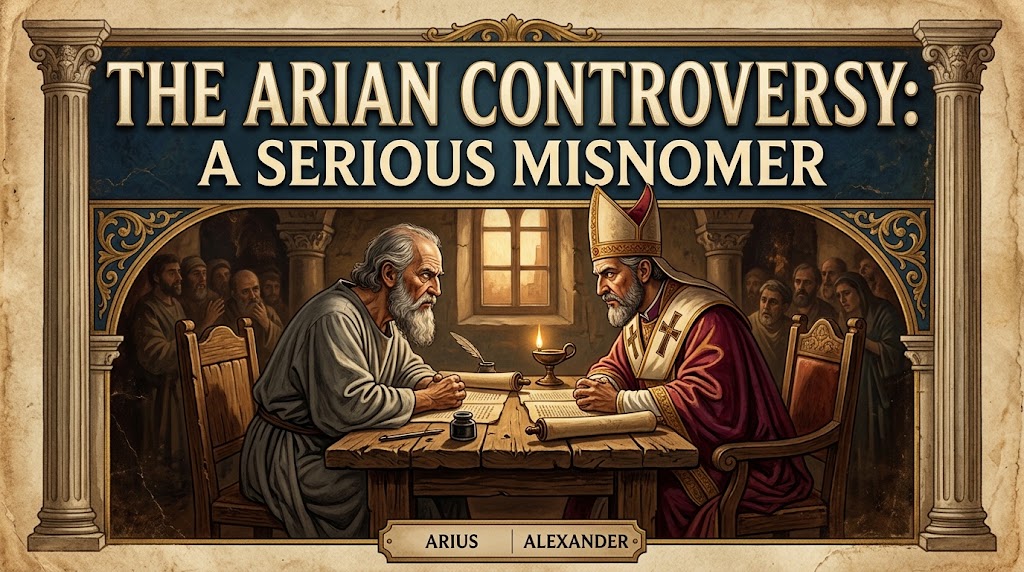
Abstract: This article re-examines the fourth-century Arian Controversy through the lens of modern patristic scholarship, drawing primarily on the works of R.P.C. Hanson, Rowan Williams, and Lewis Ayres. It argues that the conventional account—rooted largely in Athanasius’s polemical strategy—is fundamentally flawed. Arius was not a radical innovator seeking to launch a new heresy, but rather a theological conservative operating within the established dyohypostatic tradition of the pre-Nicene Church. Furthermore, the anti-Nicenes did not form a unified “Arian” party or view Arius as their leader. Consequently, scholars increasingly recognize that calling the entire sixty-two-year dispute the “Arian Controversy” is a serious historical misnomer that obscures the complex, diverse theological trajectories of the period.
INTRODUCTION
The Arian Controversy
The fourth-century Arian Controversy concerned the nature of Christ. It began in 318—only five years after Christianity was legalized—as a dispute between Arius, who oversaw one of the churches in Alexandria, and his bishop, Alexander. The controversy continued for 62 years. In 380, Emperor Theodosius legally established Nicene theology as the sole permitted form of Christianity in the Roman Empire and outlawed all others (see here).
Traditional Account
The fourth-century dispute is traditionally called the “Arian Controversy,” while the anti-Nicenes are described as “Arians.” These labels imply that Arius’s teachings prevailed through much of the century and came to dominate the Church.
According to the traditional account, a “clear Nicene doctrine [was] established in the controversy’s earliest stages” (Ayres, pp. 11–12). Arius, an Alexandrian presbyter, and his supporters are portrayed as “deliberate radicals, attacking a time-honoured tradition” (Williams, p. 21). In this account, they caused the controversy by developing and spreading a new heresy that gained many followers and eventually became dominant. Although the First Ecumenical Council decisively condemned this heresy in 325, an alleged Arian conspiracy later gained the favour of several emperors. Arius’s followers supposedly sustained his heresy until the Second Ecumenical Council finally and overwhelmingly rejected it in 381. Thus, calling the dispute the “Arian Controversy” implies that Arius caused it.
In the traditional account, these disputes are “understood as … the Church’s struggle against a heretic and his followers grounded in a clear Nicene doctrine established in the controversy’s earliest stages” (Ayres, pp. 11-12). [Show More]
Purpose of this Article
This article argues that Arius did not develop a new theology but was instead a theological conservative; that the so-called “Arians” did not follow Arius; and that the label “Arian” seriously misrepresents the nature of the controversy. It then explains why the dispute nevertheless became known as the “Arian Controversy.”
Authors Cited
Ayres observes that “the four decades since 1960 have produced much revisionary scholarship on the Trinitarian and Christological disputes of the fourth century” (pp. 11–12). Because twentieth-century scholarship substantially revised the interpretation of the Arian Controversy, this article series draws primarily on works published by leading patristic scholars during the past 50 years:
Hanson, R.P.C.: The Search for the Christian Doctrine of God – The Arian Controversy 318-381, 1987
Williams, Rowan: Arius: Heresy and Tradition, 2002/1987
Ayres, Lewis: Nicaea and its legacy, 2004
BEGINNING OF THE CONTROVERSY
There was no Orthodoxy.
According to R. P. C. Hanson, a leading twentieth-century patristic scholar, “there was not as yet any orthodox doctrine” when the controversy began (pp. xviii–xix), because “no consensus had yet been reached among the Church’s teachers” (p. 145).
The Nicene side claimed that its position was traditional, but its opponents made the same claim. Orthodoxy, as it is understood today, emerged from the controversy itself.
“This is not the story of a defence of orthodoxy, but of a search for orthodoxy … by the method of trial and error” (Hanson, pp. xix-xx).
“The limits of orthodoxy at the beginning of the fourth century . . . were still loose and unclear. The subject brought to the fore by Arius was one upon which no consensus had yet been reached among the Church’s teachers” (Hanson, p. 145). [Show More]
Arianism was Orthodox.
If any position could be described as orthodox at the beginning of the fourth century, it was closer to what later came to be called Arianism. Nicene theology held that the Father and Son are one divine Being with one mind. By contrast, Arianism understood the preincarnate Son as a second, distinct divine Being with a separate mind, subordinate to the Father.
During the third century, “one-being” theology was generally rejected. Sabellius, for example, was deposed for the theology later associated with his name.
The view that the Son was a distinct divine Being was widespread. It was held by the Apologists and by Origen, the most influential theological writer of the third century. For example:
Hanson said that “Arianism . . . does present the Son as in effect a demi-god,” but adds: “The conventional Trinitarian doctrine with which Christianity entered the fourth century . . . (made) the Son into a demi-god.”
The Christian Apologists of the second and third centuries identified the pre-existent Christ with the Second Hypostasis of Middle Platonist philosophy, a distinct divine Being, subordinate to the Father. This theological structure remained the traditional framework for Christian doctrine of God well into the fourth century, particularly in the Eastern Church. [Show More]
The Controversy Continued from the 3rd century.
Although Arius is often said to have caused the controversy by introducing a new heresy, deep theological tensions already existed at the beginning of the fourth century. The dispute between Arius and Alexander ignited a conflict that had long been developing. The dispute between Alexander and Arius was therefore the catalyst, not the underlying cause: the competing theological traditions were already well established.
“We will find pre-existing deep theological tensions at the beginning of the fourth century. Controversy over Arius was the spark that ignited a fire waiting to happen, and the origins of the dispute do not lie simply in the beliefs of one thinker, but in existing tensions that formed his background” (Ayres, p. 20). [Show More]
Arius Did Not Develop a New Theology
Arianism is often presented as a new heresy devised by Arius, but his theology drew on an established tradition. Rather than being a radical innovator, “Arius was a committed theological conservative” (Williams, p. 175). Dionysius, who served as bishop of Alexandria around the time of Arius’s birth, had likewise taught that Jesus Christ was a created being who had not always existed.
“Arius was a committed theological conservative; more specifically, a conservative Alexandrian” (Williams, 175). [Show More]
Although Arius held some extreme views that other anti-Nicenes rejected, he defended the established view that the preincarnate Son was a distinct divine being.
“To many highly intelligent people . . . Arianism seemed at the worst one extreme and drastic but not unacceptable option among many” (Hanson, p. 145). [Show More]
Nicene “One-Being” Theology Was Not Yet Orthodox
Calling Arius a conservative does not necessarily imply that his principal opponent, Bishop Alexander, was an innovator. The fourth-century controversy continued theological disputes inherited from the third century, and both broad traditions were already well established. Alexander’s ‘one Being’ theology was not the same as Sabellianism, but similar:
“The fragments of Eustathius that survive present a doctrine that is close to Marcellus, and to Alexander and Athanasius. Eustathius insists there is only one hypostasis” (Ayres, p. 69). [Eustathius and Marcellus were
“Alexander of Alexandria, Williams thinks, had maintained that the Son was proper to the ousia of the Father. To say that the Son is idios (proper) to the Father is to say that he is a property or quality of the Father, impersonal and belonging to his substance. Properties or qualities cannot be substances, as is evident from Porphyry’s Commentary on Aristotle’s Categories; they are not quantities. The statement then that the Son is idios to the Father is a Sabellian statement” (Hanson, p. 92). [Show More]
As noted, Sabellianism was rejected during the third century. Rome, however, had a Monarchian theological tradition. The Alexandrian majority may therefore have yielded to pressure from Rome, while Arius resisted this development. [Show More]
ARIUS
Arius was not important.
Within the broader controversy, Arius’ own theology was of little importance:
“Arius’ own theology is of little importance in understanding the major debates of the rest of the century” (Ayres, p. 56-57).
He disappeared from the controversy at an early stage:
“He virtually disappears from the controversy at an early stage in its course” (Hanson, p. xvii).
Even the so-called Arians did not regard Arius as a particularly significant writer or consider his works worth preserving. Some explicitly disavowed any connection with him.
“The people of his day, whether they agreed with him or not, did not regard him as a particularly significant writer. . . . neither his supporters nor his opponents thought them (his writings) worth preserving. Those who follow his theological tradition seldom or never quote him, and sometimes directly disavow connection with him” (Hanson, p. xvii). [Show More]
Moreover, the so-called Arians did not quote Arius. They appealed to respected figures from the past, but not to him. This suggests that they did not regard Arius as foundational to their theology and that his writings played little part in the debates of the mid-fourth century. [Show More]
The doctrinal crisis had been developing for some time and had become unavoidable. Arius helped ignite the controversy, but he himself was not particularly significant.
“The views of Arius were such as in a peculiar manner to bring into unavoidable prominence a doctrinal crisis which had gradually been gathering, without giving one school of thought among those existing at that time complete satisfaction. He was the spark that started the explosion, but in himself he was of no great significance” (Hanson, p. xvii).
Arius’s Supporters Did Not Follow Him
Arius did have many supporters, but they did not accept all his teachings or regard him as their leader. Rather, they supported Arius because they considered Alexander’s theology the greater threat.
“Over the next few years Arius gained support from some bishops in Palestine, Syria, and North Africa, especially Eusebius of Caesarea in Palestine and Eusebius of Nicomedia, near Constantinople. … Although these supporters may have been wary of some aspects of Arius’ theology … they joined in opposition to Alexander” (Ayres, p. 17). [Show More]
There Was No Coherent Arian Party
Although Arius won some converts to his views, he established no school of disciples. There was no single, coherent “Arian” party founded by Arius, maintained by his followers, and dedicated to preserving his theology:
“There was no such thing in the fourth century as a single, coherent ‘Arian’ party. Those who suspected or openly repudiated the decisions of Nicaea had little in common but this hostility — certainly not a loyalty to the teaching of Arius as an individual theologian. The protestation made at Antioch in 341 (‘We are not followers of Arius’) was no doubt perfectly sincere: bishops are not going to be marshalled as a faction by a presbyter, even if that presbyter’s teaching is generally acceptable. Arius evidently made converts to his views, many Libyans, the Illyrian clerics Ursacius and Valens, perhaps others; but he left no school of disciples” (Williams, p. 233). [Show More]
Arius Belonged to the Broader Eusebian Trajectory
Arius did not originate this theological trajectory. Other members of this trajectory rejected several of his ideas, and the broader school existed independently of him.
“Arius was part of a wider theological trajectory; many of his ideas were opposed by others in this trajectory: he neither originated the trajectory nor uniquely exemplified it” (Ayres, p. 2).
“Arius … represents a school … and the school was to some extent independent of him. Arianism did not look back on him later with respect and awe as its founder” (Hanson, p. 97).
According to Lienhard, “Arius . . . far from being an original thinker, was simply one more adherent of the dyohypostatic tradition.” Dyohypostatic means two hypostases, as opposed to the miahypostatic (one hypostasis) tradition of the Sabellians and Nicenes.
Ayres identifies four theological trajectories at the beginning of the fourth century:
- The Nicenes, including Alexander and Athanasius;
- The Sabellians, including Marcellus;
- Western anti-adoptionism; and
- The Eusebians—those who found common ground with either Eusebius of Nicomedia or Eusebius of Caesarea, Arius’s two most prominent supporters.
Ayres does not identify a separate “Arian” trajectory; instead, he places Arius within the Eusebian trajectory. On this analysis, “Eusebians” is a more accurate designation than “Arians” for the anti-Nicenes:
“My second theological trajectory is the one in which we locate Arius himself. This loose alliance I will term ‘Eusebian’. When I use this term I mean to designate any who would have found common ground with either of Arius’ most prominent supporters, Eusebius of Nicomedia or Eusebius of Caesarea” (Ayres, p. 52). [Show More]
THE ANTI-NICENES
The Anti-Nicenes Did Not Regard Arius as Their Leader
The anti-Nicenes, the so-called Arians, did not regard Arius as their leader or hero. They divided into several factions, including the Homoians, Homoiousians, and Heterousians. None of these groups traced their theological ancestry to Arius. Some held views significantly different from Arius’s.
“Those who suspected or openly repudiated the decisions of Nicaea had little in common but this hostility … certainly not a loyalty to the teaching of Arius as an individual theologian” (Williams, p. 233). [Show More]
The anti-Nicenes rejected some of Arius’ teachings.
The so-called Arians rejected some of Arius’ more extreme views. For example, post-Nicene anti-Nicene creeds—including the Dedication Creed (341) and the Long-Lined Creed (344)—explicitly condemned several teachings associated with him:
(a) Arius taught an extreme form of subordination that distinguished him from other Eusebians.
(b) Arius taught that the Son does not know the Father, a view apparently at odds with the theology of other “Arians.”
(c) Whereas many anti-Nicenes described the Son as begotten from the Father without using the language of substance, Arius taught that the Son was made from nothing, like other creatures.
These differences show that later forms of so-called “Arianism” diverged significantly from Arius’ own theology. [Show More]
The anti-Nicenes were theologically diverse.
The labels “Arian,” “Arian Controversy,” and “Arianism” suggest a unified anti-Nicene movement led by Arius. In reality, the anti-Nicenes held a wide range of views drawn from several theological trajectories. They formed a loose and uneasy coalition united chiefly by opposition to Nicaea in general and to homoousios in particular.
“The theologies typified as Arian draw on a variety of theological trajectories and cannot be understood as springing from one source” (Ayres, p. 2).
“‘Arianism,’ throughout most of the fourth century, was in fact a loose and uneasy coalition of those hostile to Nicaea in general and the homoousios in particular” (Williams, p. 166).
WHY IT IS CALLED ‘ARIAN’
“Arian” is a serious misnomer.
Participants in the controversy sometimes accused their opponents of being “Arians,” but these accusations were “wild unsubstantiated pieces of propaganda” (Hanson, p. xvii). The labels “Arian” and “Arianism” therefore distort the controversy: they imply that Arius created a new theology and that his teaching dominated the fourth century. Yet there was no single, coherent “Arian” party, and many anti-Nicene positions differed significantly from Arius’ own views.
“This controversy is mistakenly called Arian. No clear party sought to preserve Arius’ theology” (Ayres, p. 13).
“The expression ‘the Arian Controversy’ is a serious misnomer” (Hanson, p. xvii). [Show More]
For these reasons, some modern patristic scholars avoid using the term except when referring specifically to Arius’ own theology:
“I was still, in 1987, prepared, even with reservations, to use the adjective ‘Arian’ in a way I should now (2001) find difficult” (Williams, p. 248).
“For these reasons some scholars now simply refrain from using the term Arian other than as an adjective to describe Arius’ own theology and I shall follow that practice” (Ayres, p. 14).
Athanasius Invented Arianism
So, if Arius was insignificant, why is it called the ‘Arian’ Controversy? It was because Athanasius invented the term. His purpose was to tar his anti-Nicene opponents—including those responsible for his exile—with a name already in disrepute. Because Arius’ theology had already been formally rejected, Athanasius could use him as a straw man: by attributing Arius’ views to a diverse range of opponents, he could discredit them under a single label. He thus presented Arius as the originator of a new heresy and established the term “Arian” as a designation for the anti-Nicene movement.
“The textbook picture of an Arian system … inspired by the teachings of the Alexandrian presbyter, is the invention of Athanasius’ polemic” (Williams, p. 234).
“Heresiological labels enabled early theologians and ecclesiastical historians … to tar enemies with the name of a figure already in disrepute. Most famously some participants in the debate described loosely related but clearly distinct thinkers as Arians” (Ayres, p. 2). [Show More]
Athanasius’s polemic strategy
In chapter 5.1, Lewis Ayres describes Athanasius’ approach as the “full flowering” of a polemical strategy that shaped accounts of the fourth century for more than 1,500 years and as “a masterpiece of the rhetorical art” (Ayres, pp. 106–107). Athanasius began developing this strategy after his first exile in 335. Its principal features included the following:
“Athanasius’ account begins by presenting Arius as the originator of a new heresy” (p. 107).
“Athanasius presents himself as the preserver of the one theological tradition that is equivalent with scriptural orthodoxy” (Ayres, p. 107).
Athanasius described “his enemies as ‘Arians’ seeking to perpetuate a theology stemming from Arius” (Ayres, p. 106). “To this end, Athanasius quotes extensively from Arius’ Thalia” (Ayres, p. 107).
Athanasius called his opponents “‘Arian madmen’ or ‘Ariomaniacs’” and not even Christians (p. 107).
Athanasius employed this strategy against contemporary opponents whose theologies differed from Arius’ (Ayres, p. 107). Nevertheless, the strategy profoundly shaped later interpretations of the controversy. Rome, with its Monarchian theological tradition, accepted this account, which then became the standard explanation for more than fifteen centuries. Only in the 20th century did scholars discover that this account of the Controversy was false.
The Traditional Account is a complete travesty.
“The diatribes of Gwatkin and of Harnack [published at the beginning of the 20th century, and representing the traditional account], can to-day be completely ignored” (Hanson, p. 95).
The “conventional account of the Controversy, which stems originally from the version given of it by the victorious party, is now recognised by a large number of scholars to be a complete travesty” (Hanson).
Referring specifically to the view that homoousios was the traditional view of the Church, the “older accounts (of the Arian Controversy) are deeply mistaken” (Ayres, p. 11).
“The accounts of what happened which have come down to us were mostly written by those who belonged to the school of thought which eventually prevailed and have been deeply coloured by that fact” (Hanson, pp. xviii-xix).
This reassessment has been slow to gain broad acceptance. Athanasius’s ‘polemical strategy’ was originally created to support Athanasius’s ‘one Being’ theology, as opposed to the traditional view that the Son is a second divine Person. Because that ‘one Being’ theology evolved into the Trinity doctrine, regarded as the most fundamental teaching of the Church, the Christian world is slow to accept that Athanasius presented a false explanation of the Controversy.
Athanasius’ account distorted the controversy.
Earlier scholars often portrayed Athanasius as the hero of the controversy, praising his character and abilities despite his fanaticism (Hanson, p. 239).
Modern scholarship, however, argues that Athanasius distorted the nature of the controversy. Arius did not create an entirely new theology, Athanasius was not simply defending an established traditional orthodoxy, and the anti-Nicenes were not a unified body of Arius’ followers. Patristic scholars therefore caution against allowing Athanasius’ polemical account to determine how the fourth-century crisis is understood:
Athanasius used “unscrupulous tactics in polemic and struggle” (Williams, p. 239).
“Athanasius, a fierce opponent of Arius … certainly would not have stopped short of misrepresenting what he said” (Hanson, p. 10). [Show More]
Athanasius was not a neutral historian of the controversy. That does not mean that his theology was false.
CONCLUSIONS
The article has implications well beyond the historical question of whether “Arian” is an accurate label. It changes how we understand the development of Nicene theology, the authority of tradition, and even the doctrine of the Trinity.
Nicene theology was not the traditional view.
The fourth-century dispute should not be understood simply as orthodox Christianity defending an already-established doctrine against a new heresy. Nicene Trinitarian theology did not exist continuously from the apostles through the second and third centuries. Rather, ‘Arianism,’ defined as the view that the Son is a second divine Being, subordinate to the Father, was the traditional view. Nicene Trinitarian theology emerged from the 4th-century struggle.
Is Nicene theology true?
This historical reassessment does not by itself determine whether Nicene theology is true or false. A Catholic or development-of-doctrine approach could argue that the Church gradually found more adequate terminology for what Scripture ultimately requires.
The debate involved multiple competing understandings.
There was no single coherent “Arian” party. Arius did not establish a continuing school whose members simply reproduced his theology. The anti-Nicenes drew upon several theological trajectories. Therefore, fourth-century theology should not be reduced to Trinitarians vs. Arians. Instead, the debate involved multiple competing understandings of the relationship between the Father and Son. Consequently, calling every theology in which the Father has some kind of primacy “Arian” becomes historically and theologically misleading.
The Traditional Account is false.
The traditional account of the Controversy was how the Nicenes explained it. The anti-Nicenes had a very different explanation. The Nicene explanation was primarily created by Athanasius, and it is now clear that he was willing to exaggerate and distort.
“The accounts of what happened which have come down to us were mostly written by those who belonged to the school of thought which eventually prevailed and have been deeply coloured by that fact” (Hanson, p. xviii-xix).
Athanasius’s theological authority is weakened.
It argues that Athanasius constructed a polemical category of “Arianism” by portraying diverse opponents as followers of Arius and presenting himself as defender of the authentic theological tradition. Athanasius was not a neutral historian of the controversy. That does not mean that his theology was false. His arguments about Scripture, Christ’s divinity, salvation, worship, and the relationship between Father and Son would still have to be evaluated on their own theological merits.
It was a Sabellian Controversy.
I would like to make a statement that goes beyond what I found in the writings of the patristic scholars, but which I believe they imply: If the term ‘Arian’ implies that Arius’s theology was the problem that caused the Controversy, then it should rather be called the Sabellian Controversy. As explained by this and other articles in this series, ‘Arianism’ was the traditional view of the Church; Sabellianism was rejected in the 3rd century; Alexander’s theology was similar to Sabellianism (see here); the Nicene Council revived Sabellianism (see here); in the decade after Nicaea, the Church rejected Sabellianism, and the Sabellian term homoousios disappeared (see here), but, from the anti-Nicene perspective, the main enemy always remained Sabellianism:
“More recent and more thorough examination of Arianism has brought a more realistic estimate of it. Simonetti sees it as an extreme reaction against a Sabellianism which was at the time rife in the East” (Hanson, p. 95).
Referring to the Eastern (Arian) Dedication Council of 341, “their main theological opponent was Marcellus [the leading Sabellian], whose doctrine they countered by insisting that Father, Son, and Spirit are three hypostaseis” (Anatolios, p. 24).
“The leadership of this alliance (the Homoians) was always diverse. … It included bishops of different stripes united by the desire to find a solution to the ongoing controversy that would rule out any theologies seemingly tainted with Marcellan emphases” (Ayres, p. 138).
This article is part of a series of articles in the 4th-century Arian Controversy. Different articles address different aspects and identify several other errors in the Traditional Account.
OTHER ARTICLES
Other articles in this series
• Articles on the Trinity doctrine
• Arian Controversy
• Pre-Nicene Fathers
• Arius, Controversy begins
• Nicene Council (AD 325)
• Arianism – What is it?
• Nicenes and Nicene Theology
• End of the Controversy
• Development in Later Centuries
Other Core Articles
• The Mark of the Beast
• All articles on this Site
• Daniel’s Little Horn Identified
• Daniel 9 – Verse-by-Verse
• Daniel 9 – Four Alternative Interpretations
• The Dragon of Revelation 13
• The Beast of Revelation
• The Trinity Doctrine
• The Origin of the Trinity Doctrine
• The Sabbath and the Arian Controversy
• Christ’s Return
Other Article Series
• The Antichrist in Daniel
• The 490 years of Daniel 9
• Book of Revelation
• Christology – Who is Jesus?
• Why does evil exist?
• Death, Eternal Life, and Eternal Torment
For general theology, I recommend Graham Maxwell.