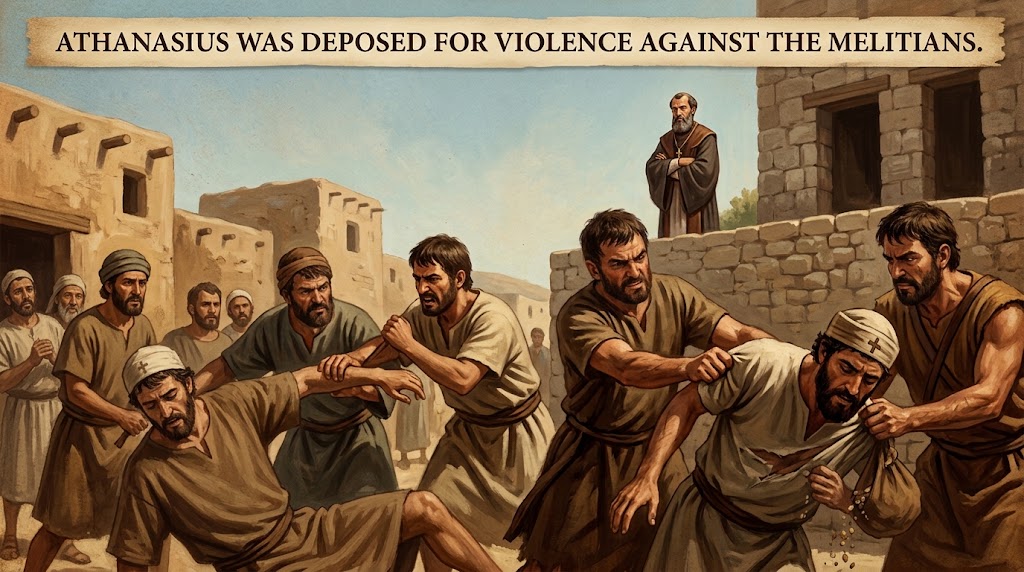
Traditionally revered as a gentle hero of the fourth-century Arian Controversy, Athanasius of Alexandria has long enjoyed a legacy of unblemished orthodoxy. However, drawing on R.P.C. Hanson’s seminal study The Search for the Christian Doctrine of God and 20th-century papyrus discoveries, this article re-evaluates the historical record. It demonstrates that Athanasius was justly deposed and excommunicated in 335 by the Council of Tyre for employing barbaric, thug-like violence and strong-arm tactics against the Melitian Christians in Egypt.
Summary
Alexander, bishop of Alexandria, died in 328. Athanasius was elected in his place. A few years later, Melitians appealed to the emperor for protection against Athanasius. They accused him of preventing people from entering church buildings, burning churches, and imprisoning, beating, and even murdering Melitians. But their appeal failed.
Eusebius of Nicomedia, one of Arius’ supporters, was exiled after Nicaea, readmitted within a few years, and became influential with the royal family. In 333 or 334, five years after Athanasius became bishop of Alexandria and also after the Melitians’ failed appeal, Eusebius approached the Melitians and promised to arrange an audience for them with the emperor if they would receive and champion Arius.
In 334, Eusebius also called a council to evaluate Athanasius’ conduct. Athanasius refused to attend, but the emperor then forced Athanasius to attend another council at Tyre in 335. After the council sent a commission to Egypt, it excommunicated Athanasius for indefensible violence in administering his see and deposed him as archbishop of Alexandria.
Athanasius responded as follows:
Firstly, he claimed that these accusations were made by ‘Arians’ to eliminate him as their theological opponent. However, Eusebius and his followers allied with the Melitians only after the Melitians had already appealed to the emperor. Athanasius’ aggression was not aimed at ‘Arians,’ but at Melitians. The fundamental cause of Athanasius’ aggression is that he did not accept the arrangement made at Nicaea about the Melitians.
“It seems clear also that Athanasius’ first efforts at gangsterism in his diocese had nothing to do with difference of opinion on the subject of the Arian Controversy, but were directed against the Melitians” (Hanson, p. 254).
Secondly, Athanasius claimed that the allegations were false. However, papyrus letters discovered in the 20th century, which we cannot dismiss as inventions, exaggerations, or propaganda, describe the barbaric treatment Athanasius inflicted. Hanson concludes that Athanasius “had been justly convicted of disgraceful behaviour in his see” (Hanson, p. 254-5).
Thirdly, he slandered his judges. “He represents the Council of Tyre, which was a properly constituted and entirely respectable gathering of churchmen, some of whom had been confessors in the Great Persecution, as a gang of disreputable conspirators, and brands all his opponents as favourers of heresy” (Hanson, p. 262).
Melitians vs Meletians
The Melitians, in the early fourth century, must be distinguished from the Meletians later in that century:
The Meletian Schism was a dispute late in the fourth century between the Western and Eastern Nicenes. While the Western Nicenes held to one hypostasis in God, the Eastern Nicenes believed in three.
The Melitians were the brave Egyptian Christians who, around the year 306 during the Great Persecution, following Bishop Melitius of Lycopolis, refused to hide from persecution. However, they also refused to receive back Christians who had denied Christ during that persecution. This caused a division in the church, which the Nicene Council of 325 attempted to address. This article is about the conflict between Athanasius and the Melitians.
Purpose of the Article
Seven years after Athanasius became bishop of Alexandria in 328 (Hanson, p. 246), in 335 he was condemned for violence against the Melitians, deposed as archbishop of Alexandria, and excommunicated.
Traditionally, the church had accepted Athanasius’s claim that these were false accusations, made by heretics (Arians) to eliminate him as their theological opponent.
This article summarizes chapter 9 of the book ‘The Search for the Christian Doctrine of God’, by the eminent historian R.P.C. Hanson’s, in which he concludes that Athanasius, traditionally regarded as the hero of the fourth-century Arian Controversy, was truly guilty of serious misconduct and violence.
Trouble began after Athanasius came to power.
Athanasius claimed that the Melitians began complaining about how they were treated even before he came to power, implying that he was not the cause of their grievances. However, the Melitians began to complain only several years later. [Show More]
Arians did not invent the accusations.
Athanasius referred to his enemies as ‘Arians’, implying that they were followers of Arius, which they were not (see here). Hanson and Ayres call the so-called Arians ‘Eusebians’ because their real leaders were Eusebius of Caesarea and Eusebius of Nicomedia.
“My second theological trajectory is the one in which we locate Arius himself. This loose alliance I will term ‘Eusebian’. When I use this term I mean to designate any who would have found common ground with either of Arius’ most prominent supporters, Eusebius of Nicomedia or Eusebius of Caesarea” (Ayres, p. 52).
Athanasius claimed that the Melitians and ‘Arians’ were in cahoots from the beginning and that ‘Arians’ invented false charges to eliminate him as their theological opponent. However, the alliance between the ‘Arians’ and Melitians was formed only after the Melitians had already unsuccessfully appealed to the emperor, about five years after Athanasius became bishop of Alexandria:
“Epiphanius goes on to say that the leaders of the Melitians were, after their discomfiture [their failed appeal to the emperor], near the court … and were at that point taken in hand by Eusebius of Nicomedia who promised that he would obtain for them an audience with the Emperor if they would receive and champion Arius, and, on their agreeing, the fusion of the causes of Arius and of Melitius took place” (Hanson, p. 250).
“In this year (333) or in the next the Melitians found an ally in the Eusebians” (Hanson, p. 258). [Show More]
Athanasius did not suppress Arians.
“It seems clear also that Athanasius’ first efforts at gangsterism in his diocese had nothing to do with difference of opinion on the subject of the Arian Controversy, but were directed against the Melitians. He had not agreed with the arrangement made about the Melitians at Nicaea. Once he was in the saddle, he determined to suppress them with a strong hand, and was not at all scrupulous about the methods he used.” (Hanson, p. 254)
Melitians, not Arians, accused Athanasius of violence.
While Athanasius claimed that these accusations were fabricated by Arians, the historical evidence is that they were made by Melitians:
“Why should the Melitians have been discontented with Athanasius? If half of what Sozomenus said was alleged by them was true, they had every reason for hostility to Athanasius” (Hanson, p. 251),
“Accusation made by Melitians (not Arians) to the Emperor against Athanasius, charging him with causing divisions and disturbances in his diocese, with preventing people from entering the church (i.e. the church building) and (charges made particularly by ‘John’, that is John Arcaph the Melitian leader, and the clergy associated with him) of murders and imprisonments and undeserved beatings and woundings and burning of churches” (Hanson, p. 249-250, quoting Sozomenus).
Ancient letters confirm his guilt.
Some of the accusations may be exaggerations, but papyrus letters discovered in the 20th century in the sands of Egypt, which we cannot dismiss as inventions, exaggerations, or propaganda, describe the barbaric treatment Athanasius inflicted:
“Was this more than wild hearsay? Had they any genuine grievances? We might dismiss the accusations against Athanasius retailed by Sozomenus and Epiphanius as the product of sheer partisanship and not worthy of credence, as, for instance, Gwatkin does, and many a church historian before and after him who was willing to take Athanasius’ protestations of his innocence at their face value.” (Hanson, p. 251)
“But, accidentally or providentially, we have available to us contemporary evidence which we cannot possibly dismiss as invention or exaggeration or propaganda, to decide this point” (Hanson, p. 251-2).
“This evidence consists of papyrus letters discovered by British archaeologists and published by H. I. Bell in his book Jews and Christians in Egypt. … They plunge us into the middle of the events which concerned Athanasius between the years 331 and 335” (Hanson, p. 252).
“It is a factual account written for people under persecution, a private missive not intended for publication nor propaganda, and therefore all the more damning” (Hanson, p. 252).
“It describes … the barbarous treatment which he (Athanasius) is meanwhile dealing out to those Melitians who have opposed him” (Hanson, p. 252). [Show More]
Not all accusations were true. One of the accusations was “that Athanasius had either murdered a bishop called Arsenius or … practised sorcery by using the severed hand of his corpse” (Hanson, p. 256). However, Athanasius’s agents were able to show that Arsenius was alive and still had both hands (Hanson, p. 257). However, not all accusations were false. Bell is cautious in his conclusions:
“The evidence of papyrus 1914, Bell remarks, makes it certain that the charges of violent and unscrupulous behaviour made against Athanasius at Caesarea in 334, at Tyre in 335, at Serdica in 343 and many times thereafter were not baseless” (Hanson, p. 254).
“’It was always suspicious’, says Bell, ‘that Athanasius, while dwelling on the charges … which he could refute, says nothing of those which accused him of violence and oppression towards the Melitians. The reason is now clear: these charges were in part true … We must conclude that there was a germ of truth in the picture given of Athanasius by his enemies as a self-willed, unruly man apt to treat even the Imperial authority with contempt’” (Hanson, p. 254).
Scholars in previous centuries have described Athanasius as a tender, gentle, and patient hero of the fourth century. For example:
“’The tenderness which could not but be loved’, the gentleness which made him … so patient and equitable as a peacemaker, the ‘majestic moral unity’ of his conduct and the freedom from anything ignoble in it.”
But Hanson concludes:
“We find Athanasius behaving like an employer of thugs hired to intimidate his enemies” (Hanson, p. 254).
“The charge against him at Tyre was the unscrupulous use of strong-arm methods against his opponents, and that charge as a general accusation … was abundantly justified” (Hanson, p. 255).
Tyre condemned Athanasius.
The Eusebians allied with the Melitians in 333. The next year (334), Eusebius called a council to evaluate Athanasius’ conduct, but Athanasius refused to attend. In 335, the emperor forced Athanasius to attend another council for the same purpose. The Council sent a commission to Egypt. As a result, Athanasius was excommunicated for indefensible violence in administering his see. [Show More]
“His conviction had nothing to do with doctrinal issues” (Hanson, p. 255).
“It must have been clear to everybody that he had been for some time using indefensible violence in the administration of his see, even though it was not easy to bring him to book on exact charges” (Hanson, p. 262).
“We can now see why, for at least twenty years after 335, no Eastern bishops would communicate with Athanasius. He had been justly convicted of disgraceful behaviour in his see” (Hanson, p. 254-5).
Athanasius claimed an Arian Conspiracy.
Since the Eusebians allied with the Melitians, Athanasius claimed that he was being persecuted for his theology, which was untrue.
The alliance between the Eusebians and Melitians “gave Athanasius an opportunity of clouding the issue by ascribing all protest against his outrageous conduct to bias towards Arianism, an opportunity of which he strove earnestly to take advantage. But … Athanasius’ offence had nothing to do with doctrine” (Hanson, p. 255).
He did not deny some accusations.
Athanasius never denies that Ischyras was assaulted but argues that Ischyras was never properly ordained as presbyter:
“Athanasius never actually denies that Ischyras was assaulted. ‘He confines his defence to pointing out that Ischyras was not in a strict sense a presbyter at all; he came from the sect of Colluthus and Colluthus had never been consecrated bishop. … In short, his opponents cried ‘Violence and sacrilege’ and Athanasius replies ‘No: only violence’” (Hanson, p. 256-7).
“He switches the attention from what was actually done to the status and history of Ischyras himself. He completely ignores the serious and well-attested evidence of his own continual use of violence” (Hanson, p. 262).
He attacked the Council of Tyre.
He brands all his opponents as disreputable conspirators and heretics.
“He represents the Council of Tyre, which was a properly constituted and entirely respectable gathering of churchmen, some of whom had been confessors in the Great Persecution, as a gang of disreputable conspirators, and brands all his opponents as favourers of heresy” (Hanson, p. 262).
Arian writings were not preserved.
Since Athanasius’ theology ultimately prevailed, the church, over the centuries, has preserved his writings but not his opponents’ writings. As a result, most of the available information about Athanasius and the Melitians is in the writing of Athanasius himself, and he was determined to conceal his violent behavior:
“We must bear in mind that our main informant (Athanasius himself) is determined to conceal his violent behaviour by alleging that all was invented by people who were dangerous heretics, and that most of the rest of the sources, and most writers since, have taken this plea at its face value” (Hanson, p. 255).
Conclusions
Athanasius began defending the Nicene Creed only after he was exiled.
During his conflict with the Melitians, Athanasius had not yet begun defending the Nicene Creed. Another article shows that the Nicene Creed and the term homoousios fell out of the Controversy soon after Nicaea and were only brought back in the mid-350s when Athanasius began using them to defend against Emperor Constantius. During the Melitian conflict, the Arians/Eusebians had no theological axe to grind with Athanasius.
Athanasius’ behavior had a lasting impact on the church and set the stage for the persecutions during the Middle Ages.
“We can see by virtue of historical hindsight that Athanasius in following this policy set an evil example to his successors of the use of force and intrigue” (Hanson, p. 255).
Other Articles
Other articles in this series
• Articles on the Trinity doctrine
• Arian Controversy
• Pre-Nicene Fathers
• Arius, Controversy begins
• Nicene Council (AD 325)
• Arianism – What is it?
• Nicenes and Nicene Theology
• End of the Controversy
• Development in Later Centuries
Other Core Articles
• The Mark of the Beast
• All articles on this Site
• Daniel’s Little Horn Identified
• Daniel 9 – Verse-by-Verse
• Daniel 9 – Four Alternative Interpretations
• The Dragon of Revelation 13
• The Beast of Revelation
• The Trinity Doctrine
• The Origin of the Trinity Doctrine
• The Sabbath and the Arian Controversy
• Christ’s Return
Other Article Series
• The Antichrist in Daniel
• The 490 years of Daniel 9
• Book of Revelation
• Christology – Who is Jesus?
• Why does evil exist?
• Death, Eternal Life, and Eternal Torment
For general theology, I recommend Graham Maxwell.