Purpose
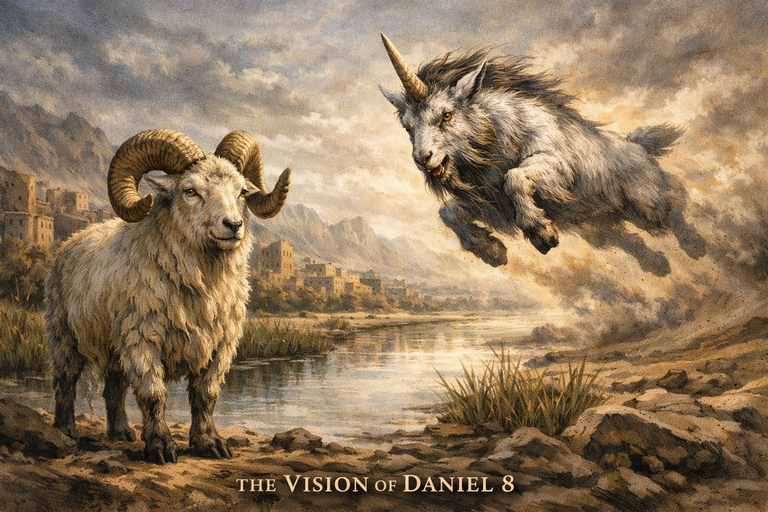
Daniel 8 presents two symbolic animals—a ram and a goat:
Verse 20 explicitly identifies the Ram as Medo-Persia. It has two horns, representing the Medes and the Persians, respectively. The ram conquers in three directions: north, west, and south (verse 4).
Next, a Goat comes from the west with such speed that it seems to fly. Verse 21 identifies it as Greece. At first, it had one large horn, representing the united Greek Empire of Alexander the Great. It rushes at the Medo-Persian ram, tramples it in fierce anger, and shatters its horns. But at the height of the goat’s power, the great horn is broken off. Four horns came up in its place, extending toward the four winds of heaven—that is, toward the four directions of the compass. These four horns represent the four parts into which the Greek empire divided, after Alexander’s death.
Yet the central figure in the vision is another horn, described as a “Little Horn.” Though small at first, it grows exceedingly powerful. Unlike the ram and the goat, it does not attack another beast or kingdom. Instead, it opposes God and persecutes God’s people. It symbolizes the Antichrist.
Daniel then overhears two heavenly beings discussing the vision. One asks how long God’s holy place and God’s people will be trampled. The other answers that the holy place will be restored after 2,300 evenings and mornings (Daniel 8:13–14).
The main purpose of this article is to explain the major alternative interpretations of the Little Horn.
Previous Conclusions
Before turning to that discussion, it is helpful to review the previous articles in this series:
Daniel 2
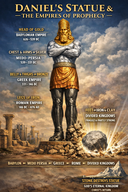
The first article examined the vision in Daniel 2. Using the statue of a man, that vision gives an overview of the kingdoms of the Western world. It divides history into six consecutive ages, or kingdoms:
The first kingdom, symbolized by the head of gold, was the ancient Babylonian Empire, about 600 years before Christ.
It was followed by three other empires, which Daniel 2 does not name.
The vision describes the fifth kingdom as divided. It continues the fourth kingdom, but in a fragmented form; that is, it represents a period in which multiple kingdoms exist at the same time.
The vision ends with Christ’s return. At that time, all previous kingdoms will be destroyed, so completely that no trace of them will remain. Christ’s return will inaugurate the sixth and final age: God’s eternal kingdom.🔗
Daniel 7
 The second article discussed the vision in Daniel 7.
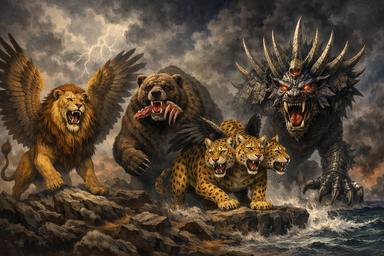
This vision describes four animals, representing the same four consecutive empires, shown in Daniel 2. However, Daniel 7 does not name them.
The fourth animal had ten horns, symbolizing that the fourth empire would fragment into multiple concurrent kingdoms. These horns correspond to the divided kingdom in Daniel 2.
Later, an eleventh horn grows out of the fourth animal. This final fragment of the fourth empire symbolizes the Antichrist. Daniel 2 does not mention this power, but it becomes the main character in Daniel 7, and in Daniel’s later visions.
As in Daniel 2, the vision ends with Christ’s return, when the eleventh horn is destroyed. 🔗
The Fourth Animal
 The third article identifies the animals in Daniel 7.
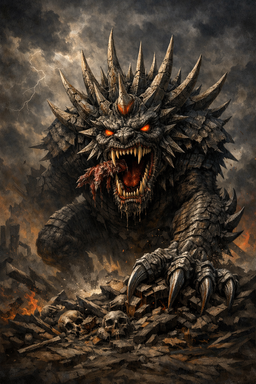
As noted above, both Daniel 7 and Daniel 8 use animals as symbols for empires, and both portray the Antichrist as a horn. Daniel 7 does not name any of its animals, but Daniel 8 explicitly identifies its two animals as Medo-Persia and Greece. By comparing the descriptions of the animals in Daniel 7 with those in Daniel 8, the third article identifies the animals in Daniel 7 as follows:
- The second animal in Daniel 7, the bear, corresponds to the ram in Daniel 8, and symbolizes Medo-Persia.
- The third animal in Daniel 7, the leopard, corresponds to the goat in Daniel 8, and symbolizes Greece.
- It follows that the dreadful fourth beast in Daniel 7, from which the Antichrist arises, represents Rome. 🔗
In other words, the Antichrist arises from the Roman Empire. It begins as a fragment of that empire and continues Rome’s influence.
Out of One of Them
The fourth article identifies the Antichrist in Daniel 8.
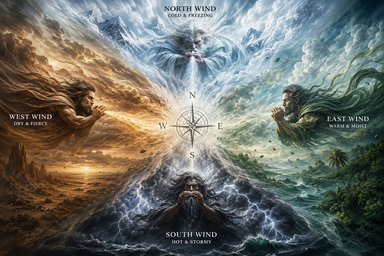
In Daniel 8:9, the Antichrist-horn is said to come “out of one of them.” The key question is, what does the phrase “one of them” refer to? Since the previous verse mentions the four horns of the Greek goat, many assume that the Little Horn comes out of one of those Greek horns. However, that interpretation would conflict with the previous article’s conclusion, that the Little Horn arises from the Roman Empire.
To address this issue, the fourth article analyzes the phrase, “out of one of them.”
First, it argues that if the Little Horn came out of one of the Greek horns, then one horn would be growing out of another horn. But horns do not grow from other horns. Horns grow from the heads of animals.
Second, Hebrew nouns and pronouns have grammatical gender. In the original Hebrew of the phrase, “one of them,” both “one” and “them” have genders. As with English pronouns such as “he” and “she,” Hebrew pronouns must agree, in gender, with the nouns to which they refer.
The fourth article then shows that “one of them” cannot refer to the four horns because the genders do not agree.
It concludes instead that “one of them” refers to one of the four winds of heaven, both because that is the final phrase in the preceding verse and because the genders agree.
The four winds of heaven represent the four compass directions. Therefore, the Little Horn comes from one of those directions, not from one of the Greek horns. Yet because it is still a horn, it must belong to some animal. Since it is not a horn of the Greek goat, it must be the horn of the next beast: Rome. 🔗
Antichrist
With that review of the previous articles complete, we can now return to the purpose of the present article.
Most interpreters agree that the Little Horn in Daniel 8 represents the same power as the evil horn in Daniel 7. This horn is the central figure in Daniel’s visions. It grows greater than the other horns, speaks out against God, wears down His people, and seeks to change God’s laws (Daniel 7:25). For these reasons, it represents the Antichrist.
Although the previous four articles identified the horn’s origin, they did not identify it specifically. The present article, therefore, surveys the main interpretive options. Interpreters disagree widely over its identity. The next article in this series will evaluate those options and identify the horn.
The Same Horn as in Daniel 7
For the following reasons, commentators generally agree that the evil horns in Daniel 7 and 8 represent the same power:
First, the visions use the same symbol: a horn. If Daniel intended two distinct powers, a different symbol would likely have been used.
Second, the two horns have the same characteristics. Both (1) begin small, (2) become great, (3) blaspheme God, (4) persecute God’s people, (5) are the main characters in their respective visions, and (6) are eventually destroyed (see Daniel 7:8, 21, 25, 26; 8:9, 11, 25).
Third, it is a general principle that later visions expand on earlier ones. For example, Daniel 7 repeats the four empires, described in Daniel 2, adding detail. In the same way, Daniel 8 elaborates on Daniel 7. Therefore, the Little Horn in Daniel 8 should be understood as a further explanation of the horn in Daniel 7.
Three Interpretations
Who, then, is this Antichrist horn that blasphemes God and persecutes His people? What is the sanctuary, and what are the 2,300 evening-mornings during which the Antichrist profanes it? We will now consider three major interpretations.
1. Préterist – The Greek King Antiochus
We begin with the Liberal, or Preterist, interpretation. This view teaches the following:
First, the prophecies in the book of Daniel are not viewed as genuine predictions but as history written in prophetic form. In this view, they do not predict events relevant to our present or the future.
Second, the Little Horn is understood to arise from one of the four divisions of the Greek Empire, symbolized by the four horns of the goat.
Third, the Little Horn, or Antichrist, is identified specifically with the Greek king Antiochus IV Epiphanes in the second century BC, who persecuted Israel and defiled the temple.
Fourth, the 2,300 evening-mornings are interpreted as 2,300 individual sacrifices—one offered in the morning and one in the evening. Thus, the period is understood as 1,150 literal days, or about 3.2 years, during the reign of Antiochus.
Fifth, the sanctuary is identified as the literal temple in Jerusalem, which Antiochus polluted and which the victorious Jewish rebels later purified.
Two other articles in this series discuss specifically the Liberal Interpretation. The one shows that King Antiochus does not fit the specifications of Daniel 7. 🔗 The other shows that he does not fit the description of the vile person in Daniel 11. 🔗
Futurists – An end-time Antichrist
The second main interpretation may be called Futurist.
Futurists believe that the evil horn symbolizes an end-time Antichrist. Generally, Futurists, like Liberals, believe that Daniel’s prophecies point to Antiochus, but they regard him as only a TYPE of an Antichrist, who will arise in the final years of earth’s history, just before Jesus returns.
Some futurists apply the 2300 evening-mornings to the end time. They interpret it as a literal 2300 days, which is about 6.3 years, during which this end-time Antichrist will reign.
In the Futurist View, in the End Time, the Jews will build a literal temple in Jerusalem. But the Antichrist will pollute it. The 2300 days will end when Christ returns. He will end the reign of the Antichrist and restore the temple.
Historicists – The Roman Church
The Historicist interpretation—famously championed by the Protestant Reformers—presents a compelling look at biblical prophecy. According to this view, the “eleventh horn” of Daniel 7 (the Antichrist) emerged directly from the ancient Roman Empire.
In other words, the Antichrist began as a part of the ancient Roman Empire. Rather than vanishing with the collapse of Rome, this power survived, evolved into a distinct geopolitical and spiritual entity, and continues to exist today—destined to remain until the return of Christ. Specifically, Reformers identified this power as the Roman State Church, of which all Romans were members, and the emperor was the head of the Church.
After the Fall of Rome, this church survived and became the Roman Church, with the Pope replacing the Roman Emperor as its head.
To justify this connection, historicists historically pointed to the medieval Church’s systematic persecution, torture, and martyrdom of millions of dissenters.
To understand how this transition happened, we must explore the fascinating history of the early Church and the theological struggles that shaped it.
The Traditional Account
Due to discoveries and research during the 20th century, experts today explain the Arian Controversy of the 4th century very differently compared to their 19th-century counterparts. For example, R.P.C. Hanson, regarded by many as the greatest 20th-century expert on the Controversy, described the Traditional Account as a complete travesty. Consequently, readers who are familiar with the Arian Controversy, but only with how it was described 100 years ago, may be surprised by some of the statements below:
The Pre-Nicene Church: What Did Early Christians Believe?
To understand how the Roman State Church evolved, we have to look at the massive shift in how early Christians understood the nature of Jesus Christ.
Modern readers are often surprised to learn that the early Church did not originally teach the modern Trinity doctrine. During the first three centuries, the mainstream view was that the Son is a second, distinct divine Being who is subordinate to the Father. The core issue was not that the Son is subordinate, but that He is a second divine Being, in contrast to the Trinity doctrine, in which the Father and Son are one single Being with a single mind, will, and action. This is discussed in a separate article. 🔗 The following are quotes from scholars:
“There is no theologian in the Eastern or the Western Church before the outbreak of the Arian Controversy [in the fourth century], who does not in some sense regard the Son as subordinate to the Father.” — R.P.C. Hanson (The Search for the Christian Doctrine of God, p. 64)
As theological historian Henry Bettenson noted, subordinationism was indeed pre-Nicene orthodoxy. The standard doctrine with which the Church entered the fourth century essentially viewed the Son as a distinct, subordinate divine being, as detailed in this Hanson article.
Re-evaluating “Arianism”
Today, the belief that the Son is a distinct, subordinate being is often labeled “Arianism”—implying it was a radical new heresy invented by the 4th-century priest Arius. However, 20th-century historical breakthroughs have completely overturned this traditional narrative. Modern scholars agree that Arius was actually a theological conservative.
In reality, Arius was a conservative. To quote some scholars:
Archbishop Rowan Williams noted that Arius was a “committed theological conservative; more specifically, a conservative Alexandrian.”
Catholic scholar Joseph Lienhard wrote that Arius was simply an adherent of the “dyohypostatic” tradition—the belief that the Father and Son are two distinct Beings (hypostases).
Origin of the term ‘Arian.’
If the traditional view was that the Son is a second divine being, subordinate to the Father, why is it called Arianism? The shift occurred because Athanasius, who deviated from this established tradition, used Arius as a “straw man.”
By grouping all his traditionalist opponents under the umbrella label of “Arians,” Athanasius could easily attack them. In reality, most of his opponents did not follow Arius’s extreme views (such as the idea that the Son was created out of nothing – they believed the Son was generated directly from the Father’s own being and shared His divine attributes).
It was only over the last 100 years, through in-depth research, that scholars realized, as historian R.P.C. Hanson observed, using the term “Arian” to describe the anti-Nicenes is a “serious misnomer” (p. xvii), and Lewis Ayres agreed, “t;fd;phis controversy is mistakenly called Arian.”
Monotheism
The Trinity doctrine is a form of Monotheism, the view that only one divine Being exists. Although the Trinity doctrine did not exist during the first three centuries, other forms of Monotheism did exist, mainly Monarchianism and Sabellianism. However, in the 3rd century, Monotheism was a minority view. It was formally condemned. The view that the Son is a second divine Being was taught by Origen, the most influential writer of the first four centuries, and by most other important writers.
While the Eastern Greek Church (where Christianity originated, and where the majority of early Christians lived) held the “two-being” (dyohypostatic) view, the Western Latin Church in Rome favored a strict “one-being” (miahypostatic or Monarchian) tradition. For the first three centuries, while Christianity was outlawed and Rome’s influence was limited, these two views existed side-by-side. 🔗
The Council of Nicaea (325 AD)
Everything changed with Emperor Constantine. After he, himself, had become a Christian, he legalized Christianity in 313. Constantine, initially ruling only the West, naturally aligned himself with the Monotheist tradition of the Roman church. For that reason, as Lewis Ayres stated on page 89, in the dispute between Arius and his bishop, Alexander, “Constantine had taken Alexander’s part.”
Seeking imperial unity, at the Council of Nicaea in 325, As Hanson stated on page 850, “Constantine took part in the Council of Nicaea and ensured that it reached the kind of conclusion which he thought best.” 🔗
This included the term homoousios. In the 3rd century, this term had been heavily associated with Sabellianism (a condemned form of monotheism). 🔗 For example, in a dispute between Rome and Alexandria, around the year 260, Rome had a Sabellian theology and championed homoousios. At that time, Alexandria opposed homoousios. 🔗 At Nicaea, Constantine personally insisted on including the controversial term homoousios (“of one substance”) in the Nicene Creed.
This shows how emperors understood their role in the Church. As the respected scholar Simonetti stated, the emperors regarded themselves as the head of the Church. They did not hesitate to force the church to accept the view they thought best. Similarly, on page 849, Hanson stated that, during the Arian Controversy, the will of the Emperor was the final authority in church doctrine. 🔗
The Great Post-Nicene Fluctuation
The story did not end at Nicaea. Within a decade, Constantine reversed his stance. He adopted the Arian view, allowed all exiled Arians to return, and exiled all leading monotheists. As another example of how Constantine switched sides, near the end of his life, he accepted baptism from the Arian leader, Eusebius of Nicomedia. 🔗
By the mid-4th century, “Arianism” (the belief in two distinct divine Beings) once again dominated the Eastern Greek Church, where most Christians lived. Arian emperors even forced the Western Latin Church to sign Arian creeds.
However, Rome—strongly backed by Athanasius of Alexandria—stood firm in its monotheistic stance. Since it was the church of the Capital, it had significant influence in the Western Latin Church.
Ecumenical Councils
The two ecumenical councils of that century, Nicaea in 325 and Constantinople in 381, were not really ecumenical. Both were almost exclusively Eastern, and both were dominated by the emperor.
In the years 359-360, a series of church councils was held that was much more ecumenical. It truly involved the entire Roman Church. However, these councils were unable to come to a consensus. Consequently, the Arian Emperor of that time, Constantius, Constantine’s son, manipulated the councils to accept an Arian Creed. This manipulation was not worse than in 325 and 381. However, since this series of councils concluded with an Arian Creed, it is not regarded as Ecumenical today.
But not even this series of councils was fully ecumenical. The general councils of the 4th century were not called by the Church. They were called by the emperors. And the emperors invited only Romans. Other nations, such as the Goths, also became Christian, but they were not invited to these councils.
Emperor Theodosius
The definitive turning point came in 378 AD when Theodosius I, a strict Western Monotheist, became Emperor of the East. Since, in the Roman Empire, the emperors decided which religions to legalize, the emperors also decided which factions of religions to allow. For that reason, and because Monotheism already dominated in the church in Rome in the Latin West, the rise of a monotheist emperor in the Arian East was bound to have a major impact.
The Edict of Thessalonica (380 AD)
Unlike previous emperors, who called and manipulated church councils to enforce their preferred views, Theodosius did what no other emperor had done before. He took direct legislative action. In 380, with the support of the Western Emperor, Gratian, Theodosius issued the Edict of Thessalonica, legally defining acceptable Christian faith and making Monotheism the only legal religion of the Roman Empire. Crucially, the Edict named the bishops of Rome and Alexandria as the sole standards of orthodox faith.🔗
Nicene Theology
It is often said that Nicene theology was eventually victorious. However, that is based on an unjustified assumption about the Nicene Creed. R.P.C. Hanson calls the Nicene Creed a “drawn battle.” On page 172, he wrote:
“It is exceeding the evidence to represent the Council as a total victory for the anti-Origenist opponents of the doctrine of three hypostases. It was more like a drawn battle.”
This complex statement can be explained as follows:
The core issue in the Arian Controversy was whether the Father and Son are one single Being, with a single mind, as the Monotheists held, or two Beings, with two distinct minds, as the Arians believed. All, or most, other differences between the two sides derive from this core issue.
In the Greek terminology of the 4th century, the core issue was whether the Father and Son are one hypostasis or two hypostases.
The so-called Arians, who were the vast majority at the Nicene Council, following Origen, who said that the Father, the Son, and the Spirit are three hypostases, three distinct beings, interpreted the Creed as confirming that the Father and Son are two distinct Beings, or distinct hypostases.
The Arians even interpreted the term homoousios as consistent with this principle. 🔗
On the other hand, the Monotheists claimed that the Creed supports their view.
This disagreement, over the interpretation of the Nicene Creed, led to a major conflict after the Council. That round was won by the Arians, and all leading Monotheists were exiled.
The point is that, to say that Nicene theology was eventually victorious is to assume an interpretation of the Creed that was held by only a minority of the delegates.
For an example of how the Nicene Creed deviates from modern Nicene theology, it describes the Father alone as the ‘one God.’ That would be consistent with the view that the Son is a second divine Being. In contrast, Theodosius’s Edict explicitly defined the Father, the Son, and the Spirit as the ‘one God.’ In other words, in the Edict, the Trinity is the ‘one God,’ which is consistent with modern Nicene theology.
The Council of Constantinople (381 AD)
Second Ecumenical Council
The next year, in 381, Theodosius called the Council of Constantinople. It is known as the Second Ecumenical Council. “Ecumenical” implies it had worldwide representation. In reality, since Theodosius had already outlawed Arianism, with threats of punishment, he invited only Nicenes. And since Theodosius was emperor only in the East, he invited only Easterners. In fact, only bishops from the jurisdiction of the church in Antioch were invited. So, it was localized Eastern assembly, probably intended to end the Meletian Schism. Since only Nicenes were invited, the outcome was secured. To guarantee his desired outcome, Theodosius even appointed a trusted lay official as the Bishop of Constantinople and chairperson of the Council. 🔗
Roman State Church
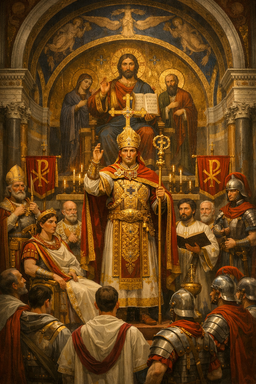
Through this political maneuvering, the Roman State Church was born. The Edict not only made Monotheism the sole legal religion, but all Romans were also legally required to be Christian monotheists. In other words, the Creed made Monotheism the State Religion of the Roman Empire. All Romans were, by law, members of the Roman State Church.
Furthermore, the Emperor acted as the functional head of the Church. For example, Theodosius unilaterally decided who to appoint as the bishop of the Capital, Constantinople. As another example, in 383, he called another council, at which he, personally, decided which of the several Christian factions were allowed. All other factions were outlawed.
The Edict was followed by severe state-sponsored persecution:
- Arians were banned from living in cities and towns.
- Arian worship meetings were strictly prohibited.
- Arian church properties were confiscated by the state.
In this way, Arianism was eliminated from the Roman State Church. 🔗
Conclusion
The purpose of this section is to show how the Roman State Church could be the 11th horn of the 4th beast in Daniel 7. For that purpose, it must show, firstly, that the Roman State Church was part of the Roman Empire.
So far, this section has achieved this first purpose. It has shown that the Roman State Church, adhering to the doctrines prescribed by the Edict of Thessalonica, with all Romans as members, and with the emperor as the effective head, was fully integrated into the Empire.
Furthermore, to fit the prophecy of the “eleventh horn” of Daniel 7, the Roman State Church had to survive the collapse of the Roman Empire and transform into a sovereign power. The remainder of the discussion will show from history that this is exactly what happened:
Fifth Century: Arian Rule
So far, we have mostly discussed Christianity within the Roman Empire. However, nations outside the Empire, such as the Goths, also accepted Christianity. These nations converted before Theodosius, when Arianism still dominated, and therefore remained Arian after the Edict of Thessalonica. Consequently, in the fifth century, after these Germanic tribes defeated the imperial forces, conquered the Western Empire, and divided it into several kingdoms, Europe again came under Arian rule.
However, the Arians tolerated the Roman State Church and allowed it to continue. They did not respond with the same kind of persecution imposed by the Roman emperors. Nevertheless, the Roman State Church was now under Arian rule. 🔗
Sixth to Eighth Centuries: Byzantine Empire
In the sixth century, the Eastern Emperor Justinian defeated and subdued the Arian kingdoms in the West, freeing the Roman State Church from Arian control. For the next two centuries, known as the Byzantine Papacy, the Eastern Empire governed the West through the Roman Church. Under the combined dominance of the Eastern Roman Empire and the Roman State Church, the defeated Arian nations abandoned Arianism and joined the Roman State Church. Conversion was imposed top-down: kings made the political decision, and their people were forced to follow. 🔗
The Roman Church
In the eighth century, Muslim conquests weakened the Eastern Roman Empire. This ended the dominance of the Eastern Empire. By then, the Western kingdoms that had joined the Roman State Church over the previous two centuries now supported and protected it. Since the Church was no longer the Roman State Church, it became simply the Roman Church.
Yet, these Western kingdoms also dominated the Church. Throughout the first millennium, political rulers dominated the Church. In particular, the rulers strongly influenced the appointment of the senior church officials.
In the 11th century, however, through the Investiture Controversy, the Roman Church freed itself from secular control. It successfully transitioned from an arm of the Roman Empire into a sovereign power and began to grow into the independent, continent-dominating powerhouse that dominated Europe’s nations and kings during the High Middle Ages. 🔗
Conclusion
The Roman State Church was part of the Roman Empire, survived the fall of Rome, grew in power, and became the Roman Church, a sovereign power, dominating the kings of Europe. Therefore, the Roman State Church can be the 11th horn of the 4th beast, in Daniel 7. Furthermore, in the Historicist view:
- The 2300 evening-mornings are 2300 literal years, beginning in the time of the Medo-Persian Ram, and ending with the French Revolution, when the persecuting power of the Roman Church was broken.
- The sanctuary symbolizes God’s people and God’s message.
- The purification of the sanctuary symbolizes the restoration of Biblical truth after the distortions of the Middle Ages.
The next article will analyze this further by comparing the description of the 11th horn to the history of the Roman State Church.
Summary: Three Interpretations of the Little Horn
To contextualize this historical journey, we can compare how the three major schools of prophetic interpretation view the Little Horn of Daniel 8:
| VIEW: | Preterist (Liberal) | Historicist (Reformer) | Futurist (End-Times) |
| Identity of the Horn | King Antiochus IV (2nd Century B.C.) | The Roman State Church (evolving into the Papacy) | A literal, future, end-time Antichrist |
| The 2,300 Days | 1,150 literal days during Antiochus’s reign | 2,300 literal years, ending with the French Revolution | 2,300 literal days of the Antichrist’s end-time rule |
| The Sanctuary | The literal Temple in Jerusalem | God’s people and God’s message | A literal, rebuilt Jewish Temple in Jerusalem |
| The Cleansing | The historical Maccabean restoration of the temple | The restoration of Biblical truth post-Middle Ages | The physical return of Jesus Christ |
Theological Implications
The theological implications of the three interpretations of the Little Horn in Daniel 8 are far more significant than people often realize. Each interpretation produces a radically different theology of history, the nature of the Church, and the identity of the Antichrist. Preterism collapses prophecy into the past, Futurism pushes fulfillment into the future, and Historicism places fulfillment inside Christian history.
1. Preterist Interpretation — Antiochus IV
Daniel is not predictive prophecy. It is merely a theological commentary on past events. Daniel becomes “history written as prophecy.”
Daniel does not provide proof of divine foreknowledge.
There is no future Antichrist figure. Evil is not a climactic, eschatological enemy.
Daniel is a strictly Jewish book. It has no or little relevance for Christian eschatology.
2. Futurist Interpretation — A Future End-Time Antichrist
Daniel’s prophecies leap over history and land in the final years before Christ’s return. There is a huge “gap” in prophecy. Rome disappeared 1500 years ago and will suddenly appear again in the end times.
A literal, future Antichrist becomes central to church preaching on eschatology.
Israel’s national restoration and a rebuilt Jewish temple become prophetic requirements. Christian theology must accommodate renewed temple sacrifices.
3. Historicist Interpretation — The Roman Church / Papacy
This is the interpretation championed by the Protestant Reformers.
Daniel’s prophecies unfold continuously through Christian history. The Antichrist is not future—it is historical and institutional.
The periods in Daniel are symbolic, representing long periods: The era of the 11th horn, the time, times, and a half, is 1260 years, beginning when the horn uproots three others, and ending with the Enlightenment / French Revolution, which ended the persecuting power of the Church. The 11th horn in Daniel is the Beast in Revelation, and the Beast is not directly involved in the end-time crisis. In the end time, the prime drivers are the False Prophet and the Image of the Beast.
The defilement of the sanctuary symbolizes doctrinal corruption. The Trinitarian doctrines of the Edict of Thessalonica, which gave birth to the Roman State Church, are questioned. Did the Trinity arise from divine revelation or imperial enforcement?
The persecution of dissenters is in the nature of the Church.
Cleansing of the sanctuary is the restoration of biblical truth (e.g., Reformation).
In our next article, we will compare the description of the Little Horn in Daniel 7 to secular history to determine which interpretation holds up to the rigorous test of scripture and time.
Other Articles
The Antichrist in Daniel
🔗 Daniel 2 – The Vision of the Statue of a Man – MP3
🔗 Daniel 7 – The Vision of Four Beasts – MP3
🔗 Daniel 7 – What is the Fourth Beast? – MP3
🔗 Three Interpretations of the Little Horn (Current Article)
🔗 Identity of the 11th horn of Daniel 7 – MP3
🔗 Daniel 8 – Out of what does the Horn come?
🔗 Daniel 11 – Who is the Vile Person?
🔗 Daniel 11 – Antiochus IV is not Daniel’s Antichrist.
Other Core Articles
🔗 All articles on this Site
🔗 Daniel’s Little Horn
🔗 Daniel 9, verse-by-verse
🔗 The Mark of the Beast
🔗 The Trinity doctrine
🔗 The True Origin of the Trinity Doctrine
🔗 The Sabbath was part of the Arian Controversy