Purpose
Daniel 8 portrays the Antichrist as a Little Horn. According to verse 9, it emerges from “one of them.” This article examines that phrase to determine its meaning—in other words, where the Antichrist, in Daniel 8, comes from.
In the Liberal interpretation, “one of them” refers to one of the four Greek horns. This seems plausible because Daniel 8 describes a goat, explicitly identifies it as Greece, and says in verse 8 that the goat had four horns. Verse 9 then says the Antichrist came out of “one of them.” However, this article will argue that the phrase does not refer to one of the four horns. To determine its meaning, the article examines the possible antecedents of “one of them.”
The Antichrist in Daniel 7
This article identifies the Antichrist in Daniel 8. The previous article identified the Antichrist in Daniel 7:
Daniel 7 presents four animals, representing four successive empires, but it does not name them.
Daniel 8, by contrast, includes only two animals: a ram and a goat, explicitly identified as Medo-Persia and Greece.
To identify the empires in Daniel 7, the previous article compared the descriptions of the animals in Daniel 7 to those in Daniel 8. It concluded that the Fourth Beast in Daniel 7 represents the Roman Empire. 🔗
In Daniel 7, the Antichrist is the 11th horn of that fourth beast. Since the fourth beast is Rome, the Antichrist is Roman in origin.
Because the evil horns in Daniel 7 and Daniel 8 symbolize the same Antichrist, the Little Horn in Daniel 8 must also be Roman in origin.
One of Them
Now consider the phrase in Daniel 8:9, “One of Them.”
In Daniel 8, the Greek Empire is represented by a goat. At first, it has one large horn, symbolizing the united Greek Empire before Alexander’s death. After that horn is broken, four horns rise in its place. These represent the four empires into which Greece was divided after Alexander died. Verse 8 describes this as follows:
“There came up four conspicuous horns toward the four winds of heaven.”
Verse 9 then introduces the Little Horn:
“Out of one of them came forth a rather small horn.”
A Greek Horn
If the Little Horn emerged from one of the Greek horns, it would be Greek in origin and could represent a Greek ruler such as Antiochus IV in the second century B.C. He persecuted Israel and defiled the Jewish temple by sacrificing unclean animals on the altar.
Or One of the Four Winds
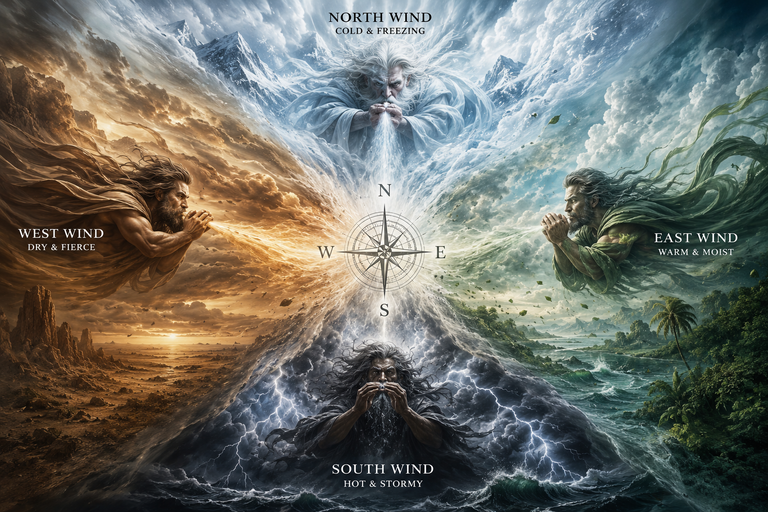
However, “out of one of them” can also be understood another way. Verse 8 mentions two sets of four: the four horns and the four winds of heaven:
“There came up four conspicuous horns toward the four winds of heaven” (Daniel 8:8, cf. 22).
Therefore, the Little Horn may have come from one of the four winds—that is, from one of the four compass directions: west, east, south, or north. The question, then, is whether the evil horn came from one of the horns or from one of the winds.
Horns do not grow on Horns.
First, horns do not come from other horns. Daniel 8 mentions six horns: the goat’s first large horn, the four horns that replace it after it is broken, and the Little Horn. Therefore, “out of one of them” cannot mean that the sixth horn came from one of the four horns, because horns grow on heads, not on other horns.
Genders must agree.
The main point of this article is that the phrase “one of them” agrees in gender with “winds of the heavens,” not with “four horns.”
Daniel 8 was written in Hebrew, where nouns and pronouns have gender. These gender distinctions are hidden in English translation. As in English, where pronouns such as “he” and “she” must match the genders of their antecedents, Hebrew pronouns must agree with the nouns they refer to. Therefore, in the phrase “one of them,” both “one” and “them” have genders that must match their antecedents.
The previous verse contains three relevant nouns: horns, winds, and heaven. Their genders help identify what “one of them” refers to.
With the relevant words marked as female or male, the passage reads as follows:
Verse 8: Four conspicuous HORNS (female)
toward the four WINDS (female)
of HEAVEN (male).
Verse 9: Out of ONE (female)
of THEM (male)
came forth a rather small horn.
“Them” Refers to the Heavens.
First, consider the pronoun “them.” It is plural. In Hebrew, “heaven” or “heavens” is always plural. Therefore, verse 8 contains three plural nouns: horns, winds, and heavens. The pronoun “them” must refer to one of these.
However, “them” is male, while “horns” and “winds” are female. The only male plural noun in the preceding phrase is “heavens,” so “them” refers to the heavens.
“One” Refers to a Wind.
Next, consider the word “one:”
First, because “one” and “them” have different genders, they do not refer to the same noun. Since “them” refers to the heavens, “one” cannot also refer to the heavens. Thus, “one of them” does not mean one of the heavens.
Second, both “one” and “horns” are female, so gender alone could allow “one” to refer to one of the horns. However, since “them” refers to the heavens, that would make the phrase mean “one of the horns of the heavens,” which is illogical. Heavens do not have horns.
Finally, since “one” is female but cannot refer to the horns, the only remaining female noun is “winds.” Therefore, “one” refers to one of the winds.
Conclusion
In conclusion, “out of one of them” means out of one of the winds of the heavens—that is, from one of the four compass directions. This fits the immediate context:
Verse 8 ends with “the four winds of heaven.”
Verse 9 then begins, “Out of one of them came…”
Thus, the opening phrase of verse 9 refers back to the closing phrase of verse 8. The relationship can be shown as follows:
| Female | Male | |||
| 8:8 | There came up four horns toward | the four winds | of the heavens. | |
| 8:9 | Out of one | of them | came forth a small horn. |
Since the Little Horn came from one of the compass directions rather than from one of the four Greek horns, it is not Greek in origin. Yet, because horns grow on animals, it must still be the horn of some beast. Since the empire after Greece was Rome, this confirms that the Little Horn came from the Roman Empire.
Where is Rome?
One objection to this interpretation is that Daniel 8 does not seem to mention Rome. It describes no separate empire between Greece and the Evil Horn. So where does Rome appear in this chapter? The answer is as follows:
1. The Horn is the Roman Empire.
In the Book of Daniel, horns represent divisions of empires. For example, the two horns of the Medo-Persian Ram, and the four horns of the Greek Goat are divisions of those empires. In the same way, the 11 horns of the Roman Beast are divisions of the Roman Empire. Daniel 7 states this principle explicitly. Daniel says he watched the horn until the beast was slain:
“I kept looking because of . . . the boastful words which the horn was speaking; I kept looking until the beast was slain” (Daniel 7:11).
In other words, in Daniel 7, the Horn continues the Roman Beast. As long as the Horn lives, the Beast lives. When the Horn acts, the Beast acts. Since the Beast is Rome, and since the Horn continues until Christ returns, Rome’s influence continues even today through the Horn. Later articles in this series explain this further.
The same principle applies to Daniel 8. The Little Horn is not an isolated horn detached from any animal. It must be the horn of some beast. Therefore, the Horn in Daniel 8 not only corresponds to the evil horn of Daniel 7; it also includes the fourth beast of Daniel 7.
2. Two Phases of Growth
This is confirmed by the Horn’s two phases of growth in Daniel 8:
First, the horn grows horizontally. According to verse 9, it expands toward the south, the east, and the Beautiful Land—Israel. This horizontal growth represents its political phase, corresponding to the fourth beast of Daniel 7, which likewise devours the whole earth, tramples it, and crushes it. (Daniel 7:8, 23).
Second, the horn grows vertically. It reaches the host of heaven, casts some of the stars to the earth, and tramples them (Daniel 8:10). It also magnifies itself against the Commander of the host (Daniel 8:11), that is, against God. This is symbolic language: the stars represent God’s people, and trampling them represents persecution. This vertical growth is the horn’s religious phase, corresponding to the Little Horn of Daniel 7.
Thus, Daniel 8 clearly includes the Roman Empire. The Little Horn in Daniel 8 represents both the fourth beast of Daniel 7 and the 11th horn that grows from that beast.
3. A Trend from Vision to Vision
This reduced emphasis on political powers continues a trend across Daniel’s visions. From Daniel 2 to Daniel 7, Daniel 8, and Daniel 11, the focus increasingly shifts from political empires to the spiritual power—the Antichrist—as shown below:
Daniel 2 covers the entire period from Babylon to Christ’s return and God’s eternal kingdom, but it does not mention the Antichrist.
Daniel 7 includes all six ages described in Daniel 2 but adds the Antichrist. Indeed, the Antichrist becomes the chapter’s main focus: the dreadful fourth beast is described in only two verses, while the Antichrist-horn receives about six.
Daniel 8 continues this pattern. It no longer mentions Babylon, the first empire, or God’s eternal kingdom, the final age. It also gives no separate symbol for Rome’s political phase. Instead, its focus rests on the Antichrist.
This progression shows that the Antichrist is the central concern of these prophecies. The political empires are described only to identify that power.
Daniel 8 can omit details found in earlier visions because Daniel’s prophecies form a unified whole. It is not a stand-alone prophecy; it explains Daniel 2 and 7 in greater detail and must be read together with them.
In conclusion, this analysis—especially the gender agreement of the nouns and pronouns in Daniel 8:8-9—confirms the conclusion from Daniel 7: the Antichrist originated from the Roman Empire. The next article will discuss three alternative interpretations of this evil power. 🔗
Theological Implications
1. Daniel’s visions must be read as one.
Daniel’s visions form a unified prophetic system. They are progressive rather than isolated: later visions clarify earlier ones. Therefore, Daniel 8 must be read together with Daniel 2 and 7.
2. The Antichrist is the central concern of Daniel’s visions.
The article identifies a clear progression:
- Daniel 2 presents broad empires but does not mention the Antichrist.
- Daniel 7 presents the empires and then introduces the Antichrist.
- Daniel 8 focuses almost entirely on the Antichrist.
The empires serve only to identify the Antichrist’s historical origin.
3. The Antichrist is not Greek.
The article’s grammatical argument shows that the horn comes from one of the winds, not from one of the Greek horns. This supports a continuous-historic interpretation rather than a preterist one. In this view, Daniel 8 is not fulfilled in Antiochus IV or any other Greek ruler, nor was it completed in the 2nd century B.C. Instead, Daniel 8 points beyond ancient history.
4. The Antichrist is Roman.
In Daniel 7, the horn continues the life of the beast. Since the beast is Rome, Rome does not simply end in the fifth century; it continues in a religious-political form until Christ’s return. This aligns with classical Protestant eschatology (e.g., Luther, Calvin, Wesley), which identified the Antichrist as a Roman successor power.
5. The Antichrist is a Long-Term Power.
Because the Little Horn remains until the beast is slain, and the beast is slain only at Christ’s return, the Antichrist cannot be a brief historical figure. It is a long-term religious-political power active throughout Christian history, with a continuous institutional presence.
6. The Antichrist is a counterfeit religious authority.
The horn “magnifies itself” against the Commander of the host. Its persecution of the “stars,” representing God’s people, and its opposition to the Commander, representing God, point to a false religious system that claims divine authority. It opposes God not only through violence but also through imitation, suggesting a counterfeit system of worship and supporting the idea of a church-state power.
Other Articles
The Antichrist (Daniel 2, 7, 8, and 11)
🔗 Daniel 2 – The Vision of the Statue of a Man – MP3
🔗 Daniel 7 – The Vision of Four Beasts – MP3
🔗 Daniel 7 – What is the Fourth Beast? – MP3
🔗 Daniel 8 – Out of what does the Horn come?
🔗 Three Interpretations of the Little Horn – MP3
🔗 Identity of the Little Horn – MP3
🔗 Daniel 11 – Who is the Vile Person?
🔗 Daniel 11 – Antiochus IV is not Daniel’s Antichrist.
Other Core Articles
🔗 All articles on this Site
🔗 Daniel’s Little Horn
🔗 Daniel 9, verse-by-verse
🔗 The Mark of the Beast
🔗 The Trinity doctrine
🔗 The True Origin of the Trinity Doctrine
🔗 The Sabbath was part of the Arian Controversy
For general theology, I recommend Graham Maxwell.