Overview
Book of Daniel
This article is essentially a combination of the conclusions from previous articles. Concerning the Book of Daniel, previous articles concluded as follows:
The fourth animal in Daniel 7 symbolizes the Roman Empire (see here).
The 11 horns growing from this animal are the kingdoms formed when the Roman Empire fragmented.
The 11th Horn is the Antichrist. It has been identified as the State Church of the Roman Empire, also called the Roman Church (see here). In the fourth century, the Church was divided into factions. However, in 380, through the Edict of Thessalonica, the Empire made Nicene Christianity its State Church, meaning that all Romans were now Christians and members of the Church, with the emperor as its head. The same Edict outlawed Arianism. This was followed by severe persecution. Arian churches were confiscated, and Arians were prohibited from preaching and living in the cities and towns (see here).
After the Roman Empire fragmented, the Roman Church survived as a distinct organization. It grew in power and became the Church of the Middle Ages (see here).
Book of Revelation
Concerning the Book of Revelation, previous articles concluded:
The Dragon, from which the Beast receives its authority, is the Roman Empire (see here).
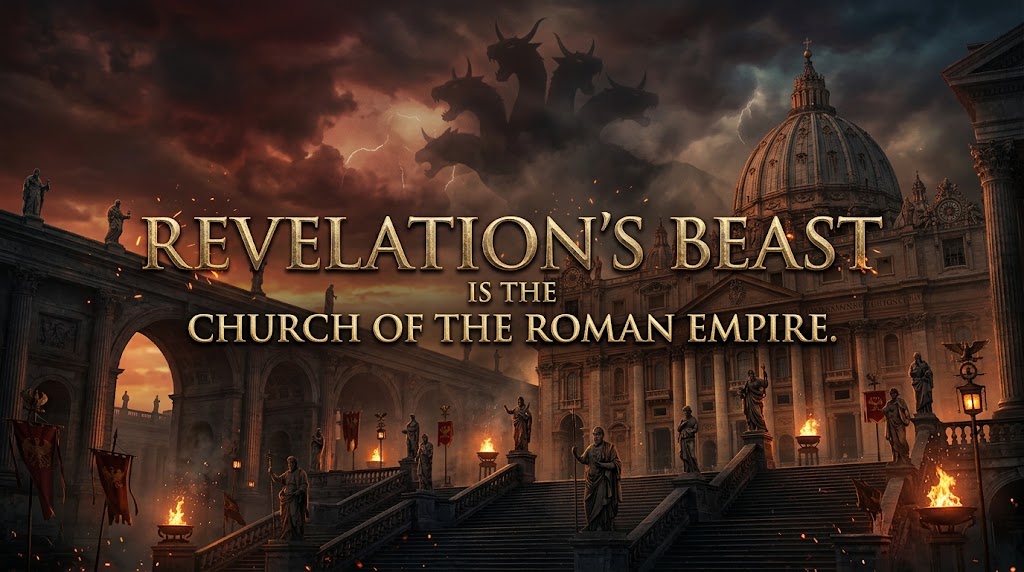
The Beast is the same as Daniel’s 11th Horn, symbolizing the Roman Church (see here).
The 42 months during which the Beast will rule (Rev 13:5) are the Middle Ages (see here).
The Middle Ages ended when religious freedom prevented the Roman Church from further persecuting God’s people. That is the fatal wound to one of the heads (phases) of the Beast (Rev 13:3) (see here). Today, we are living during this fatal wound.
In the End Time, when an Image of the Beast (a replica of the system from the Middle Ages) is established, the wound will be healed. Then the Beast will once again persecute its opponents.
Book of Daniel
The fourth animal – the Roman Empire
Daniel 7 symbolizes four successive empires as four animals emerge from the sea. The 4th animal is the Roman Empire:
There are only two animals in Daniel 8; the Ram and the Goat, explicitly identified as “the kings of Media and Persia” and as “the kingdom of Greece” (Dan 8:20-21). By comparing them to the animals in Daniel 8 (see here), the animals in Daniel 7 are identified as ancient Babylon, Medo-Persian, Greece, and the Roman Empire.
The 11 horns – fragments of the Roman Empire
The 11 horns are the kingdoms formed when the Roman Empire fragmented.
From the 4th animal (the Roman Empire), 11 horns grow. The first 10 symbolize the nations of Europe into which the Western Roman Empire divided in the fifth century:
In the Liberal view, the horns exist DURING the fourth empire. In contrast, the following shows that the 11 horns exist AFTER the 4th animal:
The Divided Empire in Daniel 2, which is symbolized by the Feet of Iron and Clay, exists after the Iron Legs of that Image. Since the Legs are parallel to the Fourth Beast in Daniel 7 and the Feet parallel to the Horns of Daniel 7, the Horns must exist after the Beast.
Furthermore, Daniel 7 explicitly says: “Out of this kingdom [the fourth] ten kings will arise” (Dan 7:24), implying that these kings will not exist inside or during the fourth kingdom but after it. Read Article
The 11th Horn is the Antichrist.
After the first 10, an 11th Horn comes up from the fourth animal (the Roman Empire). It is different from the others. It becomes larger than the other horns and opposes God. It blasphemes the Most High, persecutes His people (Dan 7:8, 24-25), and will only be destroyed when Christ returns (Dan 7:26-27).
“26 But the court will sit for judgment, and his dominion will be taken away, annihilated and destroyed forever. 27 Then the sovereignty, the dominion and the greatness of all the kingdoms under the whole heaven will be given to the people of the saints of the Highest One; His kingdom will be an everlasting kingdom, and all the dominions will serve and obey Him.”
The 11th Horn – the Roman State Church
The 11th Horn is one of the kingdoms into which the Roman Empire fragmented in the fifth to eighth centuries. In the Roman Empire, the emperors decided which religions and factions of religions to allow. In practice, after Christianity was legalized, the emperors were the heads of the Church and the ultimate judges in doctrinal disputes. [Show More]
In the fourth century, the Church was divided, mainly between Arian and Nicene factions. However, in 380, the Roman Empire made Nicene theology its State Religion (🔗), meaning that all Romans were now Christians, specifically Nicene Christians, with the emperor the Head of the Church. [Show More]
At the same time, the Empire outlawed and severely persecuted the other forms of Christianity. It confiscated Arian churches and prohibited Arians from living and preaching in cities and towns. [Show More]
Roman State Church became the Roman Church.
In the next (fifth) century, Germanic tribes took control of the Western Empire from the Romans. They fragmented it into several Germanic kingdoms, symbolized by the first ten horns of the fourth animal. Since they converted to Christianity while Arianism still dominated, these tribes were Arians. The Roman State Church, with its teachings and hierarchy of bishops, survived as a distinct organization but was now subject to Arian rule. (🔗) [Show More]
In the sixth century, the Eastern Empire sent troops to the West, subjected three Arian nations, and liberated the Roman Church. This is symbolized as the 11th Horn coming up by uprooting three other horns. However, the Roman Church in the West remained subordinate to the Eastern Roman emperors. (🔗)
In the eighth century, Muslim armies significantly weakened the Eastern Empire, rendering it unable to rule or protect the Western Church. The Church obtained protection from other Western rulers. However, it was still subject to such rulers. These rules appointed the popes and other senior church officials.
Beginning in the 12th century, in the High Middle Ages, the Papacy attained power that rivaled and exceeded that of the Western Monarchs. It became the Church of the Middle Ages, which dominated the nations of Europe and persecuted God’s people. Read Article
Book of Revelation
The Dragon represents the Roman Empire.
There are three seven-headed beasts in Revelation: the Dragon, the Sea Beast, and the Scarlet Beast. These beasts are part of the series of animals in Daniel 7, and explain those empires in more detail. Revelation 12 uses “Dragon” as a general symbol for all God’s opponents, but in Revelation 13, where it is described with the Beast, the Dragon is specifically equivalent to Daniel’s 4th animal (see here), representing the Roman Empire.
The Beast is the Roman State Church.
The Beast of Revelation, whose Mark in the Time of the End will be put on the foreheads of people (Rev 13:15-16), receives its authority from the Dragon (Rev 13:2). In other words, it received its authority from the Roman Empire. The Beast is the same as the 11th Horn that grows out of that fourth animal in Daniel 7 (see here), which has been identified as the Church of the Roman Empire. (For purpose of clarity, this article reserves the term “Beast” for the Beast in Revelation 13:1 and refers to the creatures of Daniel 7 as animals.)
Revelation confirms as follows that the Beast is the ‘church,’ and not just a political power:
(1) It is a deliberate counterfeit of Jesus Christ:
-
-
-
- Like Jesus, the Beast has a ministry that lasts three and a half years (Rev 13:5) and was killed but resurrected from death (Rev 13:3).
- While Jesus received His authority from the Father (Matt 28:18), the Sea Beast received its authority from the Dragon (Rev 13:2).
- While Jesus is the image of God (Col 1:15; John 14:9), the Beast is an image of the Dragon because both have seven heads and ten horns.
-
-
(2) The Beast persecutes explicitly God’s people (Rev 13:6-7). Only a Christian organization is able to persecute God’s true people, for God’s people are identified by their protest against unbiblical doctrines and practices in the church.
(3) The Beast uses a lamb-like beast as its agent (Rev 13:11-12). Revelation refers 28 times to Jesus as a lamb. This is the only instance in Revelation where “lamb” does not refer to Jesus. The lamb-like beast, therefore, looks like Jesus but “spoke as a dragon” (Rev 13:11). It is dragon-like with a Christian face! It claims to serve Jesus, yet its actions serve the Dragon!
(4) The New Testament elsewhere often predicts that the Church would apostatize. For example: “The Spirit explicitly says that in later times some will fall away from the faith, paying attention to deceitful spirits and doctrines of demons” (1 Tim 4:1; cf. Acts 20:28-31; 2 Tim 3:1-5; 1 John 2:18-19).
The Beast rules for 42 months.
According to Revelation 13, one of the Beast’s seven heads would have a fatal wound, but the wound would be healed (Rev 13:3). This means that the Beast would be strong for a period, followed by a period of weakness, before it again becomes strong.
The Land Beast “makes the earth and those who dwell in it
to worship the first beast, whose fatal wound was healed” (Rev 13:12). In other words, the end-time persecution of God’s people, as described in the last part of Revelation 13, describes the time after the Beast’s wound healed.
Revelation 13 also says that the Beast would have “authority to act” for 42 months (Rev 13:5). Since this cannot be the period of weakness, the question is, do the 42 months precede or follow the Wound?
The 42 months describe the Middle Ages.
The article discussing the 42 months (see here) concludes as follows:
1. The “time, times, and a half,” 42 months, and 1260 days are the same period:
In Revelation 12, the 42 months are described as a time, times, and half a time or 1260 days (Rev 12:6, 14), during which God’s people will have to hide in the wilderness. These are numerically the same period (time, times, and half a time = 3.5 years = 42 months = 42×30 = 1260 days). This same period is mentioned as a time, times, and half a time during which God’s people will be given into the hand of Daniel’s 11th Horn (Dan 7:25).
2. This period is not the End Time but always precedes the End Time. For example, in Rev 12, the end-time war (Rev 12:17) follows after this period (Rev 12:14).
3. The 3½ times it is not literally 1260 days but symbolic of a much longer period:
The nature of Revelation, with things such as beasts with seven heads and ten horns that are worshiped by the people of the world, implies that time indications are also symbolic. For example, the ten horns are ten kings that will reign “for one hour” (Rev 17:12). This must symbolize a much longer period than one literal hour, but still a relatively short period, perhaps only some months. Compared to one hour, 42 literal months (3½ years) is a very long time.
4. A Day must be counted as a Year. That is how the Reformers interpreted the apocalyptic time prophecies. Therefore, 1260 days represent 1260 years.
5. The 3½ times or 42 months are the Middle Ages:
Daniel 7 states that the 11th Horn comes up when it uproots three of the other horns (Dan 7:8). That refers to Emperor Justinian’s wars in which he subjected the three Arian nations that dominated the Roman Church. Those wars began in 533 and ended in 552.
The authority of the Roman Church was wounded by the introduction of religious liberty in the time of Napoleon and the French Revolution in the 1790s. The period from the 530s to the 1790s is 1260 literal years. Therefore, it is proposed that that was the period of authority of the Roman Church.
The three stages of the ‘Roman Church’
It follows that the ‘Roman Church’ exists through three stages.
1. The 42 months represent the many centuries during the Middle Ages when it massacred people who did not accept its blaspheming doctrines and practices.
2. Its authority received a fatal wound through religious liberty and the separation of Church and State around the time of the French Revolution. We are today living during the fatal wound. The Church is no longer able to compel people to comply with its prescripts, as it was during the Middle Ages.
3. In the End Time, the wound will be healed (Rev 13:3) when an Image of the Beast (a copy of the system during the Middle Ages) is set up, which will again kill its opponents.
The Beast in the End-Time War
Just like the Beast received its authority from the Dragon (Rev 13:2), symbolizing the Roman Empire, the Beast gives its authority to its end-time assistant, the Land Beast (Rev 13:12). The Land Beast then convinces the people of the world to make an Image of the Sea Beast (Rev 13:14). The Image persecutes and kills God’s end-time people (Rev 13:15).
The Image is an end-time organization in the likeness of the Beast. It is an end-time organization that functions on the principles of the Church of the High Middle Ages, but it is not the Beast itself. It will not be the same organization as during the Middle Ages. The Beast is resurrected by the creation of the Image, but it will be a different organization.
Image of the Beast = Religious Persecution
The Church of the Middle Ages brutally persecuted and executed believers who dared to stand up to its doctrines and practices, but the religious oppression and intolerance of the Protestant Orthodoxy (in the seventeenth and eighteenth centuries) were disturbingly similar to the Church in the High Middle Ages. For example, the role Calvin played in the murder of Michael Servetus. Bosnia, Rwanda, and the Holocaust show that today’s version of institutional Christianity has not significantly improved over that of the Middle Ages.
Whenever we see persecution and killing of people for their religious convictions, whatever form that persecution takes, we see the spirit of Satan at work, for God never uses force. If God used force, He would not have allowed evil to develop. But He created us as free beings with the wonderful ability to make our own choices. He protects our freedom, for if He overrides our freedom to choose against Him, He would destroy the miracle He has created.
Other Articles
Revelation 13
🔗 The Dragon is the Roman Empire.
🔗 The Beast continues the authority of the Roman Empire.
🔗 The Beast’s fatal wound is its sixth head. (13:3-4)
🔗 Revelation’s Beast is the Church of the Roman Empire.
🔗 The Mark of the Beast
Other Core Articles
🔗 All articles on this Site
🔗 Daniel’s Little Horn
🔗 Daniel 9 – Verse-by-Verse
🔗 Daniel 9 – Four Alternative Interpretations
🔗 Revelation 13 Dragon, Roman Empire
🔗 Revelation 13 Beast, Roman Christian Authority
🔗 What is the Mark of the Beast?
🔗 The Trinity doctrine
🔗 The True Origin of the Trinity Doctrine
🔗 The Sabbath was part of the Arian Controversy.
🔗 Christ’s Return
Other Article Series
🔗 The Antichrist in Daniel 2, 7, 8, and 11
🔗 The 490 years of Daniel 9
🔗 Book of Revelation
🔗 Christology
🔗 Origin of Evil
🔗 Death, Eternal Life, and Eternal Torment
For general theology, I recommend Graham Maxwell.