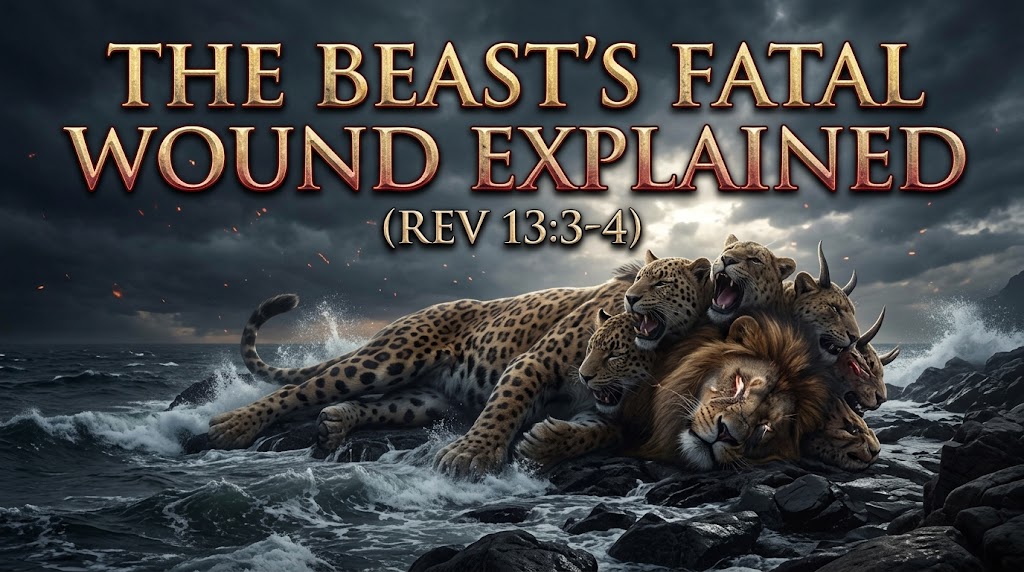
Abstract: This article explores the prophetic identity of the Beast’s “fatal wound” in Revelation 13:3-4 by cross-referencing it with the vision of Revelation 17. It argues that the seven heads of the Beast represent distinct, sequential historical phases of the Beast’s existence rather than individual contemporary rulers. The “fatal wound” corresponds to the sixth head—a period of temporary incapacity where the Beast is unable to persecute God’s people due to modern religious freedom and the separation of church and state. The study concludes that this wound will eventually be healed when the Beast revives in its seventh phase, leading to global admiration and renewed religious persecution.
Overview of Conclusions
John saw a beast with ten horns and seven heads coming out of the sea. The Beast received its authority from a dragon. As discussed in previous articles:
The Dragon symbolizes the Roman Empire.
The Beast symbolizes one of the kingdoms into which the Empire fragmented in the fifth to eighth centuries. Specifically, the Beast symbolizes the State Church of the Roman Empire that survived intact after the Empire fragmented, grew in strength, and eventually dominated the other kingdoms in Europe.
One of the Beast’s seven heads had a ‘fatal wound’, meaning that it was dead. But the Beast came to life again:
Since the seven heads exist one after the other, the seven heads symbolize the seven phases of the Beast’s existence. So, the death of one of its heads is the death of the whole Beast, but only for a time.
Revelation 17 also explains the fatal wound and the Beast’s recovery from it:
It describes the fatal wound as the Beast being incapacitated, unable to persecute God’s people.
As confirmation that Rev 13 and 17 describe the same Wound and the same Healing, both chapters say that, after the Wound was healed, “everyone whose name has not been written from the foundation of the world in the book of life” was amazed and followed after the Beast (Rev 13:3; 17:8).
Revelation 17 identifies the Wound as the Beast’s sixth head, which is our current age of relative religious freedom in the Christian world. But Revelation predicts that the Church of the Roman Empire will be revived, and again persecute God’s people.
Purpose
John saw a Beast with “ten horns and seven heads” coming out of the sea (Rev 13:1). One of his seven heads was “as if it had been slain,” for it had a “fatal wound” (Rev 13:3). In other words, it seems as if the Beast itself and the other six heads were still alive. The purpose of this article is to explain what this fatal wound is and which of the seven heads was dead.
Revelation 13:3-4
The Beast continues the Roman Empire.
The Beast received its authority from the Dragon (Rev 13:2). Previous articles identified the Dragon and the Beast:
Revelation 12 uses ‘Dragon’ as a symbol for Satan’s forces in different forms and ages. However, in Revelation 13:2, the Dragon is the same as the fourth animal in Daniel 7, which another article identified as the Roman Empire.
The Sea Beast is the 11th horn of that fourth animal, symbolizing a world power that, came into existence when the Roman Empire fragmented into many kingdoms, inherited the authority of the Roman Empire (cf. Rev 13:2), and grew in power to dominate the other kingdoms in the territory previously ruled by the Roman Empire (Dan 7:20).
The Beast was dead.
A “fatal wound” is a wound that kills. In other words, the Beast was dead. Therefore, when the wound is healed, it is said that the Beast “has come to life” (Rev 13:12, 14). That same expression is also used for Christ’s resurrection (Rev 2:8) and the resurrection of God’s people when Christ returns (Rev 20:4).
Only one phase of the Beast was dead.
But the entire Beast did not die; only “one of his heads” was “slain” with this fatal wound (Rev 13:3). Since the seven heads exist one after the other (Rev 17:9-10), the seven heads symbolize the seven phases of the Beast’s existence. So, the death of one of its heads is the death of the whole Beast, but only for a time.
The whole world worshiped the Beast.
After the wound was healed, “the whole earth … worshiped the beast” (Rev 13:3-4). This does not mean that the world thought that the Beast is God or a god. The Greek word that is translated as “worshiped” (proskuneó) simply means to bow down before a superior. In the current verse, people proskuneó the Beast as a mighty king, for they say:
“Who is like the beast, and who is able to wage war with him?” (Rev 13:4)
For a detailed discussion of ‘worship,’ see here.
The people also “worshiped the dragon because he gave his authority to the beast” (Rev 13:4). Since the Dragon symbolizes the Roman Empire, and since the Sea Beast came into existence when the Roman Empire fragmented, the Roman Empire no longer existed when the Beast received its fatal wound. But, by worshiping (obeying) the Sea Beast, the people indirectly ‘worship’ the Roman Empire because the Beast is the continuation of the authority of the Dragon (Rev 13:2).
Revelation 17
The Scarlet Beast on which the harlot sits, as described in Revelation 17, provides a different perspective of the same Beast-power. Revelation 17 describes and explains that same Fatal Wound as well as the healing of that wound. It also explains what the Fatal Wound is and which of the seven heads was dead.
At present, the Beast is incapacitated.
Revelation 17 explains the Beast and its heads by referring to the past, the present, and the future. At the ‘present’ time, the chapter describes the Scarlet Beast as incapacitated:
Is not – The Beast “is not” (Rev 17:8). In other words, in some sense, at this time, the Beast does not exist.
Wilderness – In Revelation 12, the pure woman was in the wilderness (Rev 12:6, 14), symbolizing circumstances in which it is difficult to survive. But, in Revelation 17, it is the Beast’s turn to be in the “wilderness” (Rev 17:3).
Abyss – The Beast is in the “abyss” (Rev 17:8), which symbolizes incapacity (Rev 20:3).
Diadems – In contrast to the Dragon and the Sea Beast, the Scarlet Beast has no diadems (ruler crowns) (Rev 12:3; 13:1; 17:3), implying that it does not rule.
So, in Revelation 17, the Beast is suffering, weakened, and unable to rule. In that sense, it “is not.”
This is the Fatal Wound.
For the following reasons, the incapacity in Rev 17 is the same as the fatal wound in Rev 13:
Firstly, for the Beast to be incapacitated must be unusual. Since two different chapters of Revelation describe this condition, they likely describe the same weak period.
Secondly, both the fatal wound in Rev 13 and the abyss in Rev 17 symbolize the inability to persecute God’s people:
When the Sea Beast is alive, it blasphemes God and persecutes God’s people (Rev 13:5-7; cf. Dan 7:25). Therefore, for it to be dead (to have a fatal wound) means being unable to persecute.
To be in the abyss also means to be unable to persecute. For example:
-
-
-
-
- Satan is bound in the abyss “so that he would not deceive the nations any longer” (Rev 20:3).
- After the Beast comes up from the abyss, it immediately proceeds to persecute God’s witnesses (Rev 11:7, 3).
-
-
-
Revelation 13 & 17 describe the same Healing.
Further evidence that Rev 17 describes the same fatal wound as 13:3 is that it describes the same healing of the wound as in Rev 13. Rev 17 predicts that the Beast will come up out of the abyss (Rev 17:8). The following confirms that its escape from the abyss is the healing of the wound in Rev 13:
After the Sea Beast’s “fatal wound was healed … the whole earth was amazed and followed after the Beast” (Rev 13:3).
Similarly, after the Scarlet Beast has “come up out of the abyss … those who dwell on the earth … will wonder when they see the Beast” (Rev 17:8).
Note the similarities:
-
- Both sections refer to the whole world.
- The terms “amazed” and “wonder” are translated from the same Greek word thaumazó.
- In both chapters, the Beast is exalted after its recovery.
- And, perhaps most strikingly, in both, those who adore the Beast are described in both chapters as “everyone whose name has not been written from the foundation of the world in the book of life” (Rev 13:8; 17:8).
For these reasons, the two chapters describe the same period of incapacity, symbolized in Revelation 13 by the Beast’s fatal wound and in Revelation 17 by the Beast being in the abyss or wilderness or ‘is not’.
The Sixth Head
The Fatal Wound is the Sixth Head.
Revelation 17 explains the Beast and its heads by referring to the past, the present, and the future:
| The Beast (Rev 17:8) | Heads (Rev 17:10) | |
| Past | Was | “Five have fallen.” |
| Present | Is not and is in the abyss | “One is.” This would be the sixth head. |
| Future | Will “come up out of the abyss.” The whole world will “wonder when they see the beast.” | “The other” (the seventh) “has not yet come.” |
Therefore:
The sixth head is the phase when the Beast is in the abyss, which is the head with the fatal wound.
The seventh head follows after the fatal wound has been healed, and the entire world follows after the Beast (Rev 13:4).
It is implied that the entire sixth head is dead. The sixth head or phase begins when the Beast-power is killed and ends when “his fatal wound was healed” (Rev 13:3, 12). This is confirmed by the fact that we never read that the head with the mortal wound comes to life; it is always the Beast that becomes alive (Rev 13:14).
When in history is the Sixth Head?
The fatal wound implies that the Beast goes through three phases: alive, dead, and again alive.
Since a previous article identified the Beast as the 11th horn of Daniel 7, the Beast began to exist when the Roman Empire fragmented into many kingdoms. Specifically, one of the previous articles identified the 11th horn as the Church of the Roman Empire that survived intact after the Empire fragmented, grew in power, and became the Church of the High Middle Ages:
In the Roman Empire, the emperors decided which religions and factions of religions to allow. In the fourth century, the Church was divided, mainly between Arian and Nicene factions. However, in 380, the Roman Empire made Nicene theology its State Religion, meaning that it was the only legal religion and that all Romans were required to confess the Nicene faith. Through persecution, the Empire eliminated ‘Arianism’ from the Roman State Church. However, outside the Empire, Christianity remained Arian.
The Roman State Church, with its teachings and hierarchy of bishops, survived as a distinct entity after Arian nations, in the fifth century, wrestled control of the Western Empire from the Romans. It also survived after Muslim armies, in the eighth century, subjected the Eastern Empire.
Beginning in the 12th century, in the High Middle Ages, the Roman Church attained power that rivaled and exceeded that of the Western Monarchs. It became the Church of the Middle Ages, which dominated the nations of Europe.
The Church of the Roman Empire (the Roman Church) was, therefore, the entity that carried forward the authority of the Roman Empire. (Read Article)
Consequently, another article identifies the seven heads of the Beast as follows:
- Babylonian Empire,
- Medo-Persian Empire,
- Greece,
- Roman Empire,
- The Roman Church after the Roman Empire fragmented, particularly during the High Middle Ages,
- The Roman Church is unable to dominate in the present age due to religious freedom and the separation of Church and State, and
- The Roman Church revived when the image of the Beast is erected, possibly near in our future.
The ‘Present Time’ is not John’s Time.
Many commentators assume that the ‘present time’ in Revelation 17 must refer to John’s own time because he had to understand what he was told. But that would mean that the Beast was dead in John’s time, which most certainly was not the case. At that time, the authorities were very able to persecute Christians.
My view is that, when the angel “carried” John “into a wilderness” (Rev 17:3), he took John not to a specific place but to a specific time in history. And since he carried John away, he carried John to a different time.
Other Articles
Revelation 13
🔗 The Dragon is the Roman Empire.
🔗 The Beast continues the authority of the Roman Empire.
🔗 The Beast’s fatal wound is its sixth head. (13:3-4)
🔗 Revelation’s Beast is the Church of the Roman Empire.
🔗 The Mark of the Beast
Other Core Articles
🔗 All articles on this Site
🔗 Daniel’s Little Horn
🔗 Daniel 9 – Verse-by-Verse
🔗 Daniel 9 – Four Alternative Interpretations
🔗 Revelation 13 Dragon, Roman Empire
🔗 Revelation 13 Beast, Roman Christian Authority
🔗 What is the Mark of the Beast?
🔗 The Trinity doctrine
🔗 The True Origin of the Trinity Doctrine
🔗 The Sabbath was part of the Arian Controversy.
🔗 Christ’s Return
Other Article Series
🔗 The Antichrist in Daniel 2, 7, 8, and 11
🔗 The 490 years of Daniel 9
🔗 Book of Revelation
🔗 Christology
🔗 Origin of Evil
🔗 Death, Eternal Life, and Eternal Torment
For general theology, I recommend Graham Maxwell.