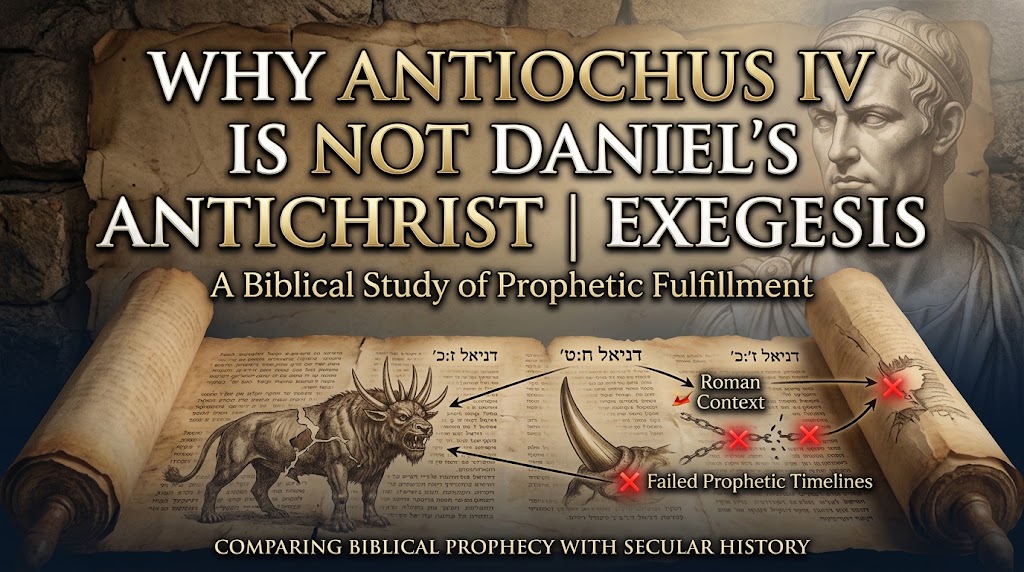
Abstract: This article challenges the liberal-critical interpretation that identifies the “vile person” and the evil horns in Daniel 7, 8, and 11 with Antiochus IV Epiphanes. By comparing the biblical descriptions with secular history, it highlights several significant discrepancies. For example, Antiochus did not rise from a Greek context, rule through deceit, expand his empire, surpass previous Seleucid rulers, directly oppose God, or fit the prophetic periods in Daniel. The article concludes that while Antiochus served as an ominous historical prototype, the ultimate fulfillment of Daniel’s prophecy remains a future, far greater Antichrist.
Antiochus does not fit.
The Antichrist is a Roman Remnant.
Previous articles have argued that the Antichrist emerges from the Roman Empire:
The animals in Daniel 7 and 8 have features such as multiple wings, heads, and horns. By comparing the animals in these chapters, another article (🔗) argues that the two animals in Daniel 8 correspond to the second and third animals in Daniel 7. Daniel explicitly identifies the animals in Daniel 8 as Medo-Persia and Greece (Dan 8:20–21); therefore, the fourth beast in Daniel 7 must represent the Roman Empire. The Antichrist, symbolized by the eleventh horn that emerges from this fourth beast, must consequently be a remnant of the Roman Empire rather than a Greek king such as Antiochus.
Some interpreters claim that Daniel 8 identifies the little horn—the Antichrist—as a Greek power because it emerges from one of the four Greek horns. However, another article (🔗) argues that it comes from one of the “winds of heaven,” meaning one of the points of the compass (Dan 8:9). If the little horn does not arise from one of the Greek horns, it must belong to the next empire: Rome.
Daniel 11 provides the strongest support for identifying the evil power in Daniel with Antiochus. However, as another article (🔗) explains, several indications point to a later antichrist:
Verses 14–20 focus on Antiochus III, the father of Antiochus IV, because his unsuccessful wars against Rome marked a turning point that brought the Roman Empire onto the world stage.
The verbal links between Daniel 11:22 and Daniel 9 identify the “prince of the covenant” in 11:22 as Jesus Christ. The vile person who shatters this prince therefore cannot be Antiochus, who lived about 200 years earlier.
According to Daniel 11:31, the vile person will set up the abomination of desolation. Yet Jesus described the abomination of desolation spoken of by Daniel as still future in His own time (Matt 24:15).
Daniel 2, 7, and 8 clearly identify the political powers involved, whereas Daniel 11 focuses more heavily on the evil religious power. Nevertheless, because the visions in Daniel 2, 7, 8, and 11 form a unified sequence, a consistent interpretation should allow Daniel 2 and 7 to clarify the political powers in Daniel 11.
The following sections identify several ways in which Antiochus does not fit the prophecy in Daniel 11.
Antiochus did not rule by Deceit.
 The “vile person” (“despicable person” in the NASB) will “seize the kingdom by intrigue” (Dan 11:21). Here, “intrigue” implies plotting, conspiracy, or trickery. Antiochus IV, however, did not gain the throne in this way. Ancientmacedonia.com describes his accession as follows:
“Seleucus (Antiochus’s brother) was murdered by Heliodorus, his treasurer (B.C. 176) … On the death of Seleucus, the throne was seized by Heliodorus; but it was not long before Antiochus, the brother of the late king, with the help of the Pergamene monarch, Eumenes, recovered it.”
He did not distribute Plunder.
The predicted evil king “will distribute plunder, booty and possessions among them” (Dan 11:24). This was not true of Antiochus IV. On the contrary, he owed huge sums of war debt to Rome following his father’s defeats against the Romans. Therefore, he needed all the money he could lay his hands on.
He did not start small.
The vile person of Daniel starts small (Dan 7:8; 8:9) and weak (Dan 11:23 – supported by few), but later becomes “exceedingly great” (Dan 8:9). Antiochus IV did not start small. He was a Seleucid prince and the brother of the murdered king. After his brother’s murderer seized the throne, he was made king with the support of a neighboring king.
He was not greater than others.
The Antichrist in Daniel 7, symbolized as the 11th horn, would be larger than the other 10 horns (Dan 7:20). In the liberal interpretation, this means that he is greater than the other kings of the Greek empire.
In Daniel 8, the horn is even larger than Alexander the Great: Alexander is described as “very great” (Dan 8:8), but the evil horn is “exceedingly great” (KJV; RSV, Dan 8:9).
This does not fit Antiochus IV. Antiochus IV was weak compared to Alexander the Great. He was not greater than the Seleucid kings who preceded him:
Seleucus I Nicator was the first king of the Seleucid branch of the Greek Empire after Alexander’s empire split up. He had significant military successes.
A few generations later, Antiochus III was called ‘the Great’ because he expanded the domain of the Seleucid kingdom to close to its original size. His military successes are described in Daniel 11:15, but later the Romans defeated him and left his empire, particularly in the west, subject to Rome’s growing dominance. Because of these defeats, Antiochus IV, as a boy, grew up a hostage in Rome.
Antiochus IV had success against the Ptolemy branch of the Greek kingdom (Egypt), but by the time liberal scholars say Daniel was written (165 BC), the Romans had already ordered him to leave Egypt, and he had to oblige. On the eastern side of his kingdom, the Parthians were taking Iran from his empire, and the need to attend to this threat later allowed the Jewish revolt to succeed; the Maccabees were soon able to drive his soldiers out of Israel and reinstate temple services.
He did not expand his kingdom.
Daniel 8:8 uses the word elahah to describe the growth of the four Greek horns. Elahah means vertical growth. This word is appropriate because the four Greek kingdoms did not expand the Greek territory. They simply subdivided the area already occupied by Alexander the Great. In symbolic language, the horns ‘grew up’ in an area that was already occupied.
In contrast, Daniel 8:9 uses the word yatsah to describe the growth of the little horn (Dan 8:9). Yatsah means horizontal growth and implies that the horn expands the area it occupies. The horizontal expansion of the predicted evil king is more specifically described as “toward the south, and toward the east, and toward the pleasant land (Judea)” (Dan 8:9). Antiochus IV did not expand his kingdom into those three directions:
He did have some success in the south (Egypt), but by 165 BC, when Daniel was written according to liberals, the Romans had already ordered him to leave “the south” (Egypt).
Antiochus IV did not expand his kingdom to Judea. It was already part of his kingdom when he became king.
In the east, he invaded nothing. At best, he strengthened his control over the areas that his father already occupied.
And if the south can be mentioned, then also the West, because he also invaded Cyprus.
He did not oppose God.
The Antichrist will be “set against the holy covenant” (Dan 11:28, 30) and “speak monstrous things against the God of gods” (Dan 11:36). But Antiochus IV was not principally opposed to the God of the Bible. What he did for Judea, he did for all nations within his empire. His objective was merely to maintain control over his empire. In ancient times, rulers determined the religions of their nations. Antiochus ordered all peoples of his empire to abandon their particular religions, not only the Jews:
“Then the king wrote to his whole kingdom that all should be one people, each abandoning his particular customs. All the Gentiles conformed to the command of the king, and many Israelites were in favor of his religion; they sacrificed to idols and profaned the Sabbath” (1M1:41-43).
Antiochus IV did not rob only the Jewish temple. He also robbed other temples (2 Macc 9:2) to pay his debt to the Romans.
He appointed the high priest in Jerusalem because he appointed rulers for all nations in his empire and because Judea was a temple kingdom, effectively making the high priest the king of Judea.
After nearly 200 years of Hellenistic dominance over Israel, the influence of the Hellenistic culture was strong, even without Antiochus IV enforcing it (1 Macc 1:11–14). The Maccabean War began in 167 BC precisely as a Jewish rebellion against the pro-Hellenistic Jews ruling Judea. When the rebels attacked Jerusalem and forced the high priest to hide, Antiochus IV saw this as a revolt against his authority (2M 5:11). It was for that reason that he attacked Jerusalem (II Macc 5:5-16). He did not attack Jerusalem because it worshipped God.
He did not serve a strange god.
The Antichrist will magnify himself above every god, not show any regard for the gods of his fathers, and honor a god of fortresses.
“The king … will exalt and magnify himself above every god and … He will show no regard for the gods of his fathers … nor will he show regard for any other god; for he will magnify himself above them all” (Dan 11:36-37). “But instead he will honor a god of fortresses, a god whom his fathers did not know” (Dan 11:38).
But Antiochus’ purpose was the opposite, namely, that all people should serve the gods of his fathers. It was a statue of Zeus that he set up in the temple in Jerusalem.
He did not kill the Prince.
The Antichrist would kill “the prince of the covenant” (11:22).
Critical scholars identify “the prince of the covenant” as the high priest Onias, but Antiochus had no direct involvement in Onias’ death. As already stated, the high priest was effectively the king of Israel, and in the same way that Antiochus IV appointed kings for other nations, he appointed the high priest in Israel. Antiochus replaced Onias III as high priest with Onias’s brother Jason, and a few years later, he also replaced Jason with Menelaus. Menelaus resented Onias’ criticism and had him killed in 171 BC. It would therefore not be valid to claim that Antiochus broke or shattered Onias. It was the Jewish high priest who arranged his death.
Based on verbal links, another article argues that “the prince of the covenant” (Dan 11:22) is the same “prince” who “confirms the covenant with many for one week” (Dan 9:27): Jesus Christ (🔗). Antiochus could not have killed Jesus, because he died about 200 years earlier.
He does not fit the prophetic periods.
Daniel mentions several periods, namely:
- The “time and times and the dividing of time,” during which the Antichrist would persecute the saints (Dan 7:25),
- 2300 “evening morning,” after which the sanctuary will be cleansed (Daniel 8:14),
- “Seventy weeks” allotted to Israel (Dan 9:24),
- 1290 days (Dan 12:11), and
- 1335 days (Dan 12).
In the liberal interpretation, all these periods describe Antiochus. However:
The KJV translates 2300 “evening morning,” as 2300 “days,” which would be equal to more than 6 years. Therefore, it does not fit the time of Antiochus IV. To get closer to the period of Antiochus’ defilement of the temple, Critics interpret this as 2300 ‘evening morning’ sacrifices, of which there was one each morning and one each evening, giving 1150 full days. But it would be more logical to interpret this as 2300 evenings and 2300 mornings: 2300 full days
The prophecy in Daniel 9 requires 483 years from the “decree to restore and rebuild Jerusalem until Messiah the Prince” (Dan 9:25). In the liberal view, the last week describes the time of Antiochus IV, which means that the preceding 483 years were past when their unidentified second-century author wrote. The 483 years must, therefore, correspond to actual history, but to fit 483 years between the possible decrees and Antiochus IV is not possible. 483 years before Antiochus brings us to about 50 years before Jerusalem was destroyed. There was no decree to rebuild Jerusalem at the time.
Liberals find it difficult to explain the differences between these periods: the 2300 “evening morning,” the 3½ times, and the 1260, 1290, and 1335 days.
Jesus referred to “the abomination of desolation which was spoken of through Daniel” as something in His future (Matt 24:15). He, therefore, placed the 1290 days in His future (Dan 12:11). It cannot relate to Antiochus.
Conclusions
The Liberals’ writer made factual errors.
Liberals may argue that the proposed second-century Jewish author portrayed Antiochus as more evil and powerful than he was because the destruction of what the Jews held sacred compromised the writer’s objectivity. On this view, emotional involvement explains why Daniel depicts Antiochus as ruling by deceit, surpassing all other Greek kings, and directly opposing God. Yet a lack of objectivity cannot account for every discrepancy.
Antiochus was a type of the Antichrist.
As discussed (🔗), Daniel 11:2–19 corresponds closely with known secular history through the death of Antiochus III in verse 19. Antiochus IV also shares several characteristics with the predicted evil king. Nevertheless, Antiochus IV does not exhaust the passage. He was a type of the later and far greater Antichrist, not its ultimate fulfillment.
Liberals destroy the Bible.
In the Liberal interpretation, the Book of Daniel is fiction. But liberals also discredit Jesus Christ and the entire Bible. The Book of Revelation, in particular, is built on the foundation of Daniel’s prophecies, for example:
-
-
- The animals in Revelation 13:2 are the same as the animals in Daniel 7:4–8.
- The “time, times, and half a time” in Revelation 12:14 comes from Daniel 7:25.
- The oath in Revelation 10:6 is a continuation of the oath in Daniel 12:7.
-
If Daniel falls, Revelation must fall as well.
Other Articles
The Antichrist (Daniel 2, 7, 8, and 11)
🔗 Daniel 2: Nebuchadnezzar’s Dream & Revelation’s Beast
🔗 Daniel 7 – The Vision of Four Beasts
🔗 Daniel 7 – What is the Fourth Beast?
🔗 Daniel 8 – Out of what does the Horn come?
🔗 Three Interpretations of the Little Horn
🔗 Identity of the Little Horn
🔗 Daniel 11 – Who is the Vile Person?
🔗 Daniel 11 – Antiochus IV is not Daniel’s Antichrist.
Other Core Articles
🔗 The Mark of the Beast
🔗 All articles on this Site
🔗 Daniel’s Little Horn Identified
🔗 Daniel 9 – Verse-by-Verse
🔗 Daniel 9 – Four Alternative Interpretations
🔗 The Dragon of Revelation 13
🔗 The Beast of Revelation
🔗 The Trinity Doctrine
🔗 The True Origin of the Trinity Doctrine
🔗 The Sabbath was part of the Arian Controversy.
🔗 Christ’s Return
Other Article Series
🔗 The Antichrist in Daniel
🔗 The 490 years of Daniel 9
🔗 Book of Revelation
🔗 Christology – Who is Jesus?
🔗 Why does evil exist?
🔗 Death, Eternal Life, and Eternal Torment
For general theology, I recommend Graham Maxwell.